All species › Passerines › Tanagers and allies › Rufous-winged Tanager
Rufous-winged Tanager | Tangara lavinia
Roodvleugeltangare | Tangara alirrufa | Saíra-de-asa-ruiva
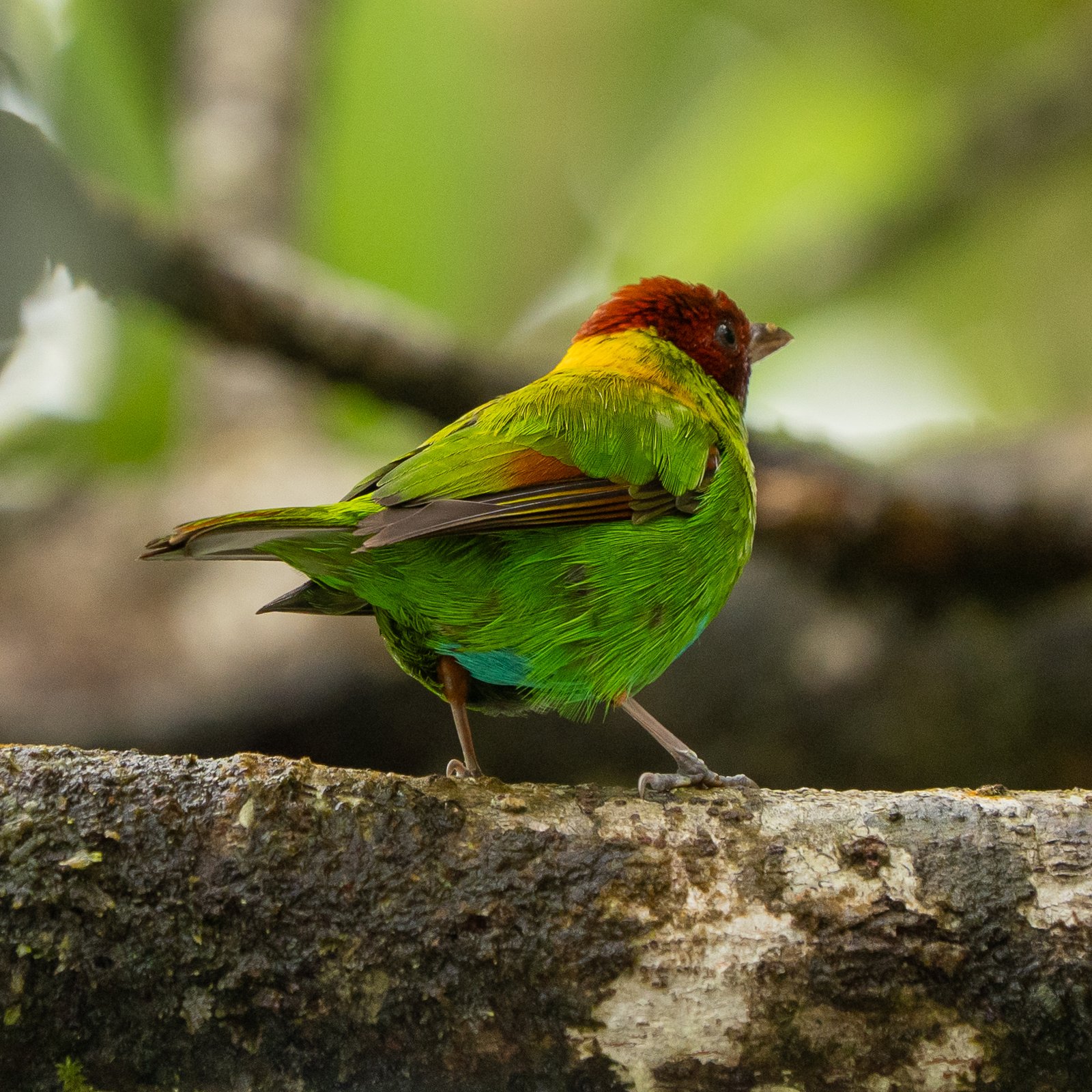
The Rufous-winged Tanager is a tanager of the humid lowlands of Central America and the Pacific side of Colombia and Ecuador. The male is green with a rufous head, rufous wings, a yellow band across the hindneck and blue on the centre of the underparts. It lives in pairs or small groups in the canopy, often with mixed tanager flocks.
Voice
High, thin tsit and tsip calls, sometimes in a quick series. The song is inconspicuous.
Recording: Patricio Mena Valenzuela — CC BY-NC-SA 4.0 · xeno-canto
Identification
13 cm. Male: head rufous to chestnut, with a golden to yellow band on the hindneck and upper mantle. The rest of the upperparts is green. The flight feathers are largely rufous, giving the wing a rufous panel. The underparts are green with a turquoise-blue stripe along the throat and the centre of the breast and belly. Female: mainly green, with at most a rufous wash on the head and wings and little blue below. Juveniles resemble the female.
Confusion species
Bay-headed Tanager Tangara gyrola also has a rufous head, but green wings and no yellow band on the hindneck. Golden-hooded Tanager Stilpnia larvata has a golden hood with a black mask. Emerald Tanager Tangara florida is green with a black ear patch and a yellow crown.
Habitat
Canopy and edges of very wet lowland and foothill forest, also tall secondary forest and forest edges with fruiting trees, mostly below 1100 m. It searches branches and leaves for insects and eats small fruits, in pairs or small groups, often with other tanagers.
Where the bird is most at home, classified by the vegetation units of the Andes and the west coast.


Range and movements
In Colombia in the Pacific lowlands and the foothills of the Western Cordillera, from the Urabá region to Nariño; in Ecuador in the north-west, mainly in Esmeraldas, scarce. Absent from Peru, Bolivia and the Galápagos. Outside the guide area from Guatemala to Panama.
- Resident
- dark = core range, pale = thinly spread
How and when to look
With mixed tanager flocks in the canopy at forest edges in the Chocó lowlands of Colombia and north-western Ecuador, for example along roads towards the coast in Esmeraldas.
Conservation status
Least Concern. Fairly scarce in large parts of its range and sensitive to the large-scale deforestation of the Chocó lowlands.
Scientific name
Tangara lavinia | (Cassin, 1858)
Cassin described the species in 1858 as Calliste Lavinia; because it was later moved to another genus, the author and year stand in brackets. The genus Tangara was introduced in 1760 by Brisson. The genus name comes from the extinct Tupi language, in which tangara means 'dancer'. The species name honours Lavinia Lydia Bowen, née Davis (1820–1888), American businesswoman, co-owner of the lithographers Bowen & Co. in Philadelphia, and herself a zoological artist and lithographer. The specimen the first description was based on came from Darién, Panama.