All species › Passerines › Antpittas › Bicolored Antpitta
Bicolored Antpitta | Grallaria rufocinerea
Tweekleurige mierpitta | Tororoí bicolor | Tovacuçu-bicolor
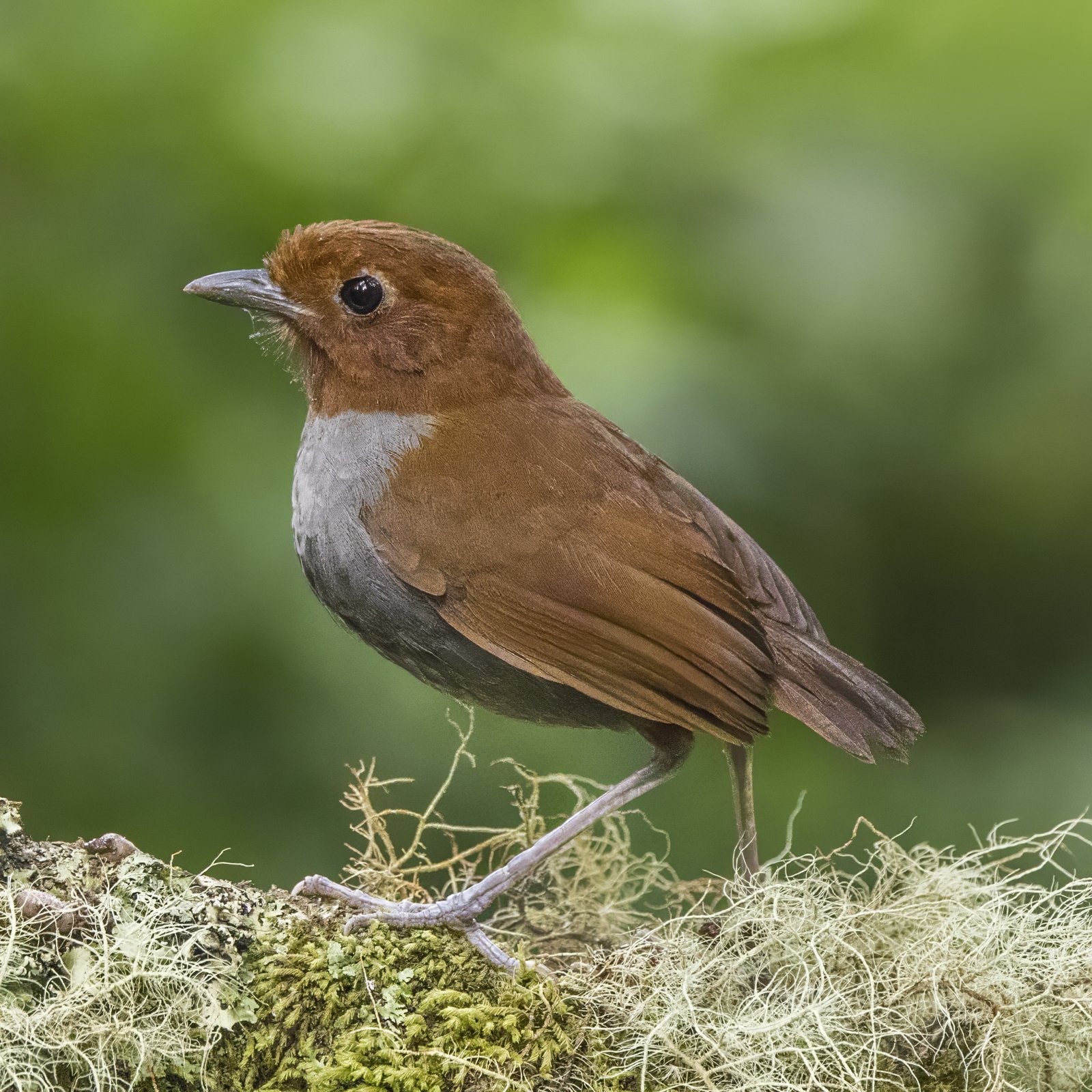
The Bicolored Antpitta is a medium-sized antpitta of the Central Andes of Colombia and the extreme north of Ecuador, with a rufous head and upperparts and grey underparts. It lives in high cloud forest up to the treeline. In Ecuador it was first recorded only in 1999.
Voice
The male sings a high, clear whistle repeated at intervals; the female answers with a rapid series of shorter notes.
Recording: Fabrice Schmitt — CC BY-NC-SA 4.0 · xeno-canto
Identification
15–16 cm, round and short-tailed, on grey to brownish legs, with a black bill. The head, throat, upperparts, wings and tail are rufous; the throat is slightly warmer, with grey mottling. The breast and belly are grey to sooty grey, with pale feather edges on the breast and flanks and a whitish belly centre. The sexes are alike.
Confusion species
The uniformly rufous antpittas of the Grallaria rufula group, such as Chami Antpitta Grallaria alvarezi and Equatorial Antpitta Grallaria saturata, lack the grey underparts. White-bellied Antpitta Grallaria hypoleuca is rufous above but white below and lives lower. Chestnut-naped Antpitta Grallaria nuchalis is larger, with dark slate-grey underparts and a chestnut nape.
Habitat
The floor and understorey of humid cloud forest up to the treeline, also forest edges and secondary forest, in Colombia roughly between 2000 and 3100 m, in Ecuador at about 2250 m. Little is known about its diet; presumably invertebrates from the forest floor. Almost nothing is known about its breeding; a male in breeding condition was caught in June.
Where the bird is most at home, classified by the vegetation units of the Andes and the west coast.


Range and movements
In Colombia in the Central Andes, in two separate parts: from southern Antioquia through Caldas and Risaralda to northern Tolima, and from western Huila south towards Ecuador. In Ecuador only in the extreme north of Sucumbíos. Absent from Peru, Bolivia and the Galápagos. Does not occur outside the guide area.
- Resident
- dark = core range, pale = thinly spread
How and when to look
At the Río Blanco reserve near Manizales antpittas, including this species, come in the morning to spots where earthworms are fed. Elsewhere, listen at dawn in high cloud forest for the high whistle.
Conservation status
Least Concern. The population is estimated at 20,000 to 50,000 mature individuals and is probably declining through deforestation for agriculture and settlement.
Scientific name
Grallaria rufocinerea | Sclater & Salvin, 1879
Sclater & Salvin described the species in 1879 and placed it straight away in the genus where it still stands. The genus Grallaria was introduced in 1816 by Vieillot. The genus name comes from New Latin grallarius, 'stilt-walker', referring to the long legs. The species name comes from Latin rufus, 'red', and cinereus, 'ash-grey'. The specimen the first description was based on came from Santa Elena, Antioquia, Colombia.