All species › Passerines › Tanagers and allies › Black-and-gold Tanager
Black-and-gold Tanager | Bangsia melanochlamys
Zwart-gouden tangare | Tangara negrigualda | Sanhaço-preto-e-dourado
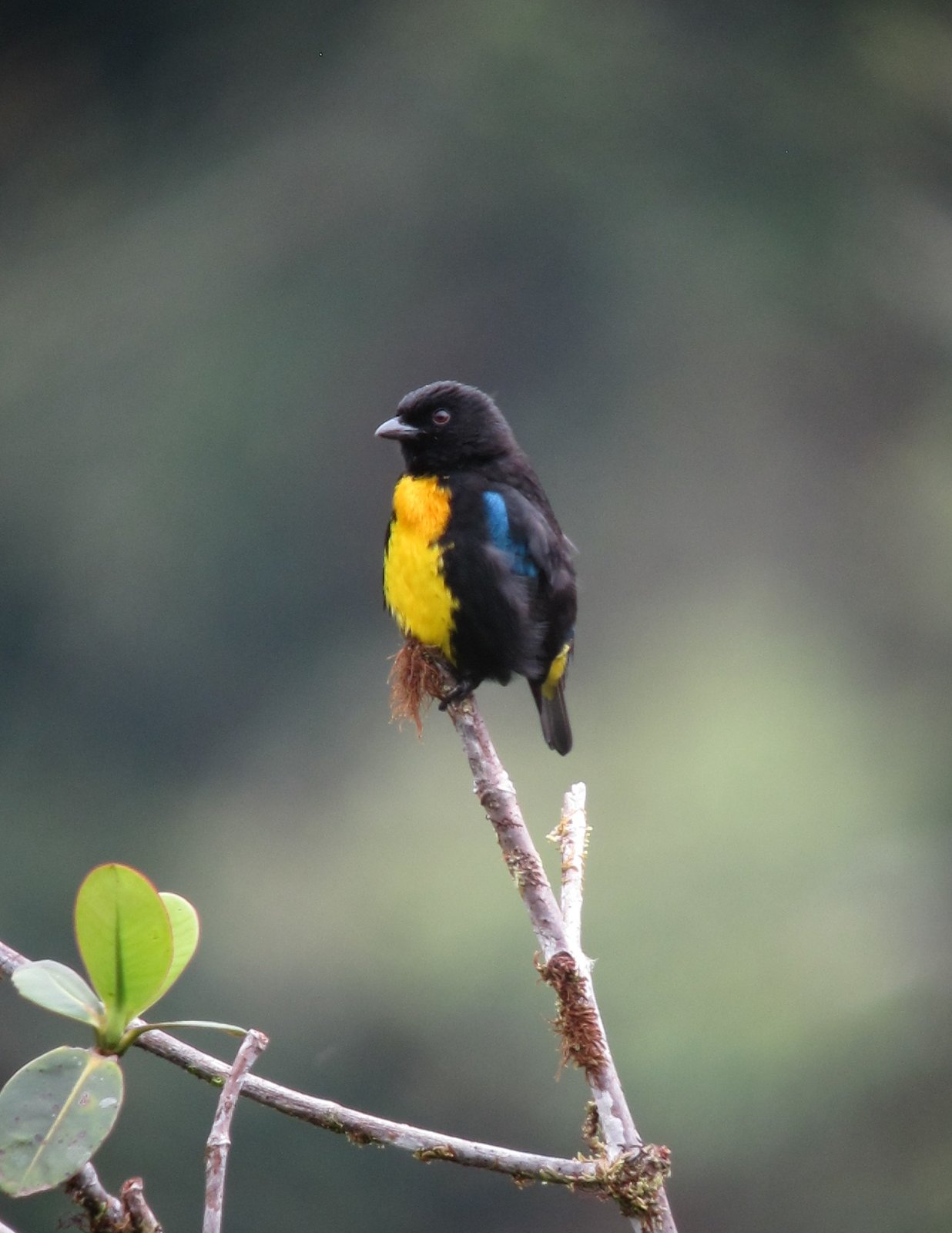
The Black-and-gold Tanager is a stocky, mostly black tanager with a golden-yellow centre to the underparts, found only in Colombia. It lives in humid montane forest on the Pacific side of the Western Andes and in the north of the Central Andes. Pairs and small groups often perch high on mossy branches and join mixed flocks.
Voice
High, thin calls and a rapid series of high, rhythmic tsee notes, often from a high perch.
Recording: Iván Lau — CC BY-NC-SA 4.0 · xeno-canto
Identification
16 cm, with a short, stout black bill and a short tail. Head, throat, upperparts, wings and tail are black, with a blue patch on the lesser wing coverts. The centre of the breast and belly is golden yellow, tinged orange-yellow at the edges; the flanks are black to olive-black. The iris is dark. The sexes are alike. Juveniles are duller and browner.
Confusion species
Gold-ringed Tanager Bangsia aureocincta lives in the same part of the Western Andes, but has a green back and a golden-yellow ring around the black cheeks. Moss-backed Tanager Bangsia edwardsi has a moss-green back and a blue head. Black-chinned Mountain Tanager Anisognathus notabilis is larger, with an olive-green back, a yellow crown stripe and entirely yellow underparts.
Habitat
Humid, very mossy montane forest and cloud forest, also forest edges, roughly between 1000 and 2300 m. It eats mainly fruit and berries and also searches mossy branches for insects, in the middle storey and the canopy. Little is known about the nest.
Where the bird is most at home, classified by the vegetation units of the Andes and the west coast.


Range and movements
In Colombia in the Western Andes in Antioquia, Chocó and Risaralda, and in the north of the Central Andes in Antioquia. Absent from Ecuador, Peru, Bolivia and the Galápagos. Does not occur outside the guide area.
- Resident
- dark = core range, pale = thinly spread
How and when to look
Search mossy cloud forest on the western slope of the Western Andes, for example in the reserves around El Carmen de Atrato; the birds often perch in the open on high branches and sing there.
Conservation status
Least Concern. The range is small and the species depends on intact montane forest, which is cleared locally; its numbers are local and sensitive to further deforestation.
Scientific name
Bangsia melanochlamys | (Hellmayr, 1910)
Hellmayr described the species in 1910 as Buthraupis melanochlamys; because it was later moved to another genus, the author and year stand in brackets. The genus Bangsia was introduced in 1919 by Penard. The genus name honours Outram Bangs (1863–1932), an American zoologist and from 1900 curator of mammals at Harvard's Museum of Comparative Zoology. The species name comes from Greek melas, 'black', and khlamus, 'cloak'. The specimen the first description was based on came from La Selva, Río Jamaraya, Colombia.