All species › Passerines › Tanagers and allies › Pampa Finch
Pampa Finch | Embernagra platensis
Pampagors | Verdón | Sabiá-do-banhado
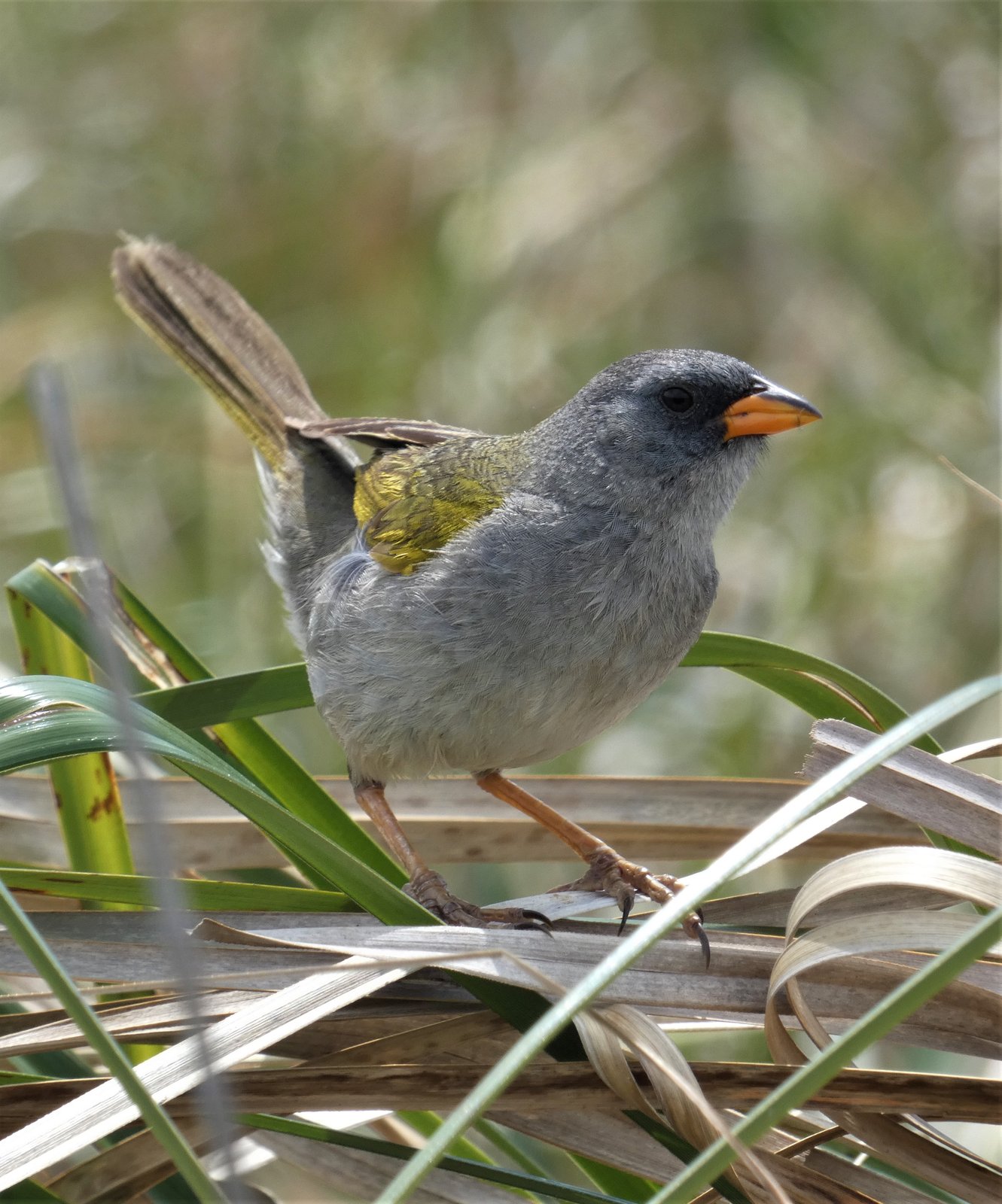
The Pampa Finch is a robust, olive-green finch of tall grassland and marsh edges in south-eastern South America. In the guide area it occurs only in Bolivia, both in the eastern lowlands and in grassland in the Andean valleys. It often perches in the open on a tall stem or shrub to sing.
Voice
The song is a short, clear phrase of a few soft and loud notes, such as chip-chiwee-choo, often from a high perch. The call is a dry chik.
Recording: Marcos E. Sosa — CC BY-NC-SA 4.0 · xeno-canto
Identification
21 cm, with a thick, orange-yellow bill with a dark culmen and a long, rounded tail. Head and breast are grey, the upperparts olive-green and the bend and edge of the wing yellow; the belly is pale grey to ochre. Birds of the Andes (subspecies olivascens) have a distinctly dark-streaked back. The sexes are alike. Young birds are browner and streaked on the head and breast.
Confusion species
Wedge-tailed Grass Finch Emberizoides herbicola is slimmer, with brown, heavily streaked upperparts, a long, pointed tail and a white eye-ring. Long-tailed Reed Finch Donacospiza albifrons is smaller, with ochre underparts and a grey supercilium. Saltators such as Golden-billed Saltator Saltator aurantiirostris have a white or ochre supercilium and a black breast band and live more in scrub.
Habitat
Tall grassland, marsh edges, wet meadows and grassy slopes with scattered shrubs, in Bolivia from the lowlands up to about 3500 m. It forages on the ground and in the grass for seeds and insects. The nest is a deep cup of grass, low in a grass tussock or shrub.
Where the bird is most at home, classified by the vegetation units of the Andes and the west coast.


Range and movements
In Bolivia in the eastern lowlands (mainly Santa Cruz) and in grassland in the valleys and on the east slope of the Andes, from Cochabamba south to Chuquisaca and Tarija. Absent from Colombia, Ecuador, Peru and the Galápagos. Outside the guide area in north-western and eastern Argentina, Paraguay, Uruguay and southern Brazil.
- Resident
- dark = core range, pale = thinly spread
How and when to look
Search grassland and marsh edges in the Bolivian Andean valleys for a large, olive-green bird singing from a stem or shrub.
Conservation status
Least Concern. Widespread and locally common; it tolerates grazed grassland but disappears where grassland is converted to cropland.
Scientific name
Embernagra platensis | (Gmelin, 1789)
Gmelin described the species in 1789 as Emberiza platensis; because it was later moved to another genus, the author and year stand in brackets. The genus Embernagra was introduced in 1831 by Lesson. The genus name is a blend of the genus names Emberiza (buntings) and Tanagra (tanagers). The species name refers to the Río de la Plata region. The specimen the first description was based on came from Buenos Aires, Argentina.