All species › Passerines › Tanagers and allies › Rufous-sided Warbling Finch
Rufous-sided Warbling Finch | Poospizopsis hypocondria
Roodflankboomgors | Monterita pechigrís | Quem-te-vestiu-de-flanco-ruivo
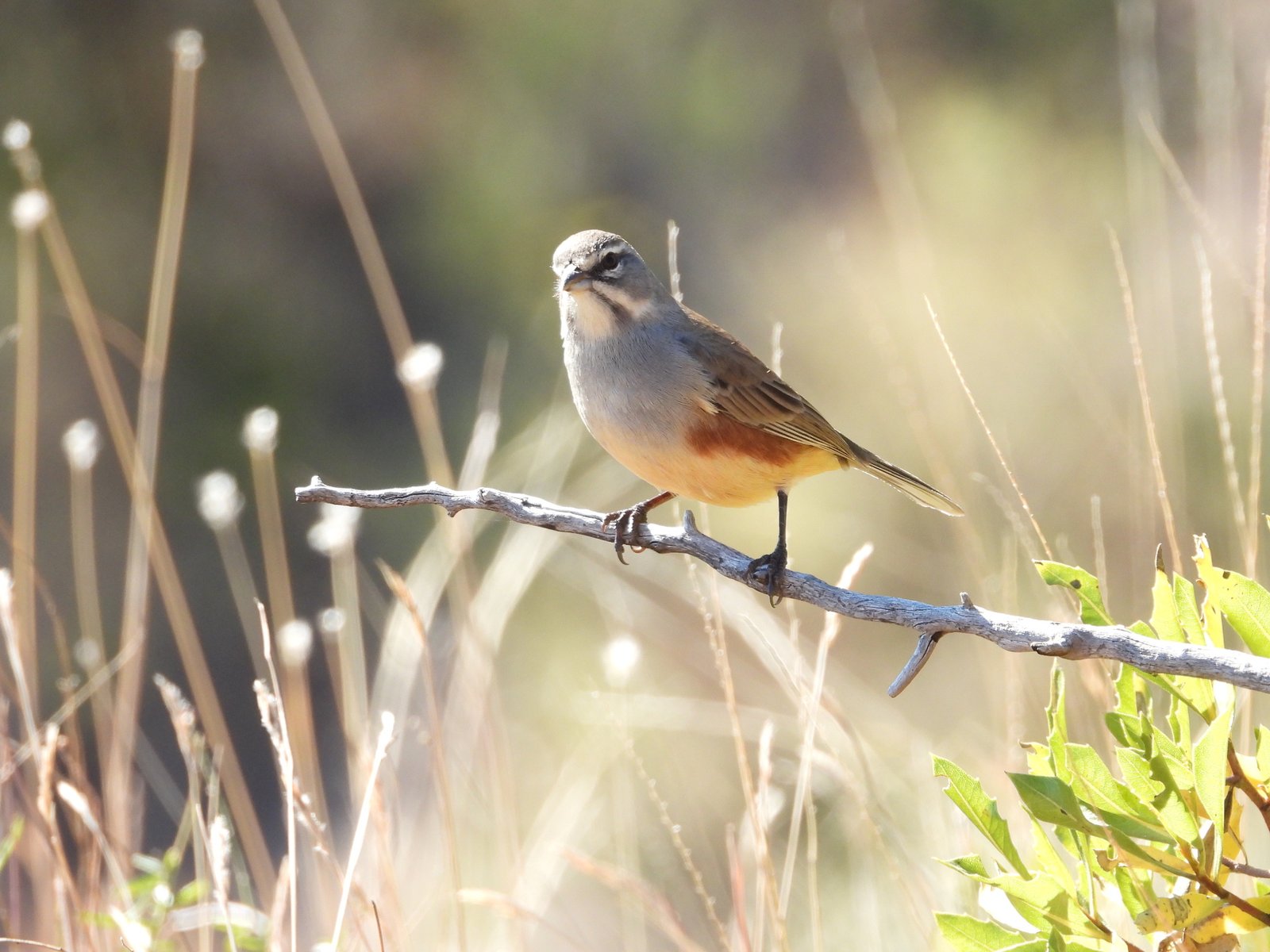
The Rufous-sided Warbling Finch is a warbling finch of dry scrub in the Andes of Bolivia and north-western Argentina. The long white supercilium and rufous flanks beside a grey breast and white belly are distinctive. It often forages on the ground between shrubs.
Voice
The song is a short, rapid, twittering phrase with a few clear whistled notes. The call is a thin tseep.
Recording: Andrew Spencer — CC BY-NC-SA 3.0 · xeno-canto
Identification
16 cm, with a pointed, dark bill and a fairly long tail. The upperparts are greyish brown, the head greyer, with a long white supercilium, a dark eye-stripe and a white throat bordered by a dark malar stripe. The breast is grey, the flanks rufous, the belly white. The tail is dark with white edges to the outer feathers. The sexes are alike. Young birds are browner, with fine streaks on the breast.
Confusion species
Ringed Warbling Finch Microspingus torquatus is smaller, with a black mask, a black breast band and white wing bars. Rusty-browed Warbling Finch Microspingus erythrophrys has a rufous brow and rusty-yellow underparts. Cochabamba Mountain Finch Poospiza garleppi is larger and entirely rufous-orange below.
Habitat
Dry and semi-arid scrub on slopes, edges of Polylepis woodland, hedges and field edges, and shrubby parts of the puna, roughly between 2000 and 4200 m. It forages mainly on the ground and in low shrubs for seeds and insects, often in pairs or small groups.
Where the bird is most at home, classified by the vegetation units of the Andes and the west coast.


Range and movements
In Bolivia in the Andes from La Paz south through Cochabamba, Chuquisaca and Potosí to Tarija. Absent from Colombia, Ecuador, Peru and the Galápagos. Outside the guide area in north-western Argentina.
- Resident
- dark = core range, pale = thinly spread
How and when to look
In the dry valleys of the Bolivian Andes, look for a greyish-brown finch that shows white tail edges as it flushes and then perches on a shrub; note the rufous flanks.
Conservation status
Least Concern. Fairly common in dry scrub; it tolerates small-scale farming.
Scientific name
Poospizopsis hypocondria | (d'Orbigny, ACVMD & de Lafresnaye, 1837)
D'Orbigny, ACVMD & de Lafresnaye described the species in 1837 as Emberiza hypocondria; because it was later moved to another genus, the author and year stand in brackets. The genus Poospizopsis was introduced in 1893 by Berlepsch. The genus name combines the genus Poospiza with Ancient Greek opsis, 'appearance'. The species name comes from Latin hypochondria, 'abdomen', from Greek hupokhondrion, 'abdomen'. The specimen the first description was based on came from Sica Sica, La Paz, Bolivia.