All species › Passerines › Tanagers and allies › Black-backed Bush Tanager
Black-backed Bush Tanager | Urothraupis stolzmanni
Zwartrugvinktangare | Quinuero dorsinegro | Sanhaço-arbustivo-de-dorso-preto
The Black-backed Bush Tanager is a dark, long-tailed tanager of the treeline in the northern Andes. It lives in noisy small groups in elfin forest and shrubbery at the transition to páramo. The genus Urothraupis contains only this species.
Voice
Groups keep in contact with constant, high, dry chattering and short chip calls; a distinct song is poorly described.
Recording: Olaf Jahn — CC BY-NC-SA 4.0 · xeno-canto
Identification
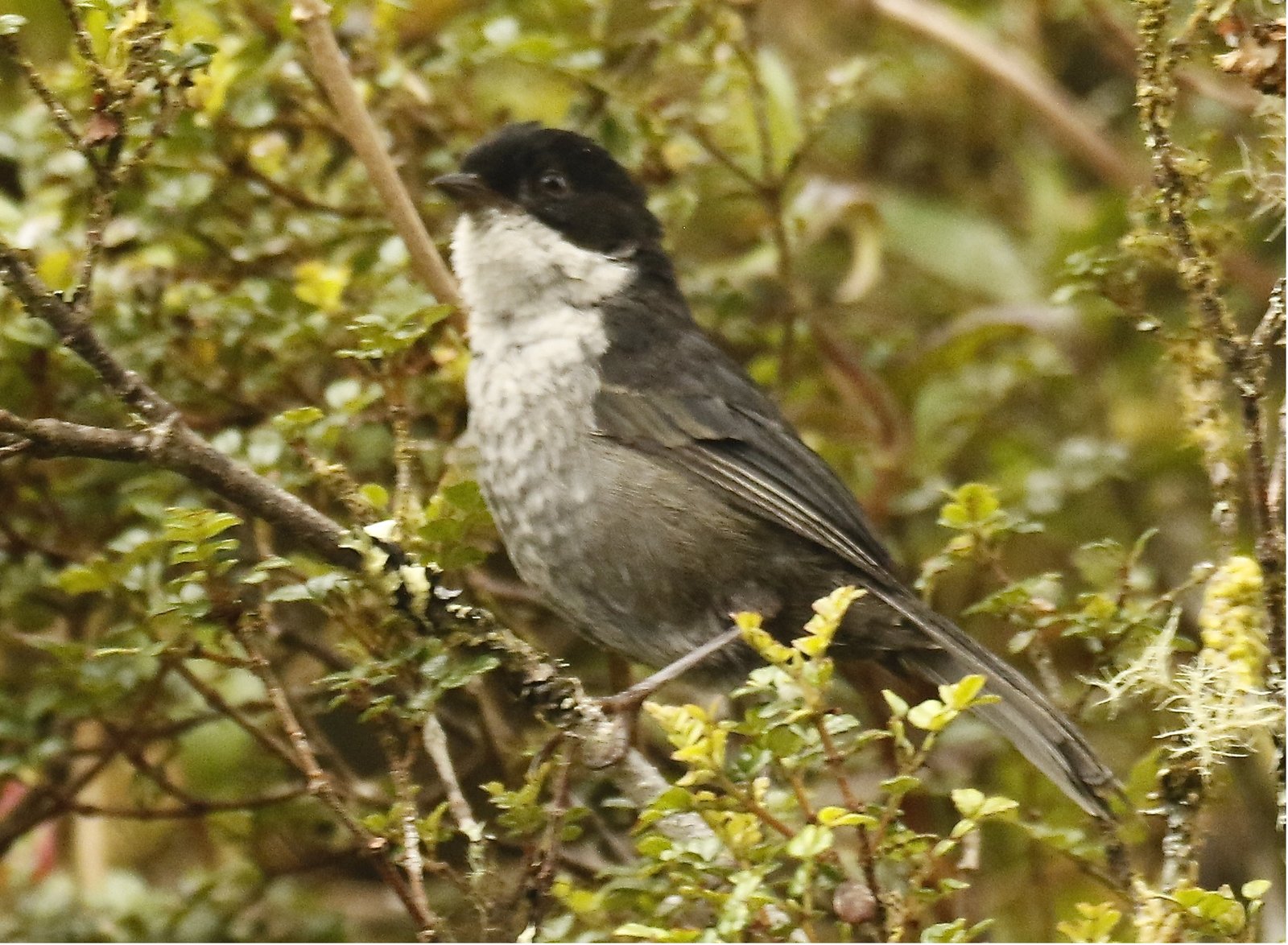
16 cm, with a short, pointed, black bill and a fairly long tail. The head, back, wings and tail are black. The throat is white and contrasts sharply; the breast and belly are grey with irregular whitish mottling, the flanks darker. The sexes are similar. Young birds are browner and less sharply marked.
Confusion species
Slaty Brushfinch Atlapetes schistaceus has a chestnut crown and a white malar stripe, and plain grey underparts. Black Flowerpiercer Diglossa humeralis lacks the white throat and has an upturned, hook-tipped bill. Grey-hooded Bush Tanager Cnemoscopus rubrirostris has a grey head, a pink bill and yellow underparts. Black-headed Hemispingus Pseudospingus verticalis has a pale crown stripe and grey upperparts.
Habitat
Elfin forest and dense shrubbery along the treeline, Polylepis groves and the shrubby edge of páramo, roughly between 3000 and 3900 m. Groups of a few to more than ten birds move through the shrubbery, searching for insects and seeds among leaves and moss, often with other species. The nest is poorly described.
Where the bird is most at home, classified by the vegetation units of the Andes and the west coast.


Range and movements
In Colombia in the Central Andes, from the Nevado del Ruiz area south to Cauca and Nariño. In Ecuador locally along the treeline in the Andes, mainly on the eastern range. Absent from Peru, Bolivia and the Galápagos. Does not occur outside the guide area.
- Resident
- dark = core range, pale = thinly spread
How and when to look
Search the upper forest edge and treeline shrubbery, for example in the Nevado del Ruiz area in Colombia or on the east slope in Ecuador; listen for the chattering of a group moving through the elfin forest.
Conservation status
Least Concern. Its habitat is largely high and remote, but fires and grazing along the treeline degrade it locally.
Scientific name
Urothraupis stolzmanni | Taczanowski & Berlepsch, 1885
Taczanowski & Berlepsch described the species in 1885 and placed it straight away in the genus where it still stands. He introduced the genus Urothraupis in that same work. The genus name combines Greek oura, 'tail', with the genus name Thraupis. The species name honours Jan Sztolcman (Jean Stolzmann, 1854–1928), a Polish zoologist who collected the type specimens in Ecuador. The specimen the first description was based on came from Hacienda San Rafael, Tungurahua, Ecuador.