All species › Passerines › Tanagers and allies › Blue-capped Tanager
Blue-capped Tanager | Sporathraupis cyanocephala
Blauwkaptangare | Tangara coroniazul | Sanhaço-de-coroa-azul
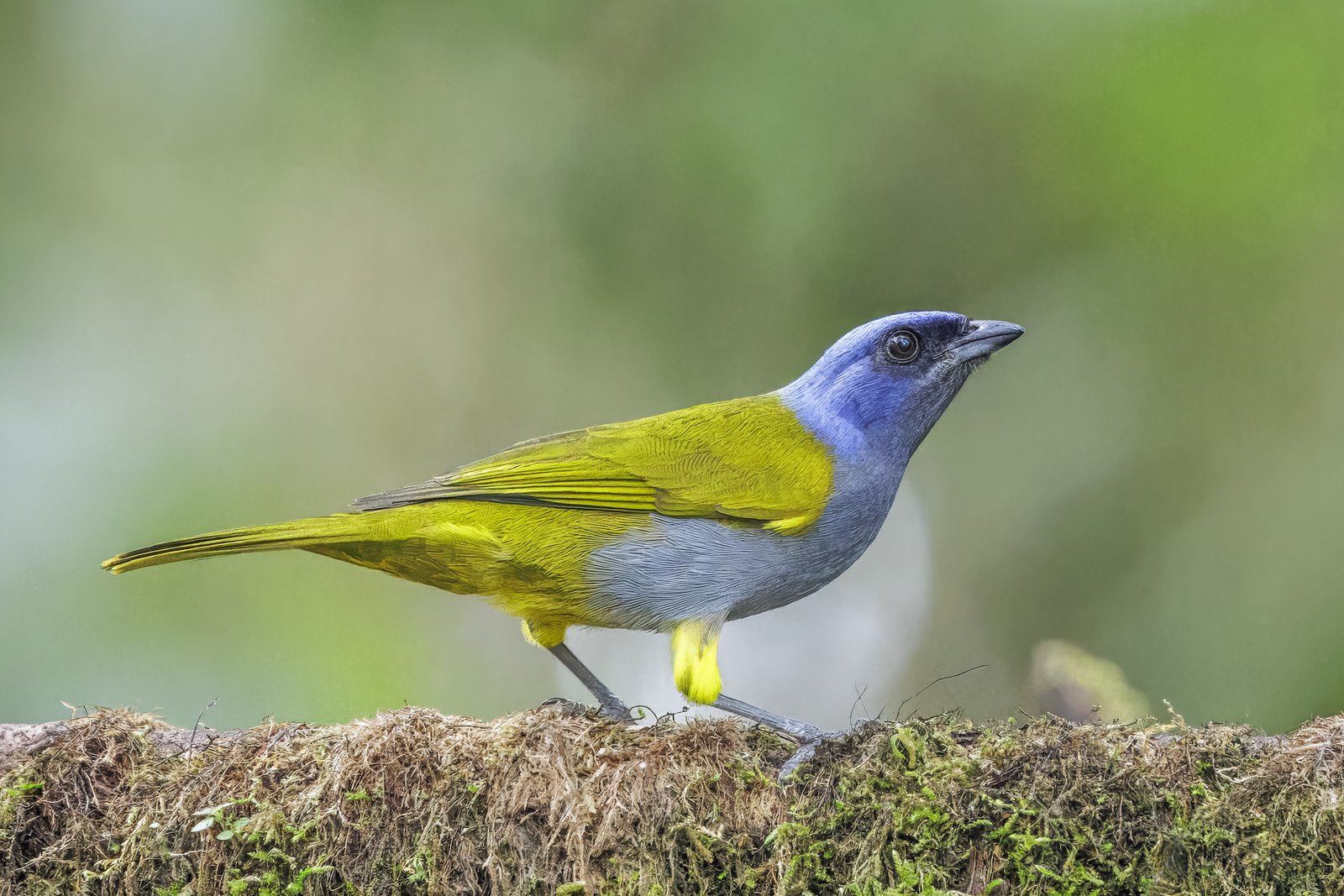
The Blue-capped Tanager is a medium-sized tanager of montane forest edges in the Andes, with a bright blue cap, a black face, an olive-green back and grey underparts. It lives in noisy pairs and small groups and regularly visits fruiting trees at forest edges and in gardens.
Voice
Gives sharp, high tseet and chip notes; the song is a rapid, dry series of squeaky and crackling notes.
Recording: Jacob Wijpkema — CC BY-NC-SA 4.0 · xeno-canto
Identification
18 cm. Crown and nape are bright cobalt blue, the face from lores to ear coverts black. Back, wings and tail are olive-green, the underparts blue-grey. The thighs and underwing coverts are yellow, which shows mainly when the bird flies. The sexes are alike. Juveniles are duller, with a greyer cap.
Confusion species
Fawn-breasted Tanager Pipraeidea melanonota also has a blue crown and a black mask, but is smaller, with a blue-black back and ochre-buff underparts. Palm Tanager Thraupis palmarum is olive-grey without a blue cap and usually lives lower. Blue-necked Tanager Stilpnia cyanicollis has a blue head, but a black body, and is smaller.
Habitat
Edges of humid montane forest and cloud forest, clearings, secondary woodland, scrub and gardens, mostly from about 1500 to 3000 m. It eats mainly fruit and berries and also takes insects, often in mixed flocks in the middle storey and along the forest edge. The nest is a cup in a tree or shrub.
Where the bird is most at home, classified by the vegetation units of the Andes and the west coast.


Range and movements
In Colombia in all three Andean ranges, the Sierra de Perijá and the Sierra Nevada de Santa Marta. In Ecuador on both slopes of the Andes. In Peru on the eastern slope from north to south. In Bolivia on the eastern slope in La Paz, Cochabamba and western Santa Cruz. Does not occur on the Galápagos. Outside the guide area in the mountains of Venezuela.
- Resident
- dark = core range, pale = thinly spread
How and when to look
Search forest edges and roads through cloud forest, often at fruiting trees; the birds are usually in pairs or small groups and reveal themselves with sharp calls.
Conservation status
Least Concern. Common and widespread; tolerates forest edges and secondary growth.
Scientific name
Sporathraupis cyanocephala | (d'Orbigny, ACVMD & de Lafresnaye, 1837)
D'Orbigny, ACVMD & de Lafresnaye described the species in 1837 as A[glaia] cyanocephala; because it was later moved to another genus, the author and year stand in brackets. The genus Sporathraupis was introduced in 1898 by Ridgway. The genus name combines Greek spora, 'seed', and thraupis, the name of an unknown small bird. The species name comes from Greek kuanos, 'donkerblauw', en kephalē, 'kop', for the blue cap. The specimen the first description was based on came from Yungas, Bolivia.