All species › Passerines › Tanagers and allies › Black-goggled Tanager
Black-goggled Tanager | Trichothraupis melanops
Zwartbriltangare | Tangara de anteojos | Tiê-de-topete
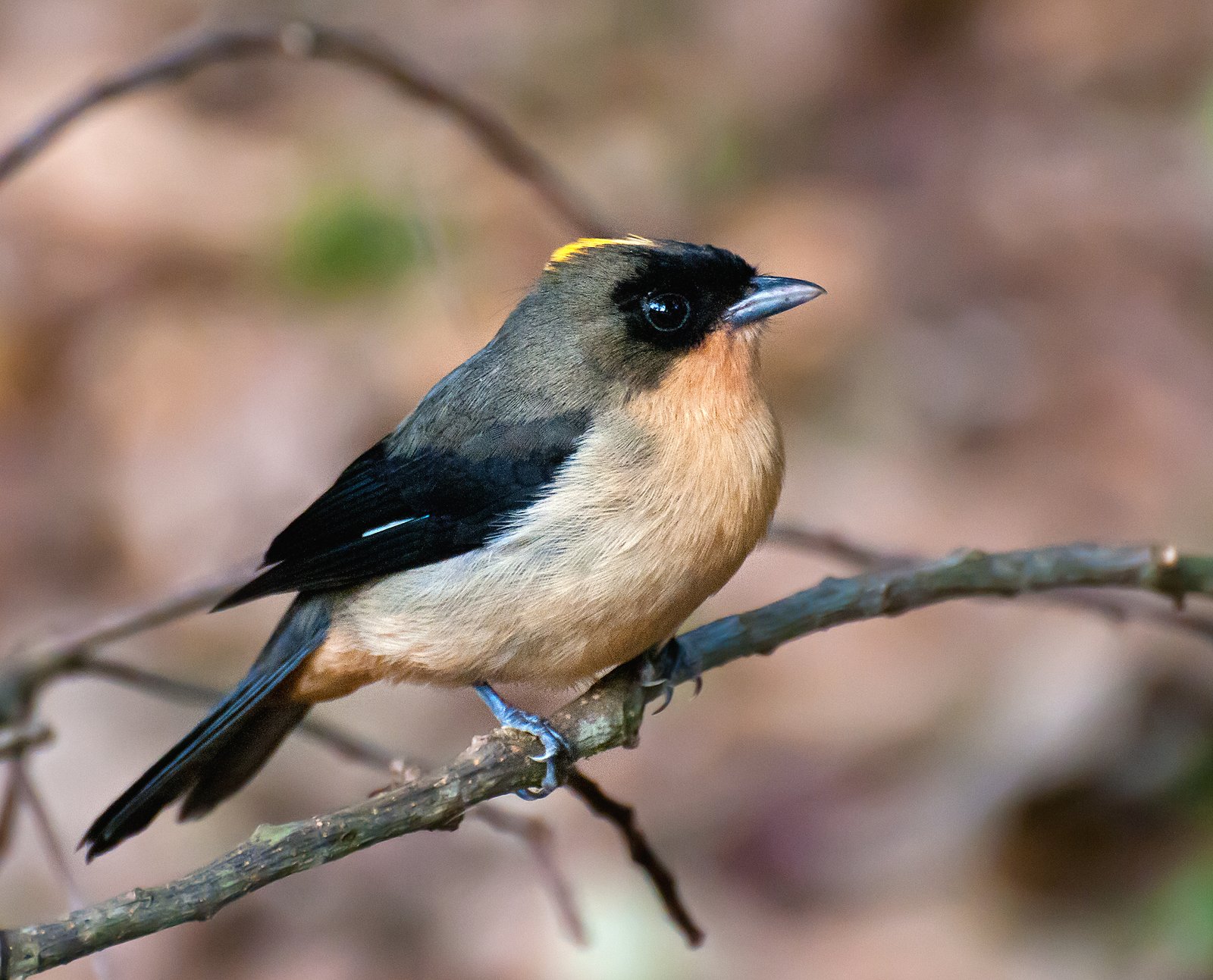
The Black-goggled Tanager is an olive-brown tanager of the lower levels of montane forest; the male wears a black mask that runs around the eyes like goggles. It occurs in the Yungas of Peru and Bolivia and, far away, in the Atlantic Forest of eastern South America. Pairs follow mixed flocks and sometimes army-ant swarms.
Voice
The song is a fast, rather shrill series of notes; the call is a sharp chip.
Recording: JAYRSON ARAUJO DE OLIVEIRA — CC BY-NC-SA 4.0 · xeno-canto
Identification
16 cm, with a fairly short, dark bill. The male is olive-brown above and ochre-brown below, with a black mask from the forehead around the eyes, a yellow crown stripe that is usually concealed, and blackish wings and tail. In flight a white patch at the base of the primaries shows. The female lacks the black mask and the yellow crown stripe. Juveniles resemble the female.
Confusion species
With its black mask the male is hardly confusable with other species in the guide area. The female resembles the female White-lined Tanager Tachyphonus rufus, which is uniform rufous-brown and lives in lower, more open country. Female Red-crowned Ant Tanager Habia rubica is browner, with an ochre-yellow crown stripe, and lives in lowland forest.
Habitat
The lower and middle levels of humid montane forest, forest edges and tall secondary forest, mainly in the lower Yungas, roughly between 800 and 2000 m. It forages for insects in the lower strata, also at ant swarms, and eats fruit. The nest is a cup in a shrub or tree.
Where the bird is most at home, classified by the vegetation units of the Andes and the west coast.


Range and movements
In Peru on the eastern slope of the Andes, from the north (Amazonas, San Martín) to the south-east. In Bolivia on the eastern slope of the Andes in La Paz, Cochabamba and Santa Cruz. Absent from Colombia, Ecuador and the Galápagos. Outside the guide area in south-eastern Brazil, eastern Paraguay and north-eastern Argentina.
- Resident
- dark = core range, pale = thinly spread
How and when to look
Search mixed flocks in the understorey of the lower Yungas, for example along the Manu road in Peru and near Coroico in Bolivia. Look for the male's black goggles and the white wing patch in flight.
Conservation status
Least Concern. The species tolerates forest edges and secondary forest.
Scientific name
Trichothraupis melanops | (Vieillot, 1818)
Vieillot described the species in 1818 as Muscicapa melanops; because it was later moved to another genus, the author and year stand in brackets. The genus Trichothraupis was introduced in 1851 by Cabanis. The genus name combines Greek thrix, 'hair', with the genus name Thraupis. The species name combines Greek melas, 'black', with ōps, 'face', for the black mask. The specimen the first description was based on came from Paraguay.