All species › Passerines › Tanagers and allies › Bananaquit
Bananaquit | Coereba flaveola
Suikerdiefje | Reinita común | Cambacica
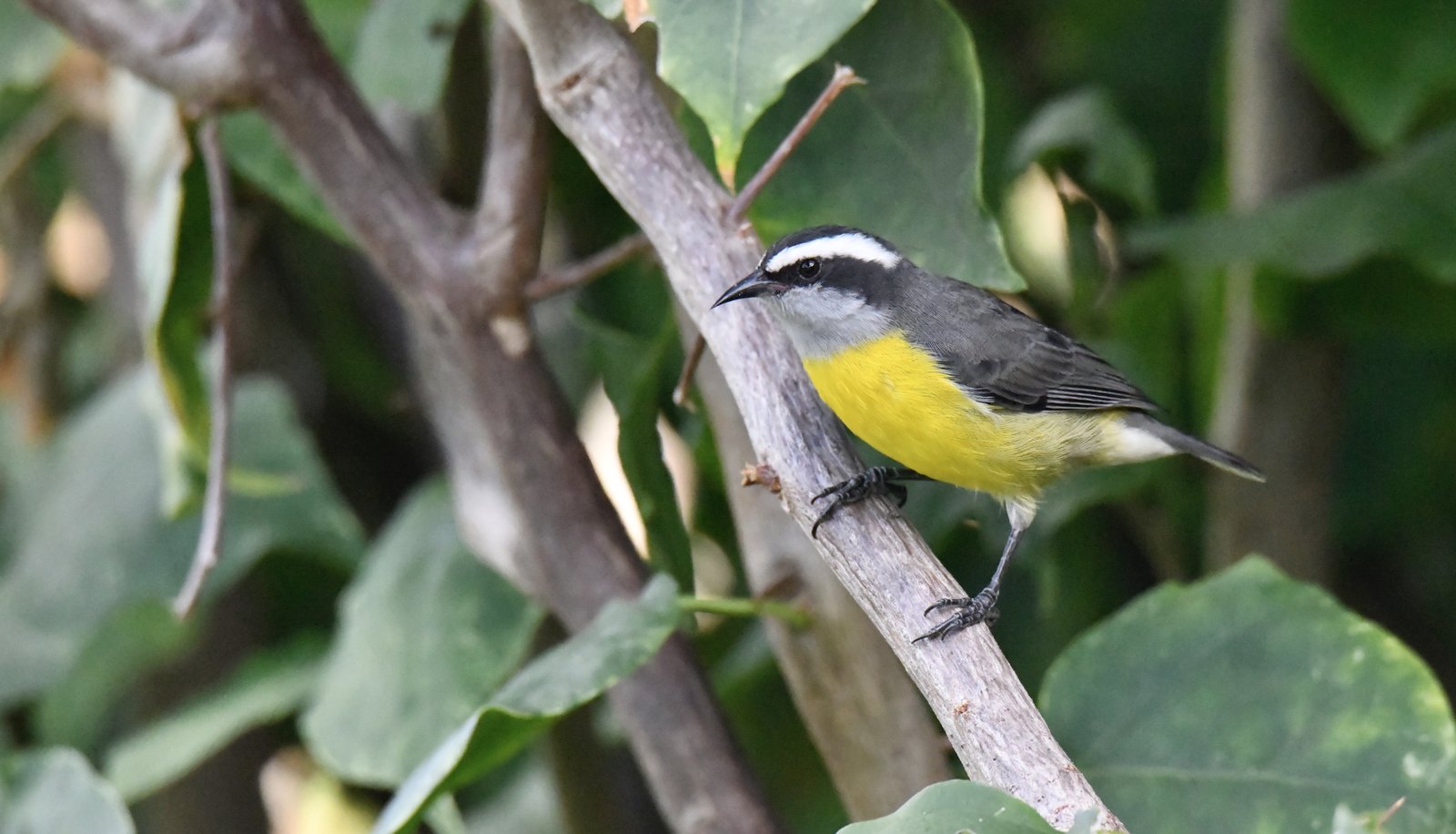
The Bananaquit is a small, active bird with a short, decurved, pointed bill, a white supercilium and a yellow belly. It pierces flowers at the side to take nectar without pollinating them. In the guide area it is one of the most widespread songbirds of forest edges, gardens and plantations in the lowlands and on the lower mountain slopes.
Voice
The song is a high, hissing and buzzy twittering of rapid, squeaky notes, often repeated at length, such as tsee-tsee-tseezee-tseezee. The call is a thin tsip.
Recording: José María Loaiza B. — CC BY-NC-SA 4.0 · xeno-canto
Identification
10–11 cm, compact and short-tailed, with a short, slightly decurved, pointed black bill and often a pink spot at the gape. The crown and upperparts are dark slate-grey to blackish, with a long white supercilium and a dark eyestripe. The throat is grey, the breast and belly are yellow, and the rump is yellow. On the wing a small white patch at the base of the primaries; the tail has white tips. The sexes are alike. Juveniles are duller and more olive, with a yellowish supercilium.
Confusion species
Tropical Parula Setophaga pitiayumi has a straight bill, blue-grey upperparts with white wing bars, a yellow throat and no white supercilium. Chestnut-vented Conebill Conirostrum speciosum has a straight, pointed bill, is blue-grey to grey without yellow and has chestnut undertail coverts. Young Bananaquits may recall young warblers, but the decurved bill and the shape of the supercilium and wing patch are distinctive.
Habitat
Forest edges, open woodland, secondary forest, gardens, parks, coffee and cacao plantations and scrub, from sea level to about 2000 m, locally higher. It forages at all levels of the vegetation, often at flowering trees and shrubs, for nectar, which it takes by piercing the corolla, and for small fruits and insects. The nest is a globular structure with a side entrance; it also builds roosting nests that are used year-round.
Where the bird is most at home, classified by the vegetation units of the Andes and the west coast.


Range and movements
In Colombia widespread in the lowlands and on the mountain slopes, except in the high Andes. In Ecuador on both sides of the Andes, in the western lowlands, on the slopes and in Amazonia. In Peru in the Amazonian lowlands, on the eastern slope of the Andes and in the north-west. In Bolivia in the northern and eastern lowlands and in the Yungas. Absent from the Galápagos. Outside the guide area from Mexico and the Caribbean to northern Argentina.
- Resident
- dark = core range, pale = thinly spread
How and when to look
In gardens, along forest edges and in plantations, watch flowering trees and shrubs, where birds often take nectar in small numbers. The high, hissing song also gives them away in dense foliage.
Conservation status
Least Concern. The species is widespread and benefits from gardens, plantations and secondary forest.
Scientific name
Coereba flaveola | (Linnaeus, 1758)
Linnaeus described the species in 1758 as Certhia flaveola; because it was later moved to another genus, the author and year stand in brackets. The genus Coereba was introduced in 1809 by Vieillot. The genus name comes from guiracoereba, a Tupi name recorded by Marcgrave (1648) for a small nectar-eating bird in blue, black and yellow. The species name is Latin flaveolus, 'yellowish', a diminutive of flavus, 'yellow'. The specimen the first description was based on came from Jamaica.