All species › Passerines › Tanagers and allies › Blue-and-black Tanager
Blue-and-black Tanager | Tangara vassorii
Blauw-zwarte tangare | Tangara azulinegra | Saíra-azul-e-preta
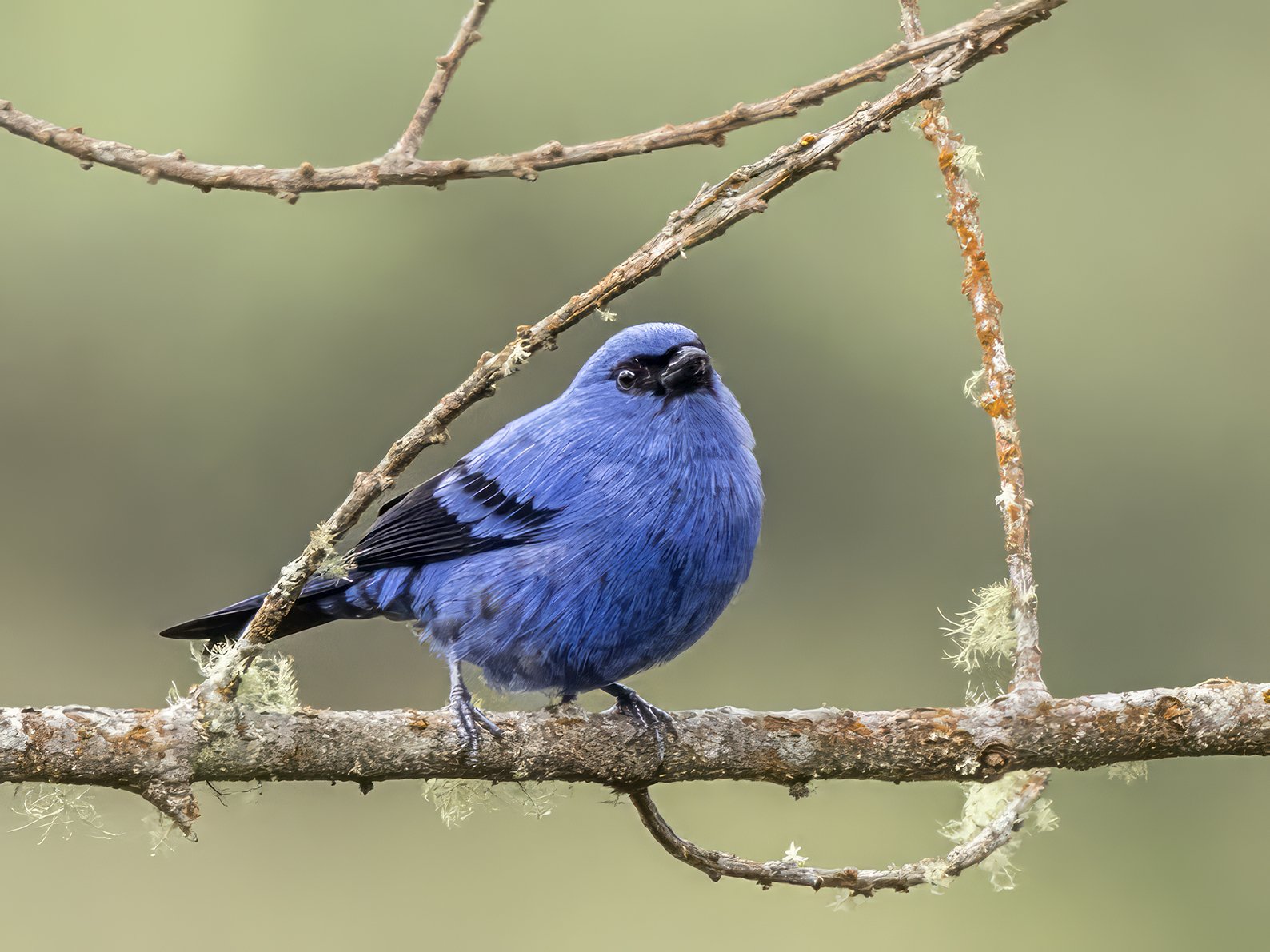
The Blue-and-black Tanager is a small, glossy blue tanager with black wings and tail that lives higher in the Andes than almost any other Tangara species. Pairs and small groups form a regular core of mixed flocks in upper cloud forest and at forest edges up to near the tree line.
Voice
High, thin tsit calls, often repeated in mixed flocks; a song is seldom heard.
Recording: Carlos Delgado JUMABITA — CC BY-NC-SA 4.0 · xeno-canto
Identification
13 cm, with a short, pointed black bill. The plumage is glossy cobalt to ultramarine blue, with black lores, black wings with blue edges to the coverts and a black tail. The sexes are almost alike; the female is slightly duller. Birds from southern Peru and Bolivia are darker blue, with black spots on the back. Juveniles are greyer and duller blue.
Confusion species
Masked Flowerpiercer Diglossa cyanea is larger and duller blue, with a black mask, a red iris and a thin bill hooked at the tip. Bluish Flowerpiercer Diglossa caerulescens is greyish blue without black wings. Golden-crowned Tanager Iridosornis rufivertex is larger and darker, with a black head and a yellow crown patch. Beryl-spangled Tanager Tangara nigroviridis is black with pale, greenish-blue spots.
Habitat
Humid upper montane forest, cloud forest and elfin forest, also forest edges, shrubbery and small woods in semi-open country, roughly between 2000 and 3400 m. It searches branches and moss for insects in the middle storey and the canopy and eats many small fruits and berries. The nest is a cup in a tree or shrub.
Where the bird is most at home, classified by the vegetation units of the Andes and the west coast.


Range and movements
In Colombia in all three Andean ranges. In Ecuador on both slopes of the Andes. In Peru on the eastern slope from north to south, and in the north also on the western slope. In Bolivia on the eastern slope in La Paz and Cochabamba. Does not occur on the Galápagos. Outside the guide area in the Andes of western Venezuela.
- Resident
- dark = core range, pale = thinly spread
How and when to look
Search mixed flocks in upper cloud forest, for example at Yanacocha and along the Papallacta Pass in Ecuador, or along roads through montane forest above 2500 m in Peru; look for a small, plain dark blue bird searching high along the branches.
Conservation status
Not Evaluated. Fairly common and widespread in suitable montane forest; tolerates forest edges and semi-open country, but depends on the survival of upper montane forest.
Scientific name
Tangara vassorii | (Boissonneau, 1840)
Boissonneau described the species in 1840 as Tanagra (Euphone?) Vassorii; because it was later moved to another genus, the author and year stand in brackets. The genus Tangara was introduced in 1760 by Brisson. The genus name comes from the extinct Tupi language, in which tangara means 'dancer'. The specific name honours the French collector M. Vassor, about whom little else is known. The specimen the first description was based on came from Bogotá, Colombia.