All species › Passerines › Tanagers and allies › Plushcap
Plushcap | Catamblyrhynchus diadema
Fluweelkaptangare | Gorradiadema | Gorro-de-pelúcia
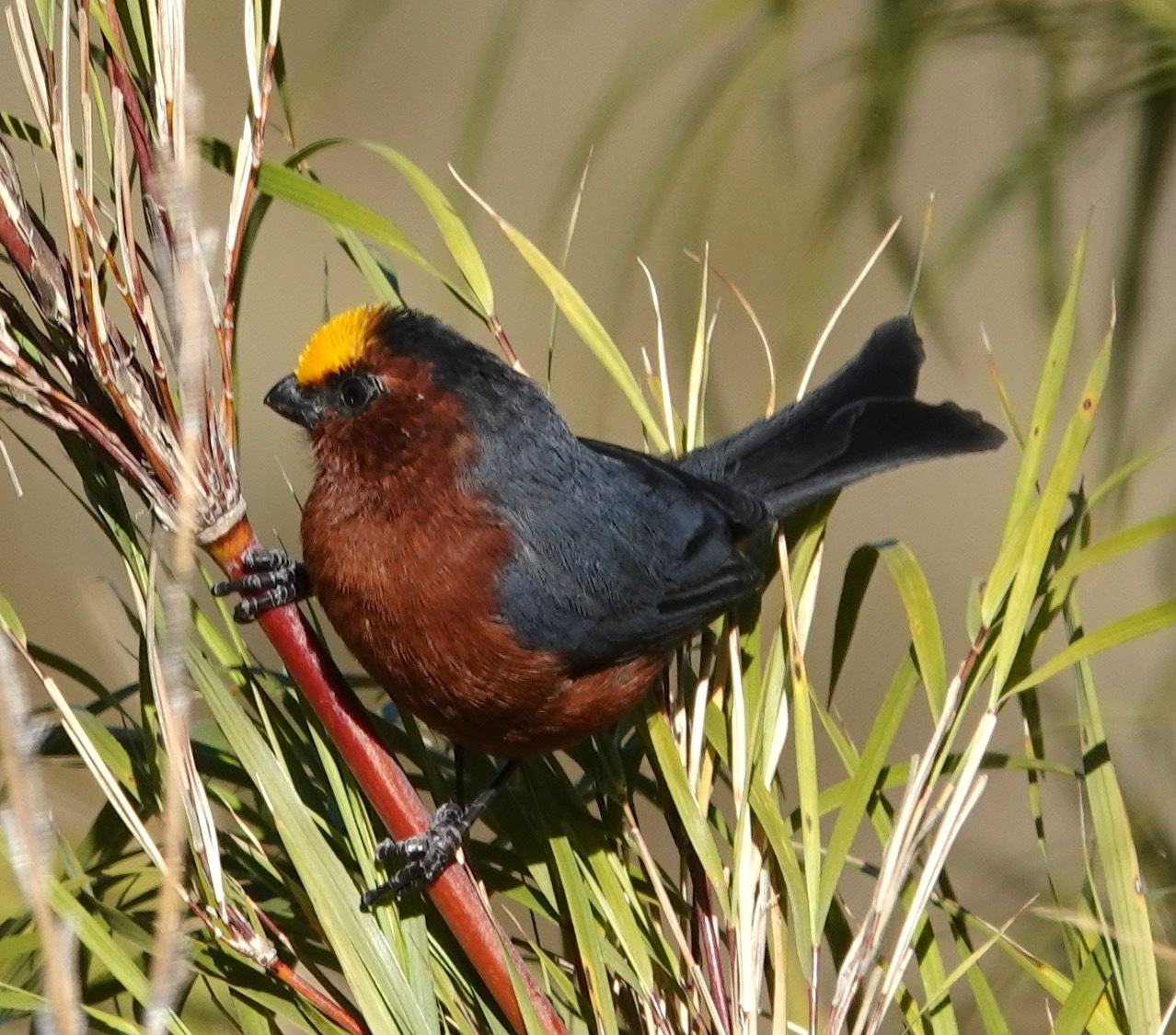
The Plushcap is a stocky, chestnut and grey bird with a golden-yellow, velvety forehead, of the higher montane forest from Colombia to Bolivia. It is closely tied to bamboo (Chusquea), prying open nodes and leaf sheaths with its short, thick bill. For a long time it was placed in its own family; it is now regarded as an aberrant tanager.
Voice
High, thin tsip calls. The song is a fast, varied series of high twittering and squeaky notes.
Recording: Fabrice Schmitt — CC BY-NC-SA 4.0 · xeno-canto
Identification
14 cm, with a short, thick, blackish bill. The forehead and forecrown are golden yellow, with short, dense, plush-like feathers; the hindcrown and nape are black. The face and underparts are deep chestnut, the upperparts, wings and tail slate-grey. The sexes are alike. Juveniles are olive-brown to ochre-brown, lacking the golden cap and with paler underparts.
Confusion species
Rufous-browed Conebill Conirostrum rufum has a rufous face and underparts, but a grey crown without yellow and a thin, pointed bill. Rufous-chested Tanager Thlypopsis ornata has a white belly and a thin bill. Golden-crowned Tanager Iridosornis rufivertex has a golden-yellow crown patch, but blue plumage.
Habitat
Bamboo stands in cloud forest and upper montane forest, also forest edges and scrub with bamboo, roughly between 2200 and 3500 m. It searches the bamboo for insects and other food in pairs or small groups, often in mixed flocks. The nest is a cup of moss and fibres in dense vegetation.
Where the bird is most at home, classified by the vegetation units of the Andes and the west coast.


Range and movements
In Colombia on all three Andean ranges and in the Serranía de Perijá. In Ecuador on both slopes of the Andes. In Peru along the Andes, mainly on the eastern slope. In Bolivia on the eastern slope of the Andes in the north and centre of the country. Absent from the Galápagos. Outside the guide area in the mountains of Venezuela and in north-western Argentina.
- Resident
- dark = core range, pale = thinly spread
How and when to look
Search bamboo in the higher cloud forest and at the treeline, especially where mixed flocks pass through bamboo. Listen for the soft cracking of the bill in the bamboo stems.
Conservation status
Least Concern. The species depends on bamboo in montane forest; forest loss and the mass die-off of bamboo after flowering can make numbers fluctuate locally.
Scientific name
Catamblyrhynchus diadema | de Lafresnaye, 1842
De Lafresnaye described the species in 1842 and placed it straight away in the genus where it still stands. He introduced the genus Catamblyrhynchus in that same work. The genus name comes from Greek katambluoō, 'to blunt', and rhunkhos, 'bill': a blunt-billed bird. The species name is Latin diadema, from Greek diadēma, 'royal headband', referring to the plush yellow cap. The specimen the first description was based on came from Bogotá, Colombia.