All species › Passerines › Tanagers and allies › Black-billed Seed Finch
Black-billed Seed Finch | Sporophila atrirostris
Zwartsnavelzaadkraker | Semillero piquinegro | Bicudo-de-bico-preto
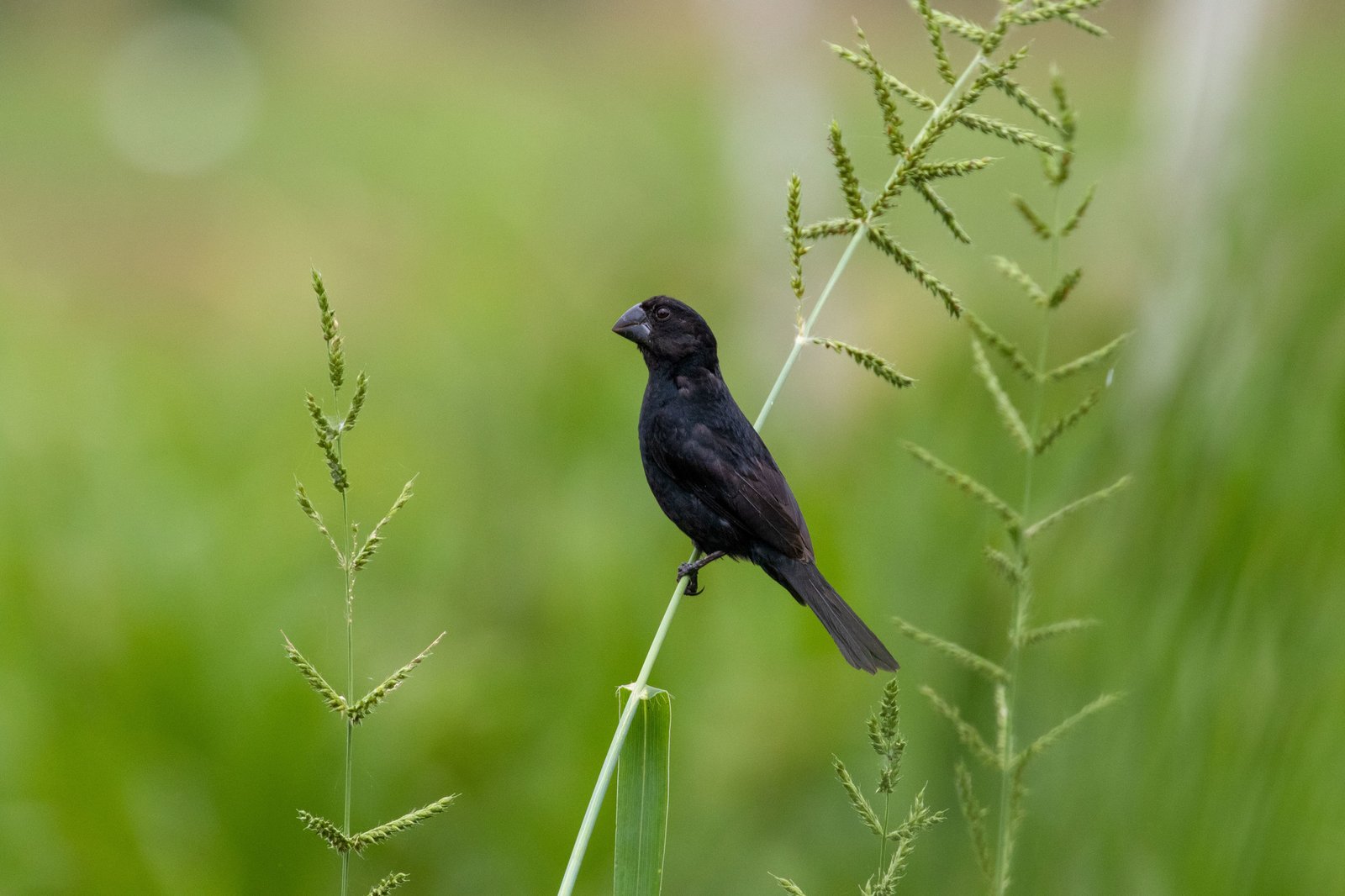
Black-billed Seed Finch is a large seed finch of western Amazonia, with a very heavy black bill. It lives locally on river islands and in rank growth along rivers and lakes. The species is scarce throughout its range and little studied.
Voice
The song is a long series of clear, melodious whistles, sometimes interspersed with twittering notes. The call is a short chek.
Recording: Paul Coopmans — CC BY-NC-SA 4.0 · xeno-canto
Identification
15–16 cm, with a very heavy, deep, black bill. The male is glossy black, with a white wing speculum and white underwing coverts. The female is warm brown and paler rufous-brown below, also with a black bill. Young males at first resemble the female.
Confusion species
Large-billed Seed Finch Sporophila crassirostris is slightly smaller, and the male has a pale, ivory-coloured bill. Chestnut-bellied Seed Finch Sporophila angolensis is clearly smaller, with a smaller bill, and the male has a chestnut belly. Male Blue-black Grassquit Volatinia jacarina is much smaller and blue-black, with a thin, pointed bill.
Habitat
Tall grass, wild cane (Gynerium) and scrub on river islands and banks, edges of lakes and marshes and rough clearings in the Amazonian lowlands and in the foothills and valleys of the eastern slope, up to about 1000 m. It eats mainly seeds of grasses and sedges. Little is known about the nest.
Where the bird is most at home, classified by the vegetation units of the Andes and the west coast.


Range and movements
In Ecuador rare and local in the Amazonian lowlands. In Peru local east of the Andes, from the north to the south-east, including the Mayo Valley in San Martín. In Bolivia scarce in the north. In Colombia at most in the extreme south. Absent from the Galápagos. Outside the guide area possibly in extreme western Brazil.
- Resident
- dark = core range, pale = thinly spread
How and when to look
Search river islands and rank growth with wild cane along rivers in eastern Ecuador and eastern Peru, and the rough clearings of the Mayo Valley near Rioja and Moyobamba, for singing males on a tall stem.
Conservation status
Least Concern, but scarce everywhere. Trapping for the cage-bird trade and the loss of riverside vegetation may play a role locally.
Scientific name
Sporophila atrirostris | (Sclater & Salvin, 1878)
Sclater & Salvin described the species in 1878 as Oryzoborus atrirostris; because it was later moved to another genus, the author and year stand in brackets. The genus Sporophila was introduced in 1844 by Cabanis. The genus name combines Greek sporos, 'seed', and philos, 'fond of'. The species name comes from Latin ater, 'zwart', en rostrum, 'snavel', for the black bill. The specimen the first description was based on came from Moyobamba, San Martín, Peru.