All species › Passerines › Tanagers and allies › Variable Seedeater
Variable Seedeater | Sporophila corvina
Noordelijk bont dikbekje | Semillero variable | Papa-capim-variável
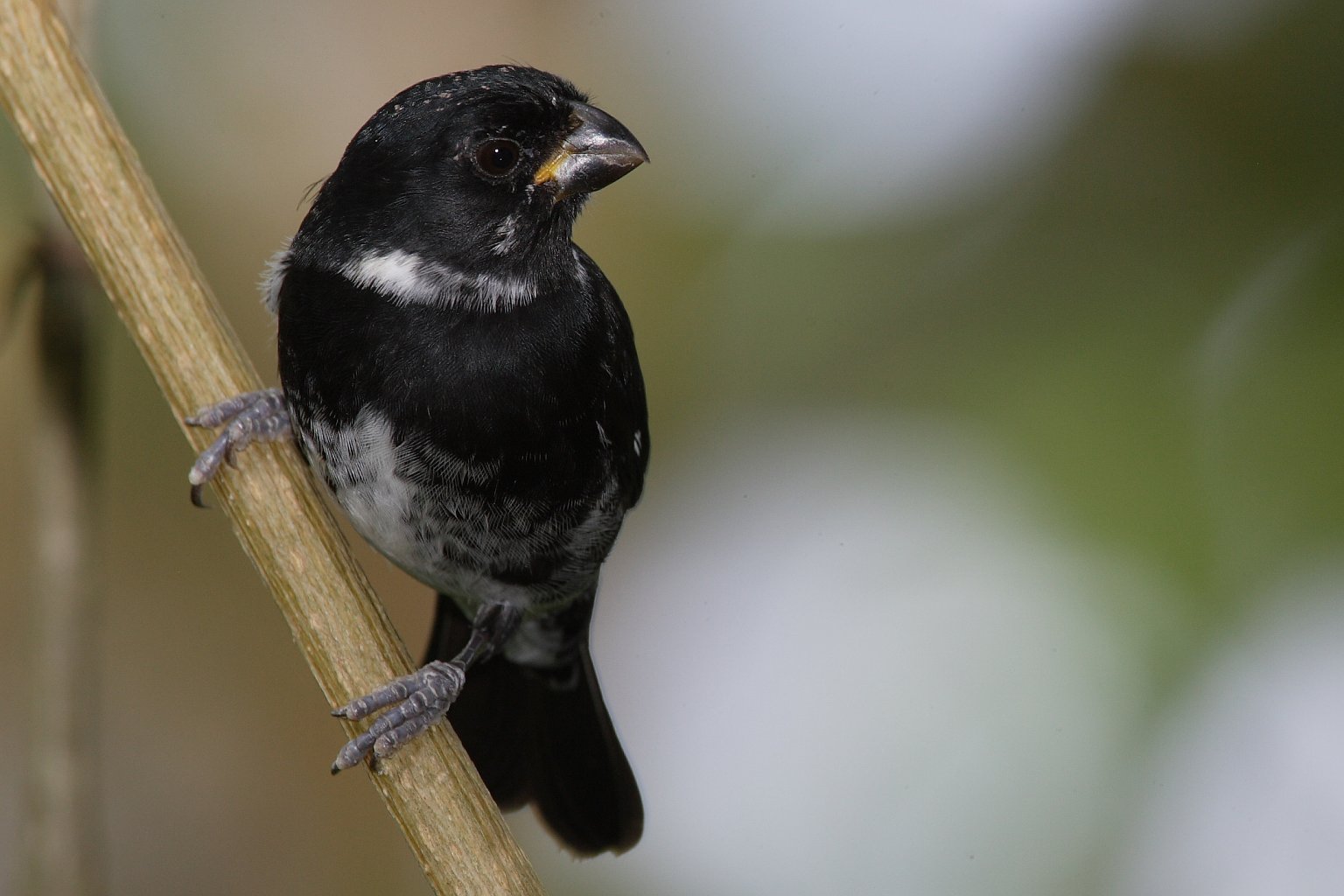
Variable Seedeater owes its name to the strong differences between its subspecies: the males range from entirely black to black and white. In the guide area it lives west of the Andes, from north-western Colombia to north-western Peru. There it is one of the commonest seedeaters of rough farmland.
Voice
The song is a fast, varied series of whistles, trills and twittering notes, often long sustained. The call is a short tsee or chep.
Recording: rudy gelis — CC BY-NC-SA 4.0 · xeno-canto
Identification
10–11 cm, with a short, thick, black bill. Males of the subspecies ophthalmica (south-western Colombia to north-western Peru) are black above, with a white rump, a white wing speculum and a white spot below the eye; the underparts are white, with a black breast band. Males of hicksii in north-western Colombia are largely black, with a variable amount of white on the belly. The female is olive-brown above and buff-brown below. Young males at first resemble the female.
Confusion species
Male Yellow-bellied Seedeater Sporophila nigricollis has a black head and throat and a yellowish belly. Chestnut-throated Seedeater Sporophila telasco is streaked grey above, with a chestnut chin, and lives mainly along the coast. Thick-billed Seed Finch Sporophila funerea is larger, with a much heavier bill, and the male is entirely black. Wing-barred Seedeater Sporophila americana lives east of the Andes.
Habitat
Rough grassland, pasture, field edges, roadsides, forest edges and clearings in humid and semi-humid lowlands and foothills, from sea level to about 1500 m. It eats mainly grass seeds. The nest is a small cup low in a bush.
Where the bird is most at home, classified by the vegetation units of the Andes and the west coast.


Range and movements
In Colombia in the Pacific lowlands, with hicksii in the north-west and ophthalmica in the south-west. In Ecuador widespread west of the Andes. In Peru in the north-west, in Tumbes and adjacent Piura. Absent from Bolivia and the Galápagos. Outside the guide area from southern Mexico to Panama. The Amazonian form murallae is now usually placed with Wing-barred Seedeater.
- Resident
- dark = core range, pale = thinly spread
How and when to look
Search roadsides and rough pastures in western Ecuador for small groups of seedeaters; singing males often sit on a wire or bush.
Conservation status
Not Evaluated as a separate species. In the guide area the species is widespread and benefits from open, man-made habitats.
Scientific name
Sporophila corvina | (Sclater, 1860)
Sclater described the species in 1860 as Spermophila corvina; because it was later moved to another genus, the author and year stand in brackets. The genus Sporophila was introduced in 1844 by Cabanis. The genus name combines Greek sporos, 'seed', and philos, 'fond of'. The species name comes from Latin corvinus, 'raven-like', for the male's black plumage. The specimen the first description was based on came from Playa Vicente, Mexico.