All species › Passerines › Tanagers and allies › Grey Seedeater
Grey Seedeater | Sporophila intermedia
Blauwgrijs dikbekje | Semillero gris | Papa-capim-cinza
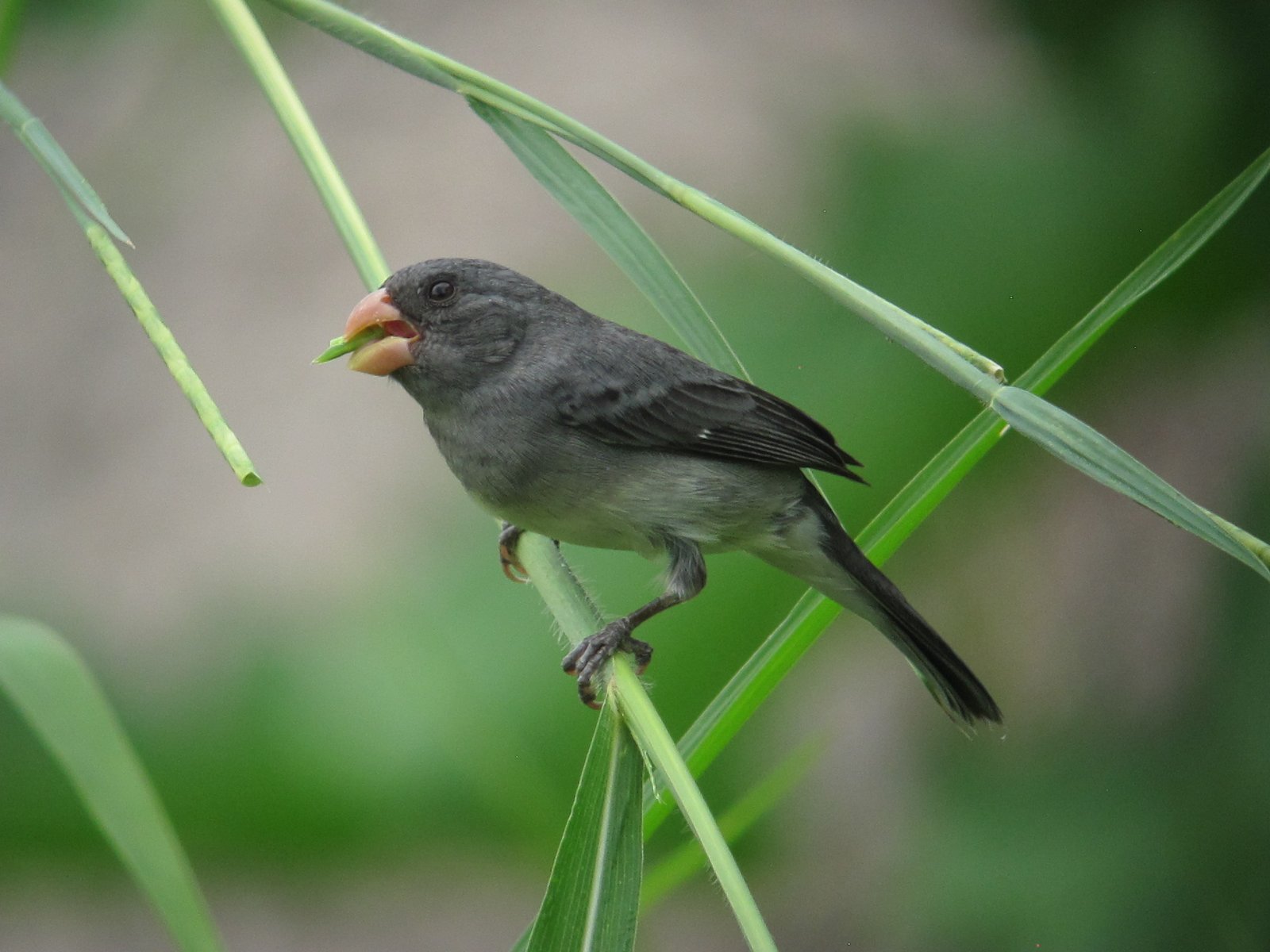
Grey Seedeater is an almost uniformly grey seedeater of open country in northern South America. In the guide area it is widespread mainly in Colombia, where it also occurs in gardens and parks. It is widely kept as a cage bird.
Voice
The song is a long, varied series of clear whistles, trills and twittering notes, often from a high perch. The call is a short tsee.
Recording: Yair Guillermo Molina Martínez. — CC BY-NC-SA 4.0 · xeno-canto
Identification
11 cm, with a short, thick bill that is pale in the male, yellowish to flesh-coloured. The male is uniform grey above and paler grey below, with a whitish centre to the belly and a small white wing speculum. The female is olive-brown above and paler buff-brown below, with a darker bill. Young males at first resemble the female.
Confusion species
Male Slate-colored Seedeater Sporophila schistacea is darker slate-grey, with a white patch on the side of the neck and a yellowish bill, and lives more at forest edges and in bamboo. Plumbeous Seedeater Sporophila plumbea has a black bill and a white spot on the chin and below the eye, and lives in the savannas of the llanos. Females of these grey seedeaters can hardly be told apart in the field.
Habitat
Rough grassland, pasture, field edges, scrub, forest edges, gardens and parks, in dry to humid terrain, from sea level to about 1500 m. It eats mainly grass seeds. The nest is a small cup low in a bush.
Where the bird is most at home, classified by the vegetation units of the Andes and the west coast.


Range and movements
In Colombia widespread in the Caribbean lowlands, the Magdalena and Cauca valleys and the llanos. In Ecuador there are only a few scattered records, and its status there is unclear. In Peru and Bolivia the species does not occur regularly; it is absent from the Galápagos. Outside the guide area in Venezuela, Guyana, Trinidad and northern Brazil.
- Resident
- dark = core range, pale = thinly spread
How and when to look
Search rough pastures and roadsides in the Magdalena Valley and the llanos of Colombia for singing males. Because the species is widely kept as a cage bird, records outside the known range may involve escaped birds.
Conservation status
Least Concern. The species benefits from deforestation and open farmland, but is locally trapped in large numbers for the cage-bird trade.
Scientific name
Sporophila intermedia | Cabanis, 1851
Cabanis described the species in 1851 and placed it straight away in the genus where it still stands. The genus Sporophila was introduced in 1844 by Cabanis. The genus name combines Greek sporos, 'seed', and philos, 'fond of'. The species name comes from Latin intermedius, 'intermediate'. The specimen the first description was based on came from Puerto Cabello, Venezuela.