All species › Passerines › Tanagers and allies › Wing-barred Seedeater
Wing-barred Seedeater | Sporophila americana
Bont dikbekje | Semillero aliblanco | Coleiro-do-norte
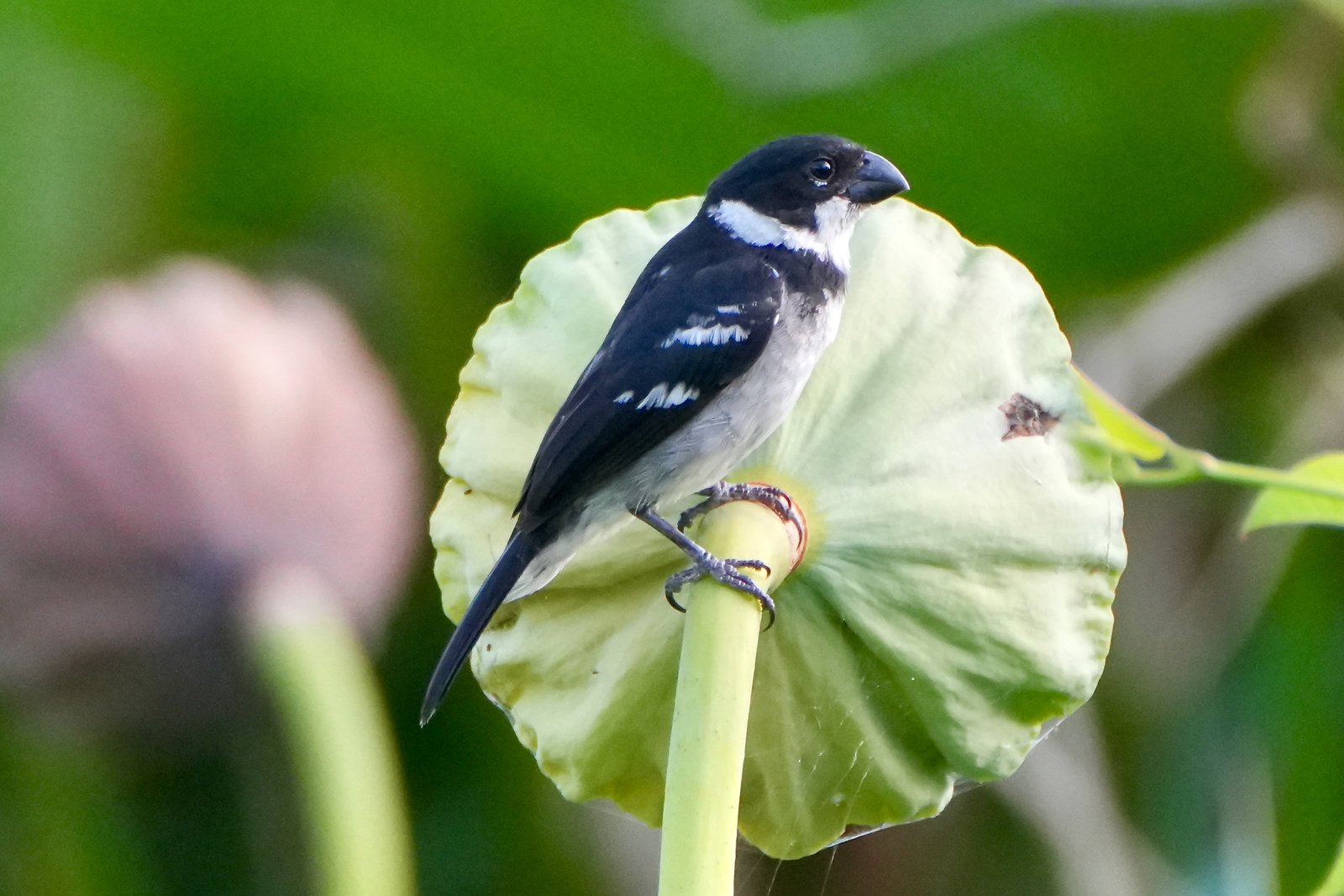
The Wing-barred Seedeater is a small black-and-white seedeater of riverbanks and clearings in the Amazonian lowlands. In the guide area the form concerned is murallae of western Amazonia, often treated as a separate species (Caqueta Seedeater). The male has narrow white wing bars, a feature lacking in most other seedeaters in the region.
Voice
The song is a long, varied series of clear whistles, twittering notes and trills, sometimes with imitations of other birds. The call is a short chip.
Recording: Rolf A. de By — CC BY-NC-SA 4.0 · xeno-canto
Identification
11 cm, with a short, thick, blackish bill. The male is black to dark grey above, with two narrow white wing bars, a white wing speculum and a grey rump. The throat is white, with a small white spot below the eye and a white collar on the sides of the neck; a narrow, often broken black band crosses the breast; the rest of the underparts is white. The female is olive-brown above and paler buff-brown below, with at most faint wing bars. Young males at first resemble the female.
Confusion species
Variable Seedeater Sporophila corvina lives west of the Andes and the male usually has no or hardly any wing bars. Black-and-white Seedeater Sporophila luctuosa has an all-black throat and breast and lives mainly in the Andes. Double-collared Seedeater Sporophila caerulescens has a black throat with a white malar stripe and no wing bars. Lesson's Seedeater Sporophila bouvronides has a black throat and white malar stripes. Females of all these species are very similar.
Habitat
Grassland, rank growth and scrub along riverbanks and on river islands, clearings, forest edge, fields and pastures in the lowlands, mostly below 600 m. It eats mainly grass seeds. The nest is a small open cup in a shrub or in tall grass.
Where the bird is most at home, classified by the vegetation units of the Andes and the west coast.


Range and movements
In Colombia in the Amazonian lowlands of the south-east (Caquetá, Putumayo, Amazonas). In Ecuador in the eastern lowlands. In Peru in the northern and central Amazonian lowlands, mainly along the large rivers. Its occurrence in Bolivia is uncertain. Absent from the Galápagos. Outside the guide area in western Brazil; the nominate form lives in north-eastern South America, from Venezuela to the mouth of the Amazon.
- Resident
- dark = core range, pale = thinly spread
How and when to look
Search the banks and river islands of the Amazon, Napo and Putumayo, for example around Leticia and Iquitos, in tall grass and young scrub. Singing males often perch high in a shrub or on a bare branch.
Conservation status
Not evaluated in this circumscription. The species is fairly common in suitable habitat and benefits from open ground along rivers; trapping for the cage-bird trade plays a role locally.
Scientific name
Sporophila americana | (Gmelin, 1789)
Gmelin described the species in 1789 as Loxia americana; because it was later moved to another genus, the author and year stand in brackets. The genus Sporophila was introduced in 1844 by Cabanis. The genus name combines Greek sporos, 'seed', and philos, 'fond of'. The species name refers to America. The specimen the first description was based on came from Cayenne, French Guiana.