All species › Passerines › Tanagers and allies › White-naped Seedeater
White-naped Seedeater | Sporophila fringilloides
Witnekdikbekje | Semillero nuquiblanco | Papa-capim-de-coleira
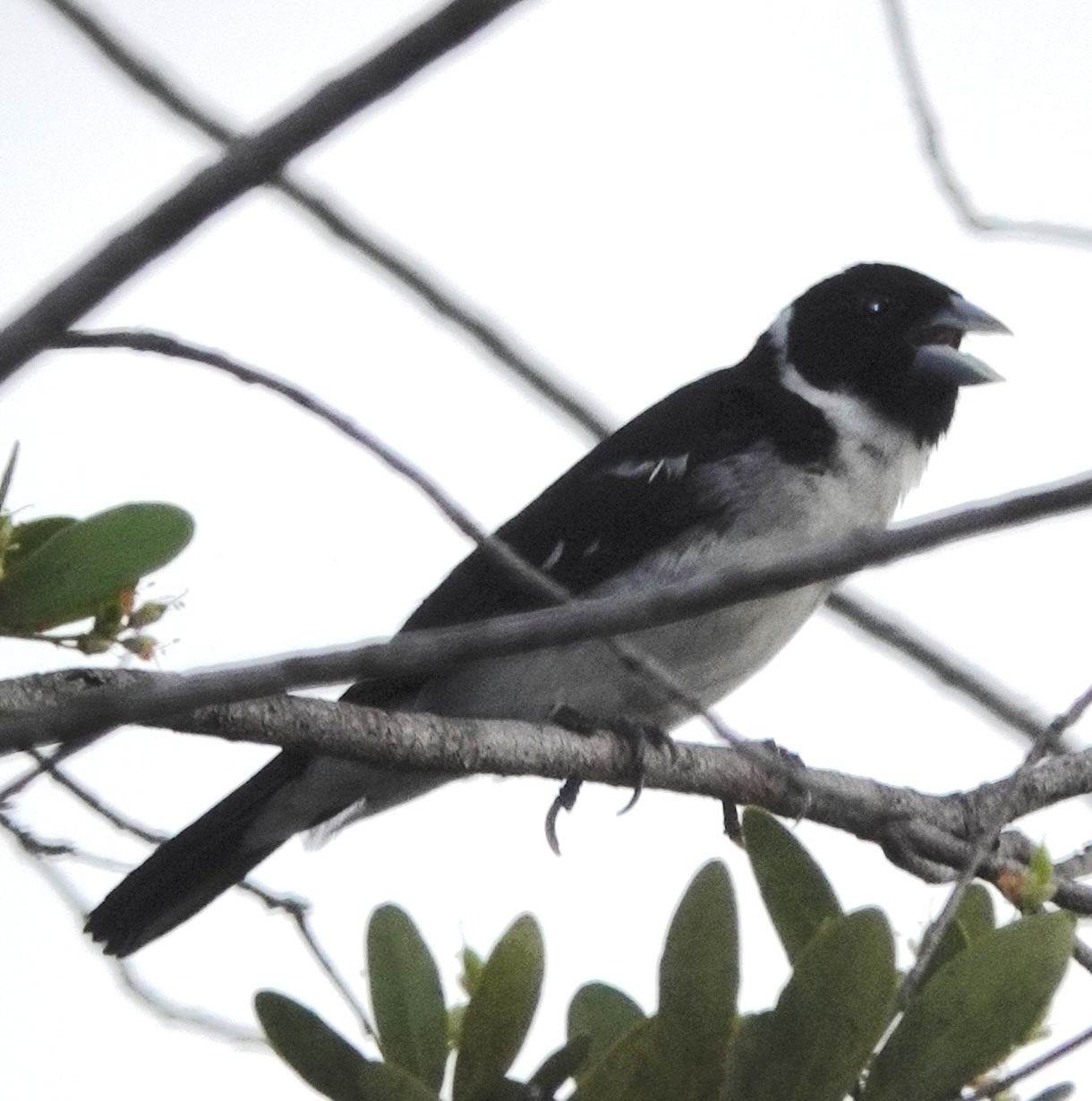
The White-naped Seedeater is a fairly large black-and-white seedeater with a heavy, pale bill, long placed in its own genus (Dolospingus). It lives in savannas and scrub on white-sand soils in northern Amazonia. In the guide area it occurs only in eastern Colombia.
Voice
Little described. The song is a series of clear, rather sweet whistles and chirping notes. The call is a short chip.
Recording: Ricardo Gagliardi — CC BY-NC-SA 4.0 · xeno-canto
Identification
13 cm, with a large, conical, whitish to horn-coloured bill. The male is glossy black above, with a white patch on the side of the neck, a white wing speculum and often narrow white wing bars; the throat and underparts are white, with black flanks at the breast. The female is cinnamon-brown above and paler buff-brown below, with a dark bill. Young males at first resemble the female.
Confusion species
Wing-barred Seedeater Sporophila americana is smaller, with a small, blackish bill and a black breast band. White-bellied Seedeater Sporophila leucoptera is grey above, not black, and has an orangish bill. Males of Large-billed Seed Finch Sporophila crassirostris are largely black, with a white wing speculum and an even heavier, pale bill, but without white underparts. The female resembles those of other large seedeaters and seed finches and can be recognised by the stout, conical bill.
Habitat
Savannas with scattered shrubs, scrub and low woodland on white-sand soils, and their edges, also along blackwater rivers; in the lowlands, mostly below 300 m. It eats seeds of grasses and sedges. Little is known about the nest.
Where the bird is most at home, classified by the vegetation units of the Andes and the west coast.


Range and movements
In Colombia locally in the east, in Vichada, Guainía and Vaupés, in the Orinoco and Río Negro region. Absent from Ecuador, Peru, Bolivia and the Galápagos. Outside the guide area in southern Venezuela, Guyana and north-western Brazil.
- Resident
- dark = core range, pale = thinly spread
How and when to look
Search the white-sand savannas around Puerto Inírida (Guainía) and along the Orinoco, in scrub at the forest edge. The species often occurs in small numbers and mixes with other seedeaters.
Conservation status
Least Concern. The species is local and poorly known, but its habitat in northern Amazonia is under little pressure.
Scientific name
Sporophila fringilloides | (Pelzeln, 1870)
Pelzeln described the species in 1870 as Oryzoborus(?) fringilloides; because it was later moved to another genus, the author and year stand in brackets. The genus Sporophila was introduced in 1844 by Cabanis. The genus name combines Greek sporos, 'seed', and philos, 'fond of'. The species name combines the genus Fringilla, 'finch', with Greek -oidēs, 'resembling'. The specimen the first description was based on came from Rio Xié, Amazonas, Brazil.