All species › Passerines › Tanagers and allies › Black-and-white Seedeater
Black-and-white Seedeater | Sporophila luctuosa
Zwart-wit dikbekje | Semillero negriblanco | Papa-capim-preto-e-branco
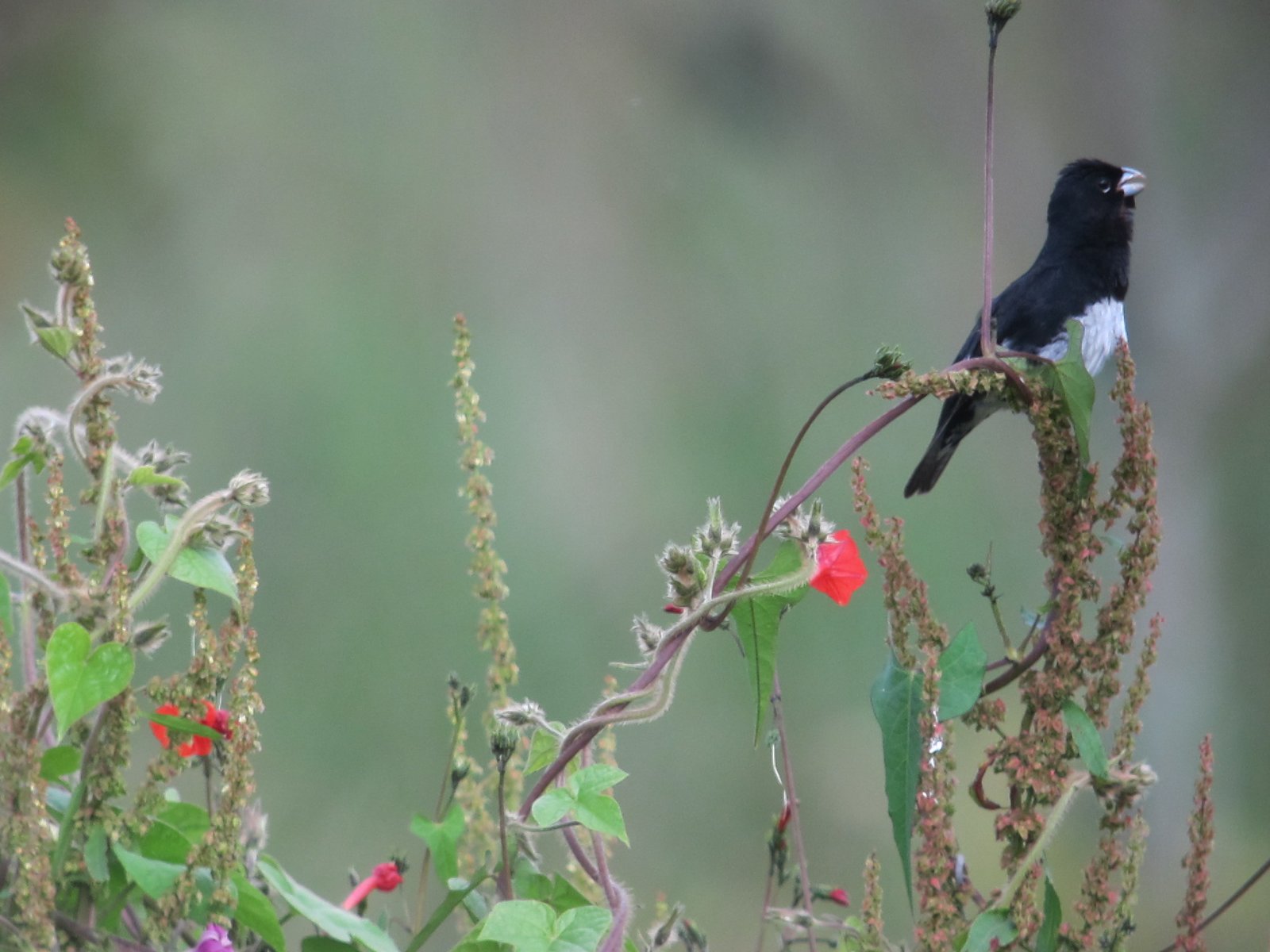
The Black-and-white Seedeater is the most widespread seedeater of the Andean slopes, from Venezuela to Bolivia. The male is black above and on the throat and breast, with a white belly and a blue-grey bill. Outside the breeding season some birds move downslope, into the Amazonian lowlands.
Voice
The song is a short, rapid series of clear, somewhat twittering whistles. The call is a short chip or a soft, nasal chee.
Recording: José María Loaiza B. — CC BY-NC-SA 4.0 · xeno-canto
Identification
11 cm, with a short, thick bill, blue-grey in the male. The male has a black head, upperparts, throat and breast, sharply demarcated from a white belly and undertail coverts, and a white wing speculum. The female is olive-brown above and paler buff-brown below, with a dark bill. Young males are brown with grey or black blotches.
Confusion species
Yellow-bellied Seedeater Sporophila nigricollis has an olive back, only a black hood and yellowish underparts. Wing-barred Seedeater Sporophila americana has a white throat and wing bars and lives in the lowlands. Lesson's Seedeater Sporophila bouvronides has white malar stripes. Double-collared Seedeater Sporophila caerulescens is grey above, with a white band between throat and breast. Females can hardly be told from those of other seedeaters in the field.
Habitat
Rank growth, scrub, forest edge, clearings, pastures, road verges and field edges in the Andes, mostly between 1000 and 2500 m, locally up to 3000 m; outside the breeding season also lower, down into the lowlands. It eats mainly grass seeds, also those of bamboo. The nest is a small open cup in a shrub.
Where the bird is most at home, classified by the vegetation units of the Andes and the west coast.


Range and movements
In Colombia in all three Andean ranges and in the Sierra Nevada de Santa Marta. In Ecuador mainly on the east slope and in the inter-Andean valleys, locally on the west slope. In Peru along the east slope of the Andes, outside the breeding season also in the Amazonian lowlands. In Bolivia on the east slope (La Paz, Cochabamba). Absent from the Galápagos. Outside the guide area in western Venezuela.
- Resident
- dark = core range, pale = thinly spread
How and when to look
Search the east slope of the Andes along roads with rank growth and grassy verges, for example along the Cosñipata road in Peru or in the valleys around Baeza in Ecuador. Males often sing from a shrub or a wire.
Conservation status
Least Concern. The species is widespread and benefits from deforestation, which creates open ground and rank growth.
Scientific name
Sporophila luctuosa | (de Lafresnaye, 1843)
De Lafresnaye described the species in 1843 as Spermophila luctuosa; because it was later moved to another genus, the author and year stand in brackets. The genus Sporophila was introduced in 1844 by Cabanis. The genus name combines Greek sporos, 'seed', and philos, 'fond of'. The species name comes from Latin luctuosus, 'mournful', for the black-and-white plumage. The specimen the first description was based on came from Bogotá, Colombia.