All species › Passerines › Tanagers and allies › Yellow-bellied Seedeater
Yellow-bellied Seedeater | Sporophila nigricollis
Geelbuikdikbekje | Semillero ventriamarillo | Baiano
The Yellow-bellied Seedeater is one of the most widespread seedeaters of northern South America, from Costa Rica to Argentina. The male has a black hood reaching the breast, an olive back and pale yellow underparts. It lives in grassland and farmland and occurs in Andean valleys up to well over 2000 m.
Voice
The song is a short, clear series of twittering whistles, often ending in a few harsh, buzzy notes. The call is a short chip.
Recording: Marco Andrés Urvina Alejandro — CC BY-NC-SA 4.0 · xeno-canto
Identification
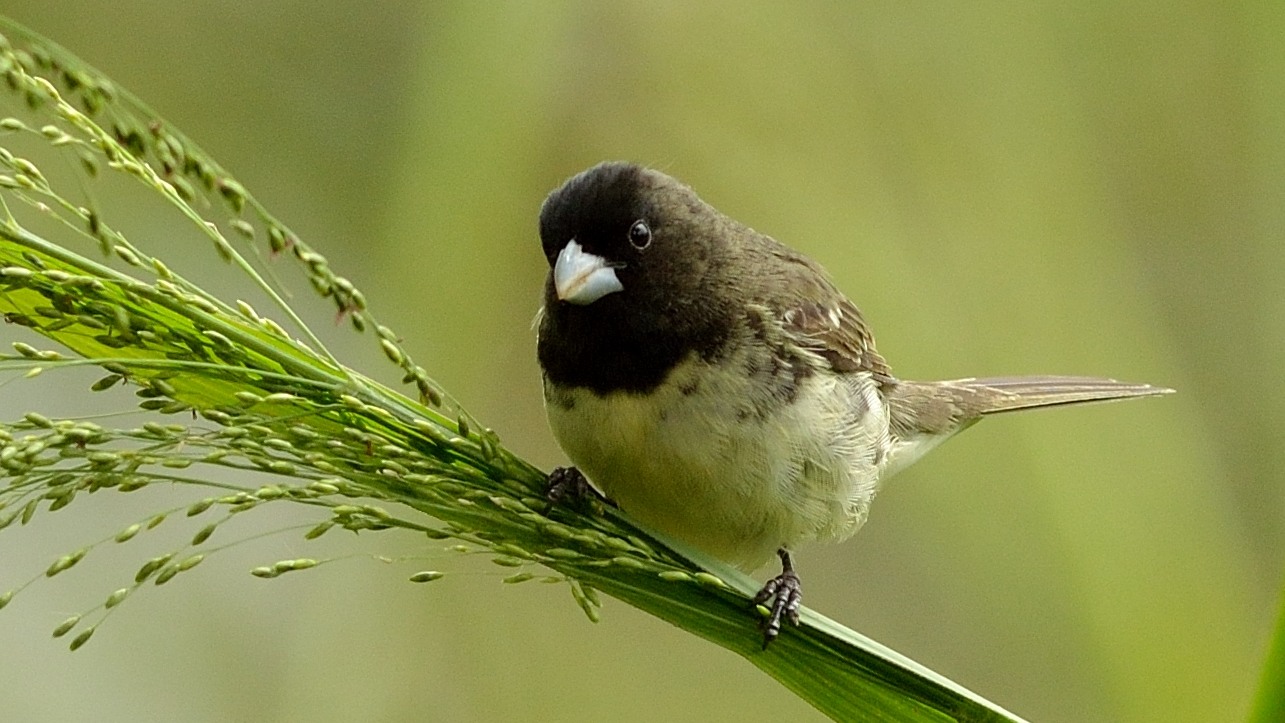
10–11 cm, with a short, thick bill, pale grey to blue-grey in the male. The male has a black head, throat and upper breast, olive-green to olive-brown upperparts and pale yellow to yellowish-white underparts; a wing speculum is usually lacking or small. The female is olive-brown above and paler buff-brown below, with a dark bill. Young males at first resemble the female.
Confusion species
Black-and-white Seedeater Sporophila luctuosa has black upperparts, a white belly and a white wing speculum. Lesson's Seedeater Sporophila bouvronides and Lined Seedeater Sporophila lineola have white malar stripes and a black back. Chestnut-throated Seedeater Sporophila telasco lives on the Pacific coast and the male has a grey back and a chestnut chin. Females can hardly be told from those of other seedeaters in the field.
Habitat
Grassland, pastures, rank growth, road verges, fields, gardens and scrub along forest edge, from the lowlands to about 2300 m. It eats mainly grass seeds, often plucked directly from the seed head. The nest is a small, shallow cup in a shrub or low tree.
Where the bird is most at home, classified by the vegetation units of the Andes and the west coast.


Range and movements
In Colombia widespread, in the Caribbean lowlands, in Andean valleys and on the lower slopes, and locally east of the Andes. In Ecuador mainly in the west and in the inter-Andean valleys, locally also on the east slope. In Peru mainly along the east slope of the Andes and locally in the north-west. In Bolivia on the east slope and in the adjacent lowlands. Absent from the Galápagos. Outside the guide area from Costa Rica and Panama to Venezuela, the Guianas, Brazil, Paraguay and north-eastern Argentina.
- Resident
- dark = core range, pale = thinly spread
How and when to look
Search pastures, road verges and rank growth in the Andean valleys of Colombia and Ecuador, where small groups often feed with other seedeaters and Blue-black Grassquits. Males sing from a wire or a shrub.
Conservation status
Least Concern. The species is common and benefits from deforestation and grassland; trapping for the cage-bird trade plays a role locally.
Scientific name
Sporophila nigricollis | (Vieillot, 1823)
Vieillot described the species in 1823 as Pyrrhula nigricollis; because it was later moved to another genus, the author and year stand in brackets. The genus Sporophila was introduced in 1844 by Cabanis. The genus name combines Greek sporos, 'seed', and philos, 'fond of'. The species name comes from Latin niger, 'zwart', en collum, 'hals', for the black throat. The specimen the first description was based on came from Brazil.