All species › Passerines › Tanagers and allies › Double-collared Seedeater
Double-collared Seedeater | Sporophila caerulescens
Witbaarddikbekje | Corbatita común | Coleirinho
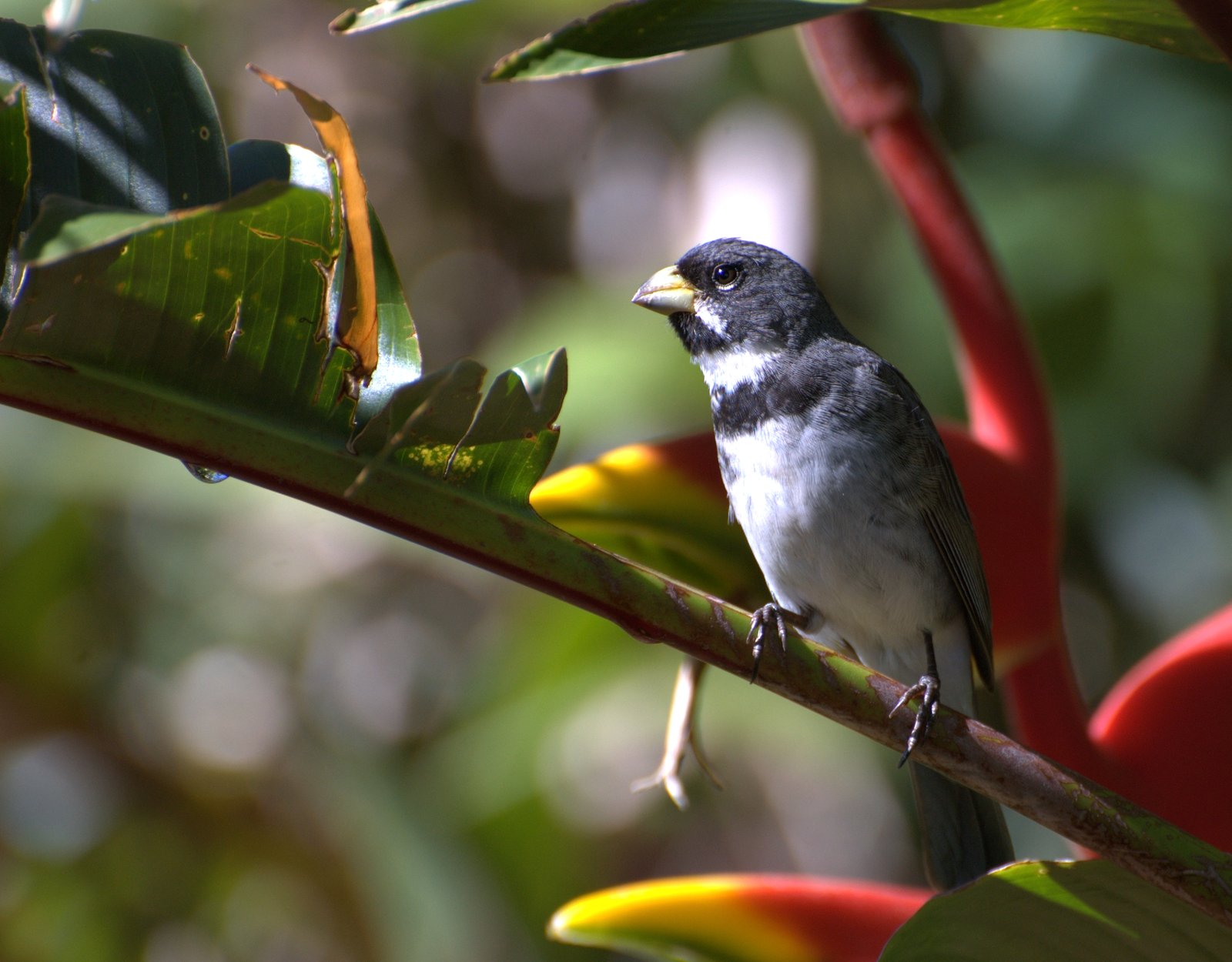
The Double-collared Seedeater is one of the most common seedeaters in south-eastern South America. The male is grey, with a black throat, a white malar stripe, a white collar and a black breast band; the name refers to those two 'collars'. Southern birds move north in the southern winter, into Amazonia.
Voice
The song is a rapid, twittering series of clear and somewhat harsh notes. The call is a short, nasal chip. In the wintering area the species sings little.
Recording: Ricardo José Mitidieri — CC BY-NC-SA 4.0 · xeno-canto
Identification
11 cm, with a short, thick bill, grey to yellowish in the male. The male is grey above, with a black chin and throat, a white malar stripe below the cheek, a white band across the lower throat and below it a black breast band; the belly is white. A wing speculum is lacking or small. The female is olive-brown above and paler buff-brown below, with a dark bill. Young males at first resemble the female.
Confusion species
Lesson's Seedeater Sporophila bouvronides and Lined Seedeater Sporophila lineola have a black back, a white rump and no white collar. Wing-barred Seedeater Sporophila americana has a white throat and white wing bars. Plumbeous Seedeater Sporophila plumbea is grey with a white spot below the bill, but without a black throat and breast band. Females can hardly be told from those of other seedeaters in the field.
Habitat
Grassland, pastures, rank growth, scrub, forest edge, rice fields and marsh edges, from the lowlands to about 2000 m in the Bolivian Andes. It eats mainly grass seeds. The nest is a small open cup in a shrub.
Where the bird is most at home, classified by the vegetation units of the Andes and the west coast.


Range and movements
In Bolivia as a breeding bird in the south and east (Santa Cruz, Chuquisaca, Tarija), more widespread in the southern winter, reaching the north. In Peru as a winter visitor in the south-eastern lowlands (Madre de Dios), rarely farther north. In Colombia and Ecuador only rare in the far east. Absent from the Galápagos. Outside the guide area in eastern and southern Brazil, Paraguay, Uruguay and northern Argentina; winters north into Brazilian Amazonia.
- Resident
- dark = core range, pale = thinly spread
How and when to look
In the southern winter, search flocks of seedeaters in rank growth and pastures in Bolivia and south-eastern Peru, for example around Santa Cruz de la Sierra. Breeding birds sing from a shrub or a wire.
Conservation status
Least Concern. The species is widespread and common and is heavily trapped as a cage bird, especially in Brazil.
Scientific name
Sporophila caerulescens | (Vieillot, 1823)
Vieillot described the species in 1823 as Pyrrhula caerulescens; because it was later moved to another genus, the author and year stand in brackets. The genus Sporophila was introduced in 1844 by Cabanis. The genus name combines Greek sporos, 'seed', and philos, 'fond of'. The species name comes from Latin caerulescens, 'bluish'. The specimen the first description was based on came from Rio de Janeiro, Brazil.