All species › Passerines › Tanagers and allies › Slate-colored Seedeater
Slate-colored Seedeater | Sporophila schistacea
Leigrijs dikbekje | Semillero pizarroso | Cigarrinha-do-norte
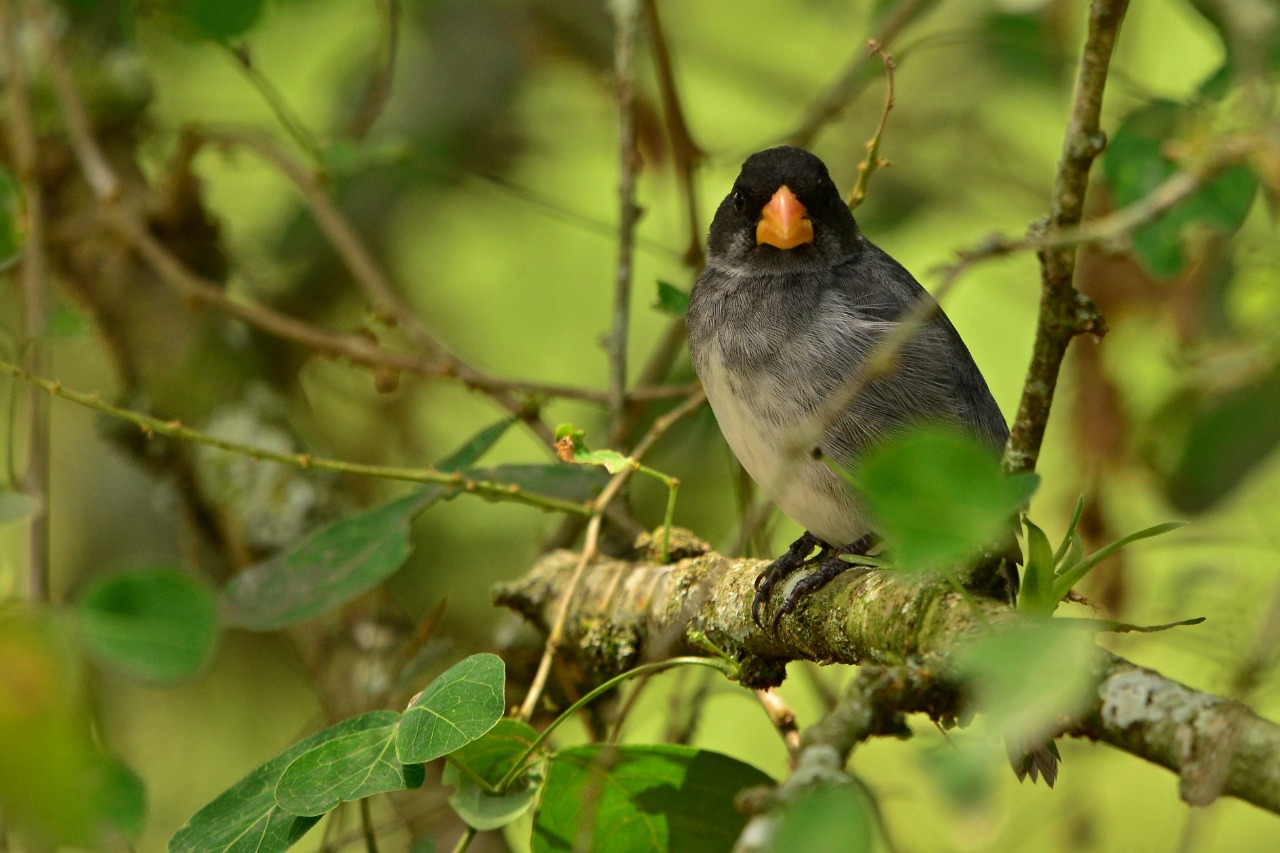
The Slate-colored Seedeater is a grey seedeater of forest edge and bamboo that ranges from southern Mexico to Bolivia but is local and irregular everywhere. It often appears in numbers where bamboo is seeding and then disappears again. The male has a bright yellow bill.
Voice
The song starts with a few high, thin notes and ends in a dry, buzzy trill that recalls an insect; the Brazilian name cigarrinha ('little cicada') refers to it. The call is a short tsik.
Recording: Andres Felipe Espinosa — CC BY-NC-SA 4.0 · xeno-canto
Identification
11 cm, with a thick, curved bill, bright yellow in the male. The male is slate grey, with a white patch on the side of the throat, a white wing speculum and a whitish centre to the belly. The female is olive-brown above and paler buff-brown below, with a dark bill that is sometimes paler at the base. Young males at first resemble the female.
Confusion species
Grey Seedeater Sporophila intermedia has a pale grey to pinkish-grey bill and a paler grey belly and lives in open country. Plumbeous Seedeater Sporophila plumbea has a dark bill and lives in savannas. Ecuadorian Seedeater Amaurospiza aequatorialis is blue-black, with a dark bill and no wing speculum. Slaty Finch Haplospiza rustica also lives in bamboo but has a pointed, dark bill and no white marks.
Habitat
Forest edge, clearings, bamboo stands and the canopy of humid forest, from the lowlands to about 1500 m, locally higher. It eats mainly seeds of bamboo (Guadua, Chusquea) and grasses. The nest is a small open cup in a shrub or tree.
Where the bird is most at home, classified by the vegetation units of the Andes and the west coast.


Range and movements
In Colombia locally in the Pacific lowlands, in the north and in Andean valleys, and east of the Andes. In Ecuador locally in the north-west and in the eastern lowlands and foothills. In Peru in the Amazonian lowlands and the foothills of the east slope. In Bolivia in the north (Pando, La Paz, Beni, Cochabamba). Absent from the Galápagos. Outside the guide area from southern Mexico through Central America to Venezuela, the Guianas and Brazilian Amazonia.
- Resident
- dark = core range, pale = thinly spread
How and when to look
Watch for seeding bamboo, especially Guadua in south-eastern Peru and northern Bolivia: Slate-colored Seedeaters sometimes appear there in groups, together with other seed-eating birds. Elsewhere males often sing high in a tree at the forest edge.
Conservation status
Least Concern. The species is widespread but local; because it follows seeding bamboo, numbers fluctuate strongly.
Scientific name
Sporophila schistacea | (Lawrence, 1862)
Lawrence described the species in 1862 as Spermophila schistacea; because it was later moved to another genus, the author and year stand in brackets. The genus Sporophila was introduced in 1844 by Cabanis. The genus name combines Greek sporos, 'seed', and philos, 'fond of'. The species name comes from Latin schistaceus, 'slaty'. The specimen the first description was based on came from Lion Hill, Panama.