All species › Passerines › Tanagers and allies › Plumbeous Seedeater
Plumbeous Seedeater | Sporophila plumbea
Loodgrijs dikbekje | Semillero plomizo | Patativa
The Plumbeous Seedeater is a grey seedeater of savannas and open grassland in the interior of South America. The male has a white spot below the bill and a white wing speculum. In the guide area it lives in the llanos of Colombia and the savannas of Bolivia and south-eastern Peru.
Voice
The song is a long, varied series of clear whistles and trills, often with imitations of other birds; for this reason the species is kept as a cage bird in Brazil. The call is a short chip.
Recording: Paul Lenrumé — CC BY-NC-SA 4.0 · xeno-canto
Identification
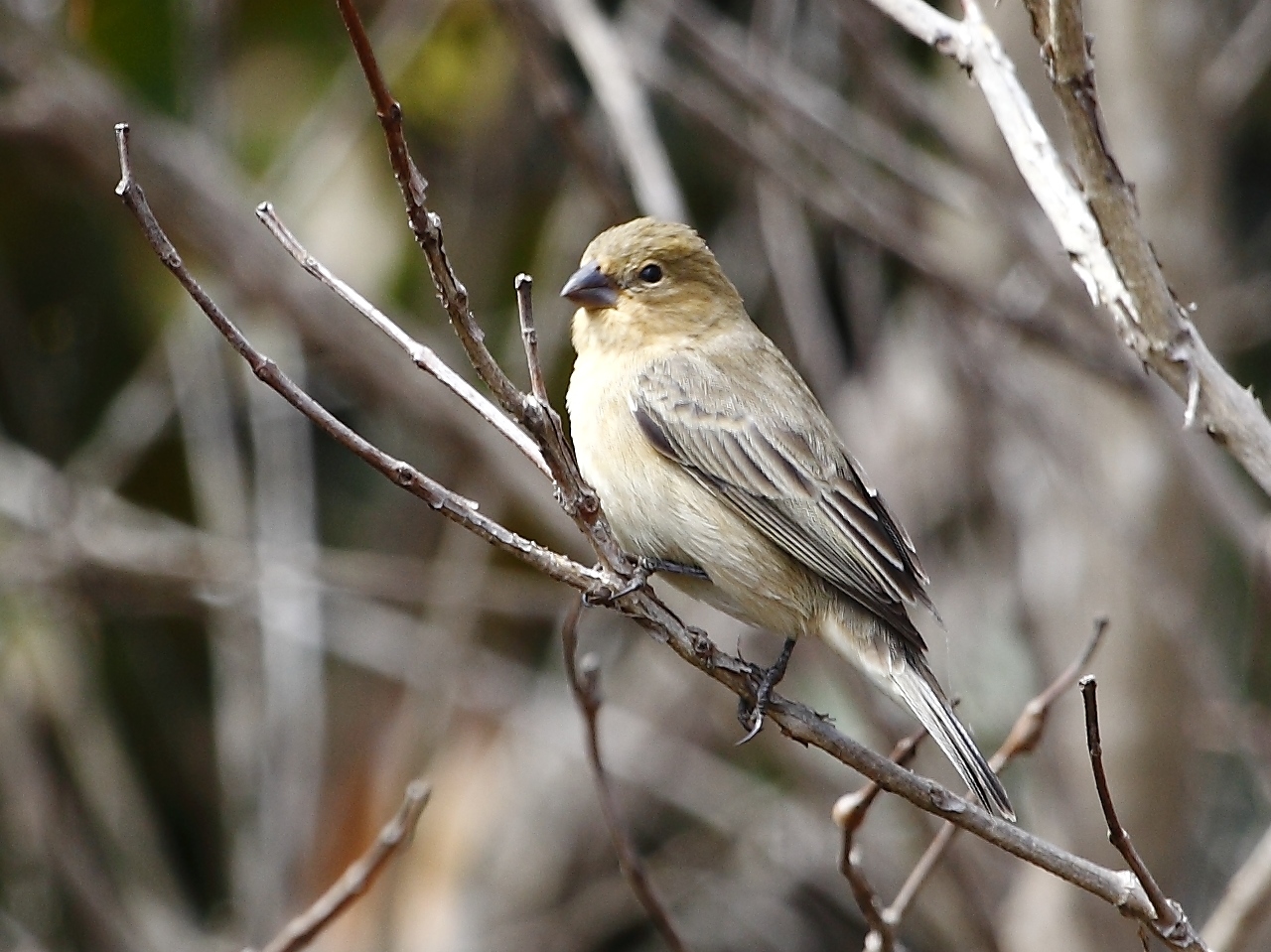
11 cm, with a short, thick, blackish bill. The male is leaden grey above and paler grey below with a whitish centre to the belly, with a white spot or stripe below the bill and a white wing speculum. The female is brown above and paler buff-brown below, with a dark bill. Young males at first resemble the female.
Confusion species
Slate-colored Seedeater Sporophila schistacea has a bright yellow bill and lives at forest edge and in bamboo. Grey Seedeater Sporophila intermedia has a pale bill and usually no white spot below the bill. White-bellied Seedeater Sporophila leucoptera is larger, with white underparts and an orangish bill. Females can hardly be told from those of other seedeaters in the field.
Habitat
Savannas with scattered shrubs, dry and wet grassland and the edges of gallery forest, in the lowlands, mostly below 1000 m. It eats mainly grass seeds. The nest is a small open cup in a shrub or in tall grass.
Where the bird is most at home, classified by the vegetation units of the Andes and the west coast.


Range and movements
In Colombia in the llanos east of the Andes (Arauca, Casanare, Meta, Vichada). In Peru only in the south-east, on the Pampas del Heath (Madre de Dios). In Bolivia in the lowland savannas (Beni, Santa Cruz). Absent from Ecuador and the Galápagos. Outside the guide area in Venezuela, the Guianas, Brazil, Paraguay and north-eastern Argentina.
- Resident
- dark = core range, pale = thinly spread
How and when to look
Search the llanos of Meta and Casanare in Colombia or the savannas of Beni in Bolivia, in grassland with scattered shrubs. Singing males often perch on top of a shrub.
Conservation status
Least Concern. The species is widespread; burning, conversion of savanna to farmland and trapping for the cage-bird trade play a role locally.
Scientific name
Sporophila plumbea | (Wied-Neuwied, 1830)
Wied-Neuwied described the species in 1830 as Fringilla plumbea; because it was later moved to another genus, the author and year stand in brackets. The genus Sporophila was introduced in 1844 by Cabanis. The genus name combines Greek sporos, 'seed', and philos, 'fond of'. The species name comes from Latin plumbeus, 'leaden'. The specimen the first description was based on came from border of Bahia and Minas Gerais, Brazil.