All species › Passerines › Tanagers and allies › Rusty-collared Seedeater
Rusty-collared Seedeater | Sporophila collaris
Roestnekdikbekje | Corbatita dominó | Coleiro-do-brejo
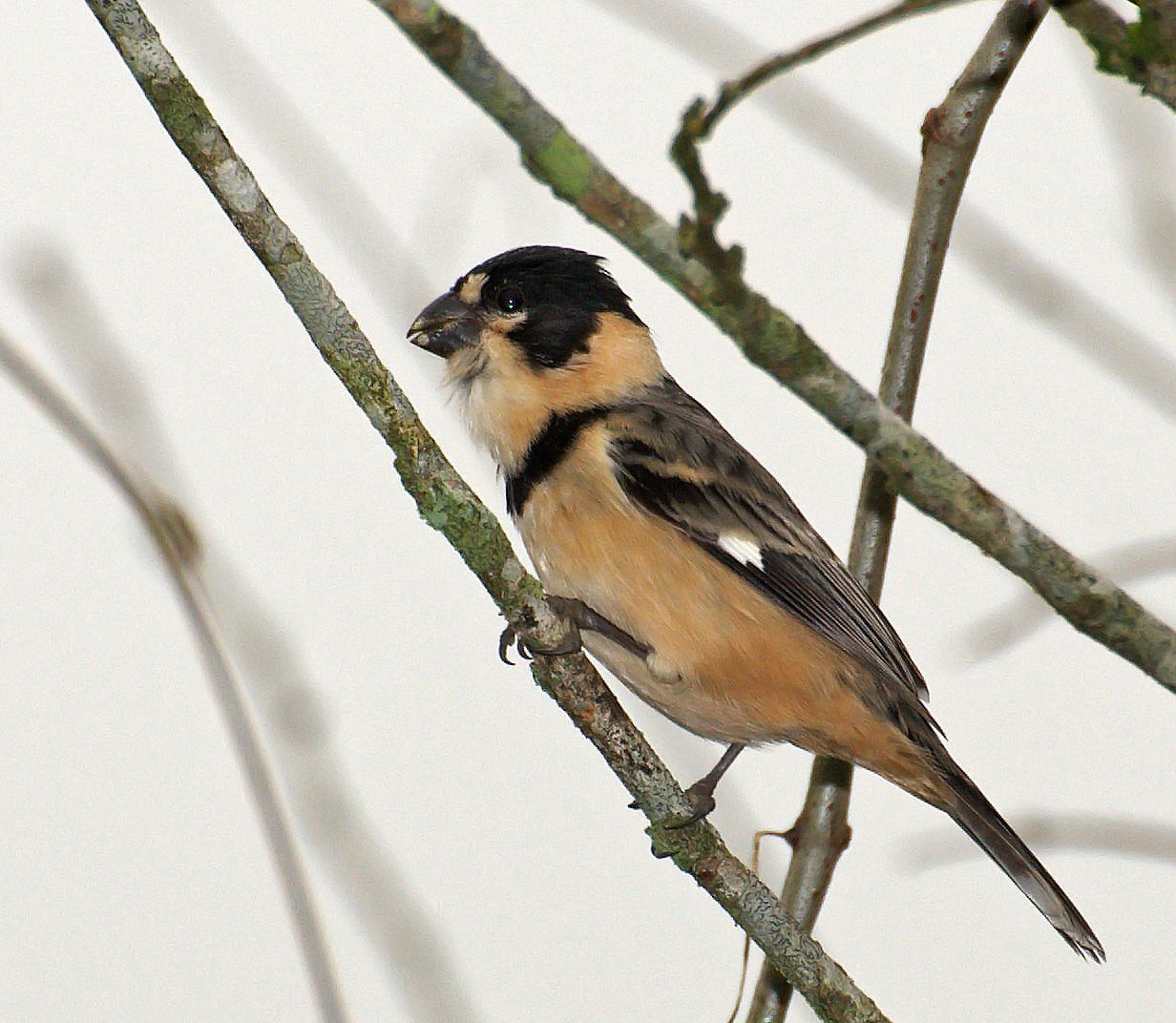
The Rusty-collared Seedeater is a seedeater of marshes and wet grasslands in south-eastern South America, which in the guide area occurs only in the eastern lowlands of Bolivia. The male has a black head, a white throat, a black breast band and a cinnamon collar. It nearly always lives close to water, in tall grass and rushes.
Voice
The song is a varied, rather long series of clear twittering and whistled notes, often given from a protruding stem. The call is a soft tsee.
Recording: JAYRSON ARAUJO DE OLIVEIRA — CC BY-NC-SA 4.0 · xeno-canto
Identification
11–12 cm, with a short, thick, blackish bill; fairly large and long-tailed for a seedeater. The male has a black crown and cheeks with a small white spot below the eye, a white throat, a black breast band and a cinnamon-brown collar that continues across the nape. The back is blackish to greyish, the rump cinnamon, the underparts warm cinnamon to ochre-brown. The wings are black with a white speculum and pale wing bars. The female is olive-brown, paler ochre below, with two distinct ochre wing bars. Young males resemble the female.
Confusion species
Double-collared Seedeater Sporophila caerulescens has grey upperparts, a black throat with a white moustachial stripe and lacks the cinnamon collar. Black-and-white Seedeater Sporophila luctuosa is black and white, without cinnamon. Males of Chestnut-bellied Seedeater Sporophila castaneiventris and Tawny-bellied Seedeater Sporophila hypoxantha are smaller, with grey upperparts and no black head or breast band. The female differs from other Sporophila females in its distinct ochre wing bars and larger size.
Habitat
Tall grass, rushes and rank vegetation along marshes, rivers, lagoons and flooded grasslands in the lowlands, up to roughly 500 m. It eats mainly seeds of grasses and rushes, which it picks from the seed heads, as well as insects. The nest is a small open cup low in the vegetation, over or near water.
Where the bird is most at home, classified by the vegetation units of the Andes and the west coast.


Range and movements
In Bolivia in the eastern lowlands, mainly in the savannas and marshes of Beni and Santa Cruz, with scattered records in northern La Paz and in Tarija. Absent from Colombia, Ecuador, Peru and the Galápagos. Outside the guide area in eastern and southern Brazil, Paraguay, Uruguay and northern Argentina.
- Resident
- dark = core range, pale = thinly spread
How and when to look
In the Beni savanna and around marshes in Santa Cruz, search the edges of tall grass and rushes near open water. Males sing from a protruding stem, especially in the rainy season.
Conservation status
Least Concern. The range is large and the species is locally fairly common. Drainage of marshes and trapping for the cage-bird trade may play a role locally.
Scientific name
Sporophila collaris | (Boddaert, 1783)
Boddaert described the species in 1783 as Loxia collaris; because it was later moved to another genus, the author and year stand in brackets. The genus Sporophila was introduced in 1844 by Cabanis. The genus name combines Greek sporos, 'seed', and philos, 'fond of'. The species name comes from Latin collaris, 'van de hals', for the collar. The specimen the first description was based on came from Rio de Janeiro, Brazil.