All species › Passerines › Tanagers and allies › Shrike-like Tanager
Shrike-like Tanager | Neothraupis fasciata
Witbandtangare | Tangara bandeada | Cigarra-do-campo
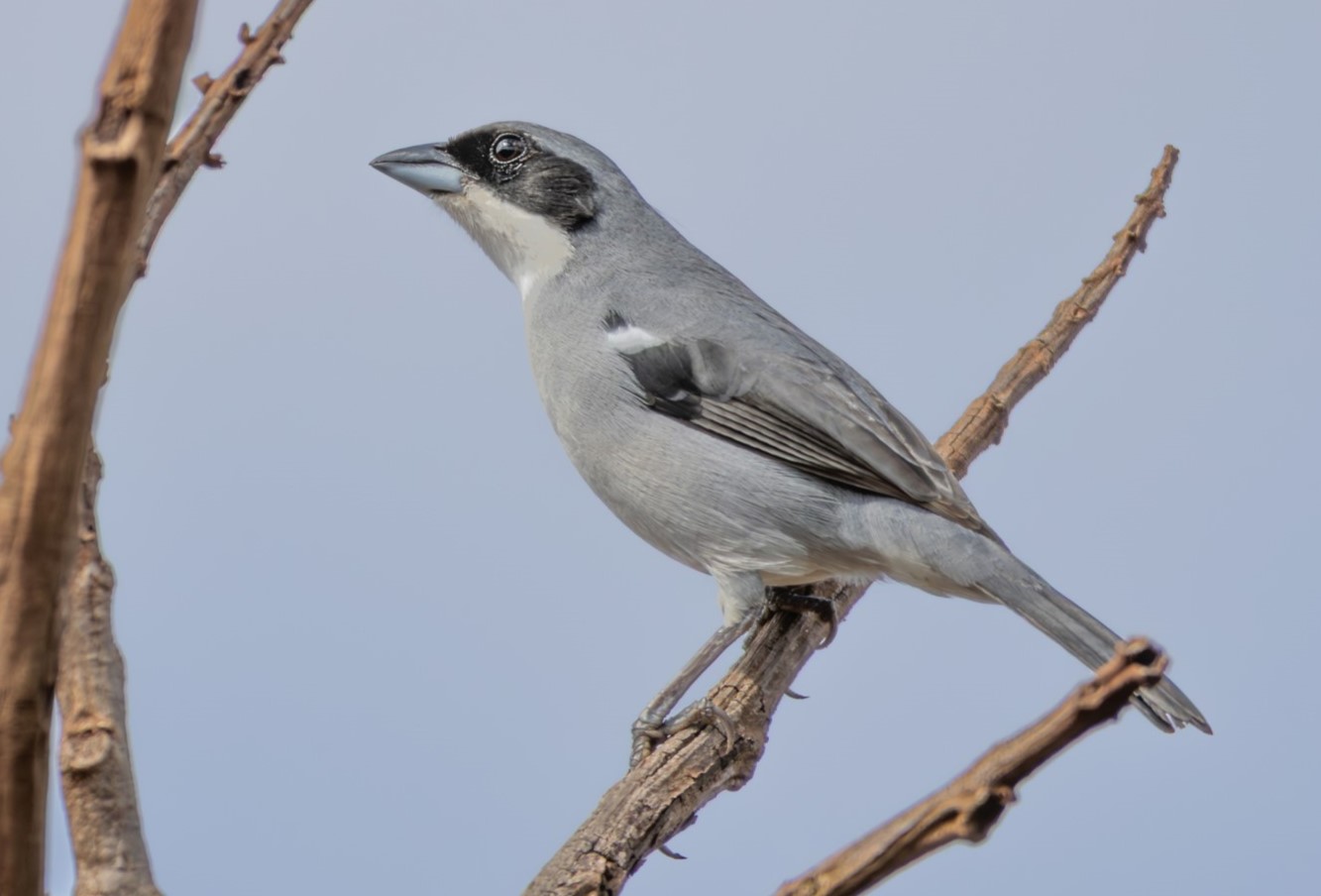
The Shrike-like Tanager is a grey tanager with a black mask from the cerrado of central South America, which in the guide area occurs only in eastern Bolivia. It perches upright on a lookout, giving it the look of a shrike, and lives in family groups that often form the core of mixed flocks in open savanna woodland.
Voice
Gives a sharp, metallic chik. The song is a loud, clear series of whistles and rattling notes, often as a duet or by the whole group at dawn.
Recording: Jacob Wijpkema — CC BY-NC-SA 4.0 · xeno-canto
Identification
16 cm, with a fairly thick, slightly hooked grey bill. The male is grey above, with a black mask from the bill through the eye to the ear coverts and a white throat. The underparts are pale grey to dirty white. The wings are blackish with a narrow white band across the lesser coverts; the tail is dark grey. The female is browner grey, with a brownish-black mask. Juveniles are browner and have an indistinct mask.
Confusion species
Black-faced Tanager Schistochlamys melanopis is grey with a black face and a black throat and lacks the white wing band. White-rumped Tanager Cypsnagra hirundinacea is black above, with a white rump and wing patch and a rufous throat.
Habitat
Open and dense cerrado, shrubby savanna grassland and savanna woodland on sandy or rocky plateaus, in the guide area at about 200 to 1000 m. It forages in groups of three to six birds in shrubs and low trees for insects and also eats fruit; other birds often join the group. The nest is an open cup in a shrub; young are also fed by helpers from earlier broods.
Where the bird is most at home, classified by the vegetation units of the Andes and the west coast.


Range and movements
Does not occur in Colombia, Ecuador, Peru or on the Galápagos. In Bolivia only in the cerrado of the east, in eastern Santa Cruz, for example on the Huanchaca plateau. Outside the guide area in central Brazil and northeastern Paraguay.
- Resident
- dark = core range, pale = thinly spread
How and when to look
Search cerrado on the Huanchaca plateau in Noel Kempff Mercado National Park; the groups often sit on top of a shrub or low tree and give themselves away in the early morning with their loud song.
Conservation status
Near Threatened. Its cerrado habitat is declining rapidly elsewhere through conversion to cropland and pasture and through fires; in Bolivia part of the range lies within a protected park.
Scientific name
Neothraupis fasciata | (Lichtenstein, 1823)
Lichtenstein described the species in 1823 as T[anagra] fasciata; because it was later moved to another genus, the author and year stand in brackets. The genus Neothraupis was introduced in 1936 by Hellmayr. The genus name comes from Greek neos, 'new', and thraupis, an unidentified small bird mentioned by Aristotle and the root of Thraupis. The species name comes from Latin fasciatus, 'banded', after the white wing bar. The specimen the first description was based on came from São Paulo, Brazil.