All species › Passerines › Tanagers and allies › Black-chested Mountain Tanager
Black-chested Mountain Tanager | Cnemathraupis eximia
Zwartborstbergtangare | Tangara montana pechinegra | Sanhaço-montanhês-de-peito-preto
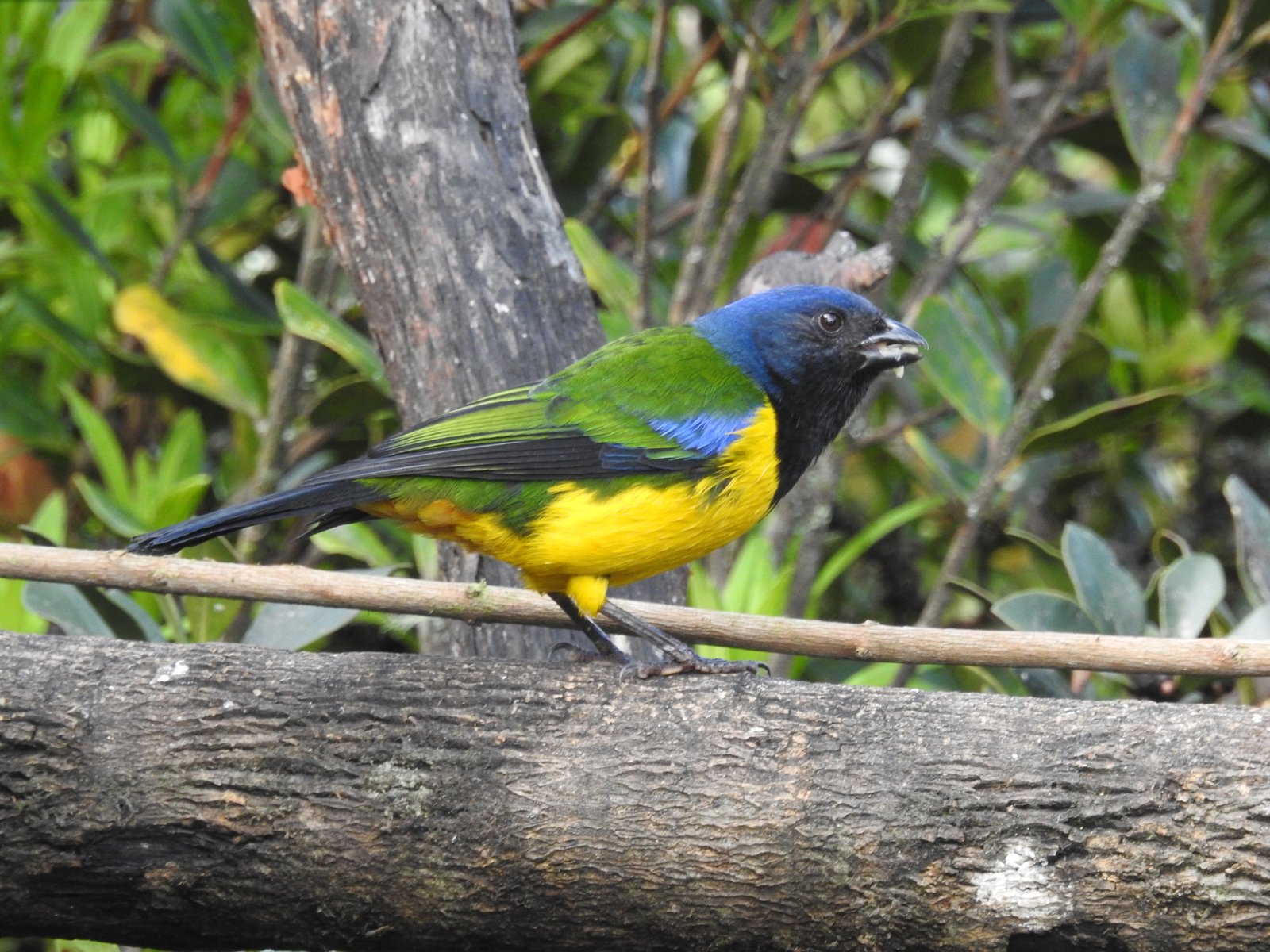
The Black-chested Mountain Tanager is a mountain tanager of the highest cloud forest and elfin forest in the northern Andes, from Colombia to northern Peru. It combines a blue crown and nape, a black throat and chest, a moss-green back and a yellow belly, and occurs locally and at low density.
Voice
Poorly documented; gives high, thin notes and a rapid chatter.
Recording: John V. Moore — CC BY-NC-SA 4.0 · xeno-canto
Identification
21 cm, with a stout black bill. The crown and nape are blue; the face, throat and chest are black. The back is moss green, the rump blue. The belly is bright yellow. The wing coverts are blue, the flight feathers and tail blackish. The eye is dark. The sexes are alike.
Confusion species
Hooded Mountain Tanager Buthraupis montana has an all-black head, a blue back, a yellow breast and red eyes. Masked Mountain Tanager Tephrophilus wetmorei has a yellow forehead and a yellow throat around a black mask. Blue-winged Mountain Tanager Anisognathus somptuosus has a yellow crown patch and a yellow throat.
Habitat
Humid elfin forest and mossy montane forest at and just below the tree line, also scrub at the edge of the páramo, mostly from about 2800 to 3600 m. It forages in pairs or small groups, often with mixed flocks, for fruit and insects. Little is known about the nest.
Where the bird is most at home, classified by the vegetation units of the Andes and the west coast.


Range and movements
In Colombia locally in the Central and Eastern Andes and in Nariño. In Ecuador locally, mainly on the eastern slope of the Andes, in the north and the south. In Peru only in the far north. Not in Bolivia or on the Galápagos. Outside the guide area in western Venezuela.
- Resident
- dark = core range, pale = thinly spread
How and when to look
Search elfin forest just below the tree line in the early morning, when small groups forage along the forest edge and in mossy scrub.
Conservation status
Least Concern. Local and usually scarce; sensitive to loss of forest at the tree line.
Scientific name
Cnemathraupis eximia | (Boissonneau, 1840)
Boissonneau described the species in 1840 as Tanagra eximia; because it was later moved to another genus, the author and year stand in brackets. The genus Cnemathraupis was introduced in 1919 by Penard. The genus name combines Greek knēmē, 'leg, shin', with thraupis, an unidentified small bird. The species name is Latin eximius, 'exceptional' or 'distinguished'. The specimen the first description was based on came from Bogotá, Colombia.