All species › Passerines › Tanagers and allies › Black-hooded Sierra Finch
Black-hooded Sierra Finch | Phrygilus atriceps
Zwartkapsierragors | Yal cabecinegro | Tico-tico-de-capuz-preto
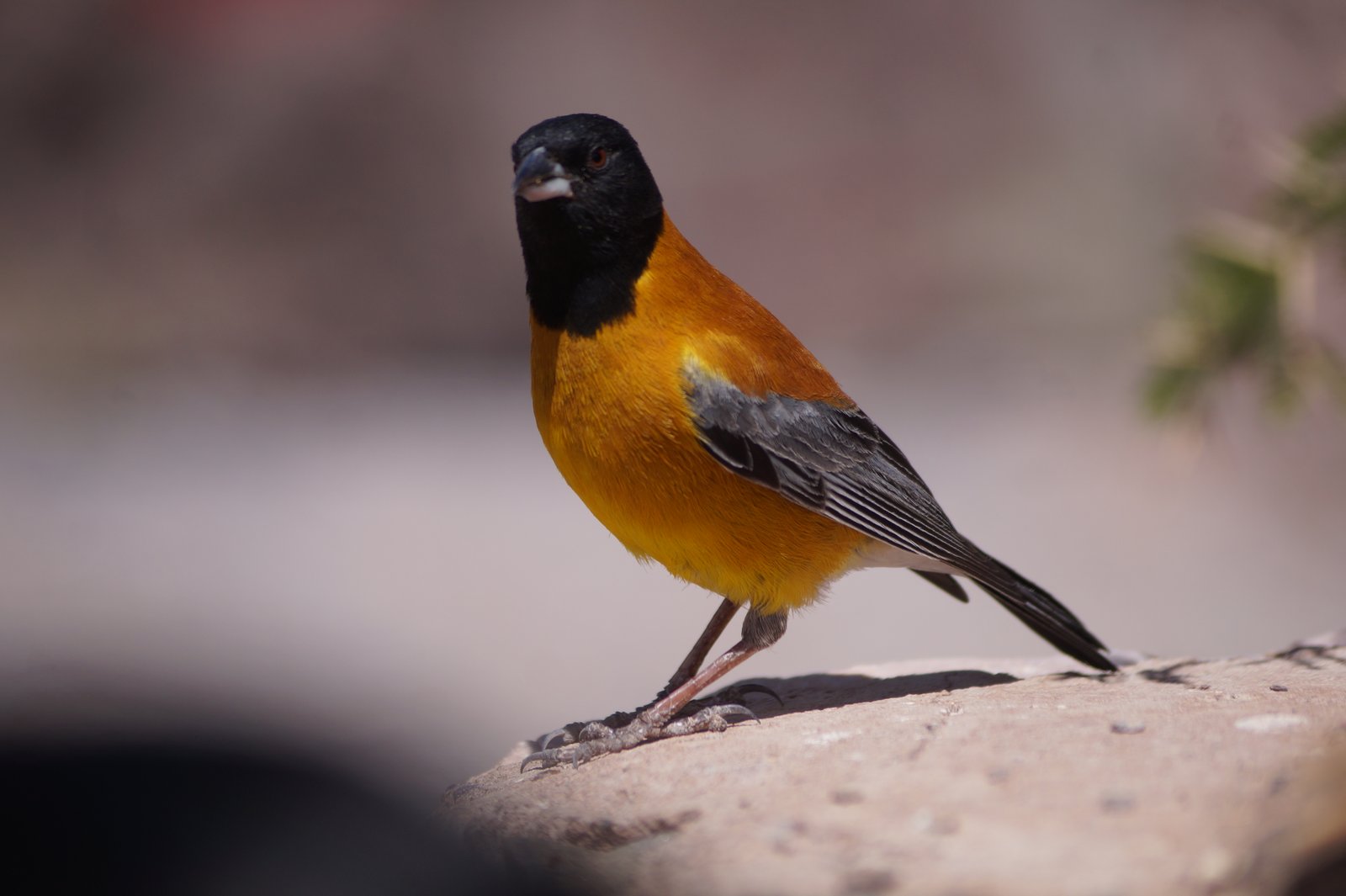
The Black-hooded Sierra Finch is a sturdy finch of dry puna and dry valleys in the south-west of the guide area, with a black hood, a golden-brown back and yellow underparts. It is one of three closely related sierra finches with a dark or grey hood and a yellow breast. Outside the breeding season it forms flocks around villages and fields.
Voice
The song is a short, rather hoarse series of twittering and whistled notes, often from a rock or shrub. The call is a metallic tchip.
Recording: Fernando Medrano — CC BY-NC-SA 4.0 · xeno-canto
Identification
15–16 cm, with a conical grey bill. The male has a black head, throat and upper breast. The mantle is golden-brown to rufous-brown, and the rump grey. The breast and belly are bright golden yellow, the lower belly and undertail coverts whitish. The wings and tail are grey with dark centres. The female is duller: the hood is brownish-black to dark grey, the back browner and the underparts paler yellow. Juveniles have a brownish hood and are faintly streaked above and below.
Confusion species
Peruvian Sierra Finch Phrygilus punensis has a grey rather than black hood and an olive-brown back, and lives further north and east, in more humid puna. Grey-hooded Sierra Finch Phrygilus gayi also has a grey hood and occurs in the guide area only as a vagrant at most. Mourning Sierra Finch Rhopospina fruticeti is grey and black, with white wing bars and a yellow bill. Yellow finches (Sicalis) have a yellow head.
Habitat
Scrub and shrubby slopes of the dry puna, Polylepis groves, rocky ravines, fields, terraces and villages, roughly between 2500 and 4500 m. It feeds on the ground and in shrubs on seeds and insects; outside the breeding season in small flocks, sometimes with other finches. The nest is placed in a shrub or a rock crevice.
Where the bird is most at home, classified by the vegetation units of the Andes and the west coast.


Range and movements
In Peru in the south-west, in Arequipa, Moquegua, Tacna and western Puno. In Bolivia on the altiplano and in the dry Andean valleys of the west, in La Paz, Oruro and Potosí. Absent from Colombia, Ecuador and the Galápagos. Outside the guide area in northern Chile and north-western Argentina.
- Resident
- dark = core range, pale = thinly spread
How and when to look
Look around villages, stone walls and fields on the altiplano and in the canyons of Arequipa, such as the Colca Valley. Flocks often feed in farmyards and along paths.
Conservation status
Least Concern. Fairly common; the species does well in small-scale farmland.
Scientific name
Phrygilus atriceps | (d'Orbigny, ACVMD & de Lafresnaye, 1837)
D'Orbigny, ACVMD & de Lafresnaye described the species in 1837 as Emberiza atriceps; because it was later moved to another genus, the author and year stand in brackets. The genus Phrygilus was introduced in 1844 by Cabanis. The genus name comes from Ancient Greek phrugilos, an unidentified bird mentioned by Aristophanes. The species name comes from Latin ater, 'black', and -ceps, '-headed', referring to the black hood. The specimen the first description was based on came from Tacora, Arica, Chile.