All species › Passerines › New World warblers › Black-lored Yellowthroat
Black-lored Yellowthroat | Geothlypis auricularis
Zwartteugelmaskerzanger | Mascarita lorinegra | Pia-cobra-de-loro-preto
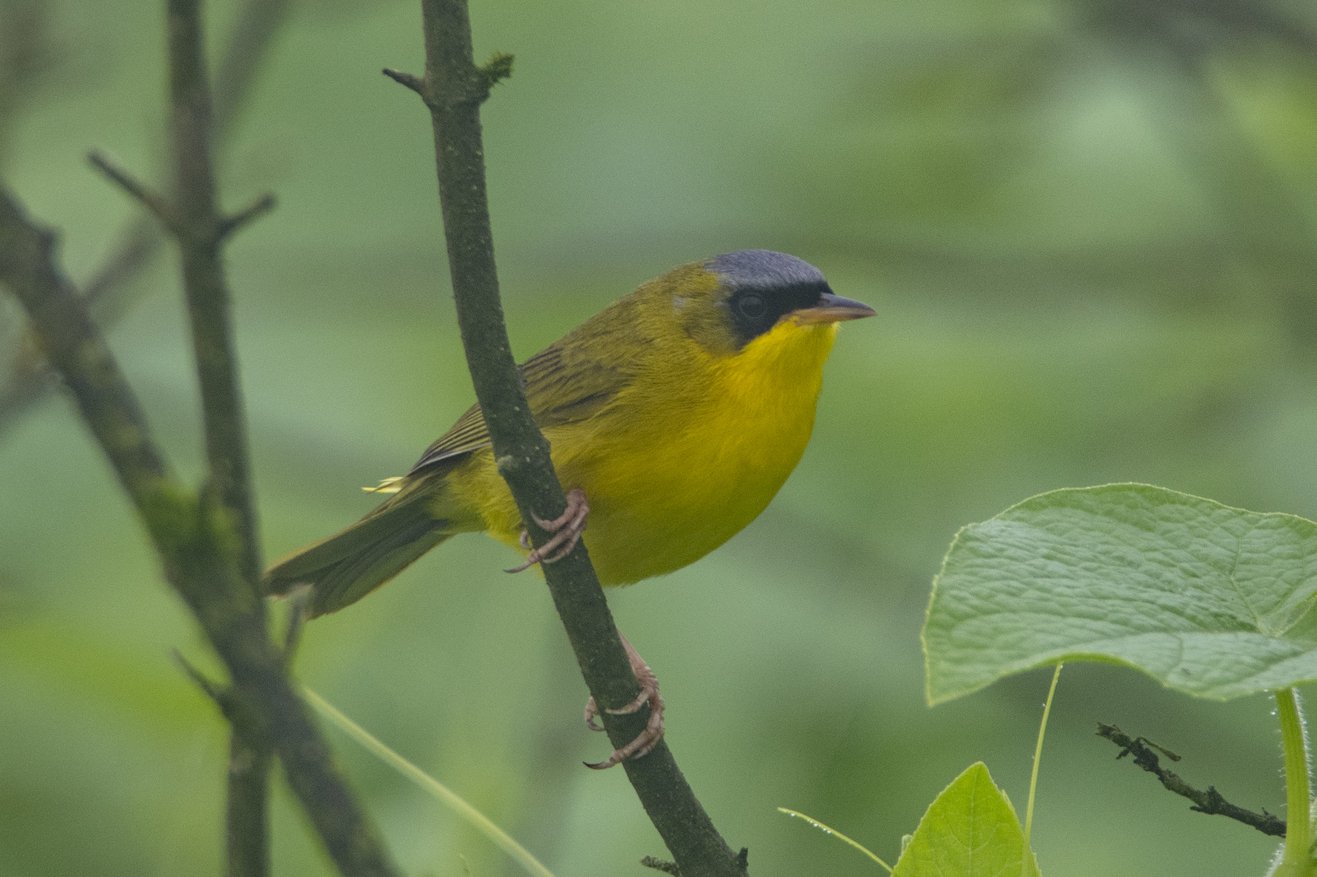
The Black-lored Yellowthroat is a yellow yellowthroat of the wet lowlands west of the Andes in Ecuador and Peru. It was formerly included in Masked Yellowthroat and looks very similar, but the black on the male's face is more restricted. It lives in reedbeds, marshes and rice fields, also in the oases of the Peruvian coastal desert.
Voice
The song is a fast, clear, warbling series of whistled notes, often given from a reed stem or shrub. The call is a sharp chip.
Recording: Juan Freile — CC BY-NC-SA 4.0 · xeno-canto
Identification
13–14 cm, with a fairly long, rounded tail and a stout bill. The male is olive-green above and bright yellow below, with black on the forehead, lores and around the eye; this mask is smaller than in related species and is bordered above by a greyish crown. The female has no mask, an olive head with a yellowish eye-ring and lores, and yellow underparts. Young birds resemble the female.
Confusion species
Olive-crowned Yellowthroat Geothlypis semiflava, in humid north-western Ecuador, has a large black mask reaching well over the forehead and ear coverts, without a grey border, and an olive crown. Common Yellowthroat Geothlypis trichas is possible as a vagrant and has a whitish border above the mask and a whitish belly. Southern Yellowthroat Geothlypis velata and Masked Yellowthroat Geothlypis aequinoctialis live east of the Andes.
Habitat
Reedbeds, marshes and lagoons with fringing vegetation, rice fields, rank growth along irrigation canals and rivers in the coastal valleys, and humid scrub, mainly in the lowlands, locally higher in the valleys. It forages low in the vegetation for insects and spiders. The nest is an open cup, low in dense vegetation.
Where the bird is most at home, classified by the vegetation units of the Andes and the west coast.


Range and movements
In Ecuador in the western lowlands, mainly in the dry and semi-arid south-west. In Peru in the coastal valleys and oases of the west, from Tumbes south to at least the department of Lima. Absent from the Galápagos and Bolivia; not known with certainty from Colombia. Endemic to the guide area.
- Resident
- dark = core range, pale = thinly spread
How and when to look
Search reed fringes, irrigation canals and rice fields in the coastal valleys of northern Peru or south-western Ecuador. In the morning males sing from a stem at the edge of the reeds.
Conservation status
Least Concern. The species tolerates irrigated farmland but depends on wet patches; drainage of marshes and lagoons locally affects its habitat.
Scientific name
Geothlypis auricularis | Salvin, 1883
Salvin described the species in 1883 and placed it straight away in the genus where it still stands. The genus Geothlypis was introduced in 1847 by Cabanis. The genus name combines Greek geō-, 'ground-, earth-', with thlupis, an unidentified small bird. The species name comes from Latin auricularis, 'of the ear', after the black patch around the eye and ear region. The specimen the first description was based on came from Callao, Peru.