All species › Passerines › New World warblers › Kentucky Warbler
Kentucky Warbler | Geothlypis formosa
Kentuckyzanger | Reinita de Kentucky | Mariquita-do-kentucky
The Kentucky Warbler is a North American warbler that lives on and just above the forest floor. It winters mainly from Mexico to Panama; northern Colombia lies at the southern edge of its winter range. There it is a scarce winter visitor in the undergrowth of humid forest.
Voice
In winter mainly a low, hard, rather hollow chup, often from dense undergrowth. The song, a rolling churry-churry-churry, is rarely heard on the wintering grounds.
Recording: Sue Riffe — CC BY-NC-SA 4.0 · xeno-canto
Identification
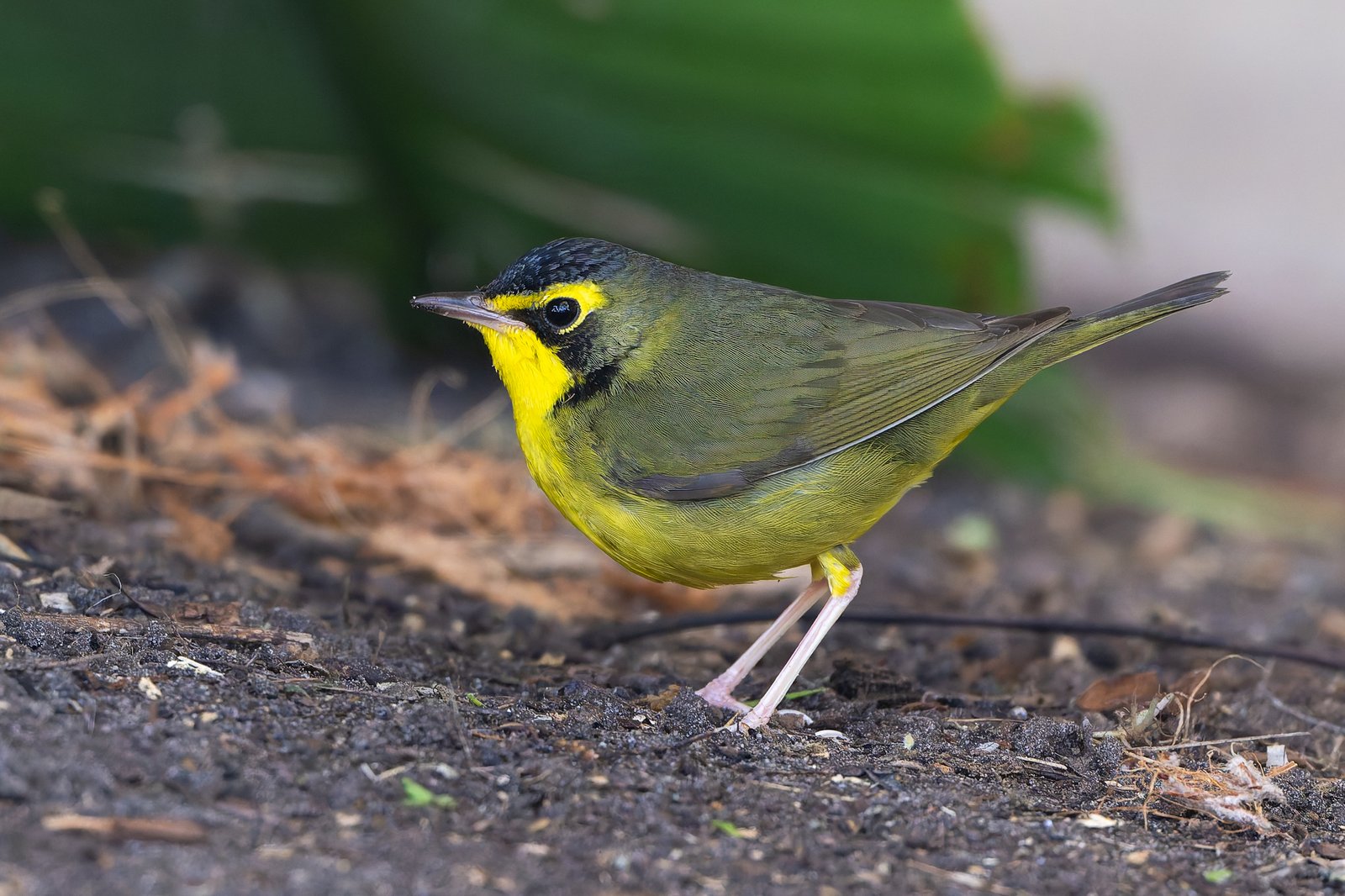
13 cm, with a rather short tail and long, pink legs. The upperparts are plain olive-green, the underparts bright yellow. A yellow supercilium curls around the eye, forming spectacles. The forecrown and a broad, drooping patch below the eye are black. In the female the black is smaller and duller. First-winter birds show even less black, but the yellow spectacles are always visible.
Confusion species
Mourning Warbler Geothlypis philadelphia has a grey hood without yellow spectacles or a black cheek patch. Masked Yellowthroat Geothlypis aequinoctialis has a black mask through the eye and no yellow supercilium, and lives in grassland rather than forest. Female Hooded Warbler Setophaga citrina has a yellow face without a black cheek patch and white spots in the tail. Canada Warbler Cardellina canadensis is grey above, with a streaked necklace.
Habitat
In winter in the undergrowth of humid lowland forest, old secondary forest and forest edges, also in shade coffee and cacao, from sea level to about 1500 m. It walks on the ground and through low shrubs, turning dead leaves and taking insects and spiders; in winter it often holds its own territory. It does not breed in the guide area.
Where the bird is most at home, classified by the vegetation units of the Andes and the west coast.


Range and movements
Winter visitor, mainly September to April. In Colombia scarce in the north: the Caribbean lowlands, the Sierra Nevada de Santa Marta, the Serranía de Perijá and the northern Magdalena Valley and Chocó. In Ecuador exceptional at most. Absent from Peru, Bolivia and the Galápagos. Breeds in the south-eastern United States and winters from Mexico to northern Colombia and north-western Venezuela.
- Winter visitor (c. Oct–Mar)
- dark = core range, pale = thinly spread
How and when to look
In humid forest in northern Colombia, listen for a low, hard call from the undergrowth; the bird often walks over the leaf litter and stays hidden behind dense shrubs. Wait quietly near an open patch of forest floor.
Conservation status
Least Concern. The North American population has declined over recent decades; fragmentation of forest on both breeding and wintering grounds plays a part.
Scientific name
Geothlypis formosa | (Wilson, 1811)
Wilson described the species in 1811 as Sylvia formosa; because it was later moved to another genus, the author and year stand in brackets. The genus Geothlypis was introduced in 1847 by Cabanis. The genus name combines Greek geō-, 'ground-, earth-', with thlupis, an unidentified small bird. The species name comes from Latin formosus, 'handsome, well-formed'. The specimen the first description was based on came from Kentucky, United States.