All species › Passerines › New World warblers › Olive-crowned Yellowthroat
Olive-crowned Yellowthroat | Geothlypis semiflava
Groenkruinmaskerzanger | Mascarita coronioliva | Pia-cobra-de-coroa-oliva
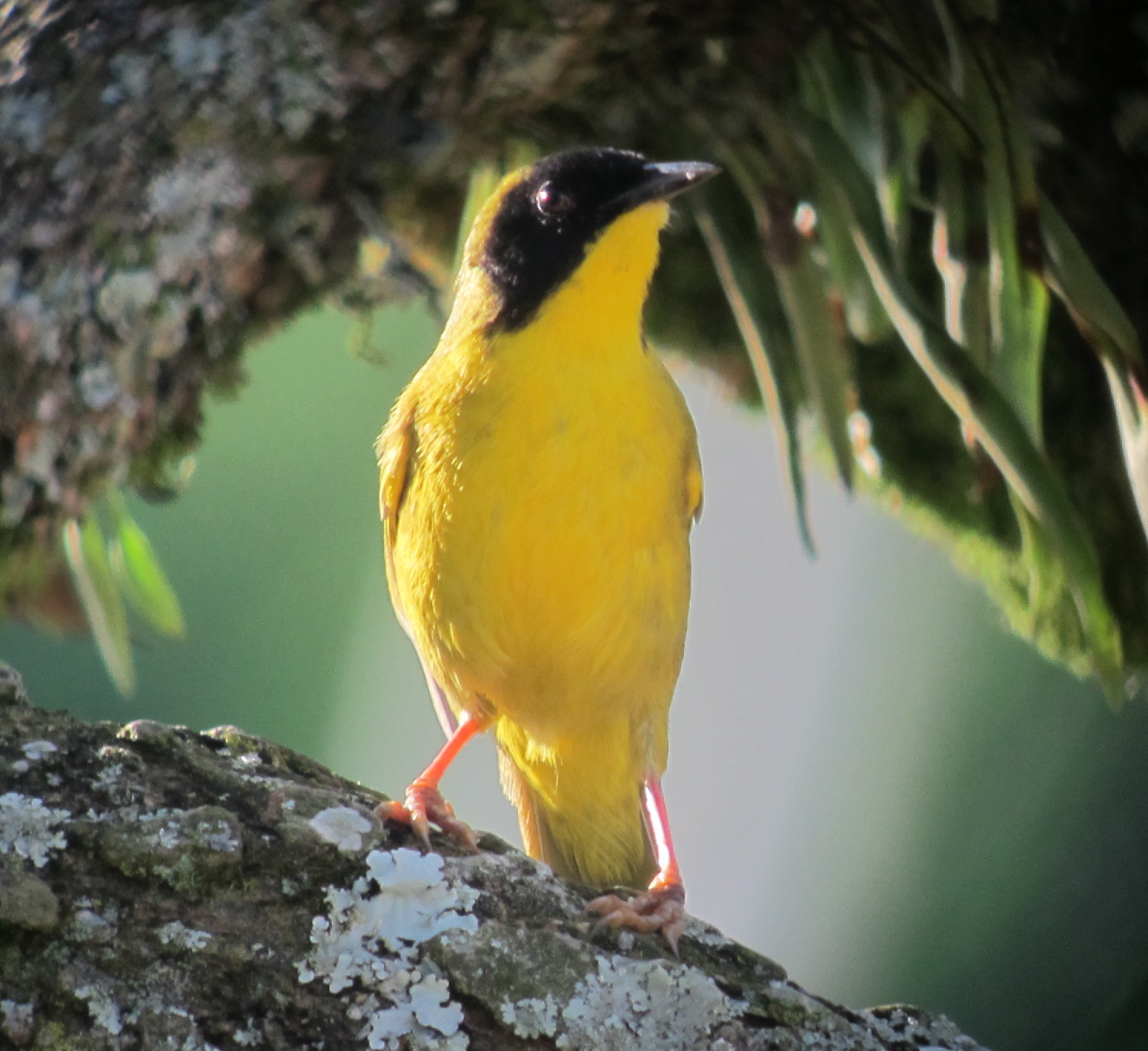
The Olive-crowned Yellowthroat is a resident of wet, rank grassland on the Pacific side of Colombia and Ecuador. The male has a broad black mask that merges directly into an olive crown, without a grey or white border. It sings often, frequently from a tall grass stem or a small shrub.
Voice
The song is a long, fast, richly varied series of whistled and twittering notes, longer and fuller than in the other yellowthroats of the guide area. The call is a dry chet.
Recording: Natasza Fontaine — CC BY-NC-SA 4.0 · xeno-canto
Identification
13–14 cm, with a rather long, rounded tail. The male has a broad black mask from forehead to ear coverts; crown and nape are olive, without a grey tone. The upperparts are olive-green, the underparts entirely bright yellow, with olive flanks. The female lacks the mask and has an olive-yellow face with a faint pale eye-ring; the underparts are yellow. Young birds resemble the female.
Confusion species
Male Masked Yellowthroat Geothlypis aequinoctialis has a grey crown and a grey border above the mask. Black-lored Yellowthroat Geothlypis auricularis has a narrower black mask and a grey crown, and lives in drier areas of south-western Ecuador and north-western Peru. Male Common Yellowthroat Geothlypis trichas has a whitish band above the mask and a white belly. Females of these species are very similar; check the head colour and the company they keep.
Habitat
Tall, wet grass, damp pastures, marsh edges, rank growth along ditches and rivers, reedbeds and overgrown fields, mainly in the lowlands and foothills, up to about 1500 m and locally higher. It forages low in the vegetation for insects. The nest is an open cup low in dense grass or scrub.
Where the bird is most at home, classified by the vegetation units of the Andes and the west coast.


Range and movements
Resident. In Colombia in the lowlands and foothills on the Pacific side, from Chocó to Nariño, and locally in adjacent valleys. In Ecuador in the western lowlands and foothills, south to the south-west of the country. Absent from Peru, Bolivia and the Galápagos. Outside the guide area in Central America, from Honduras to Panama.
- Resident
- dark = core range, pale = thinly spread
How and when to look
In the western lowlands, listen along wet pastures and rank grass for the long song; males often sing from a projecting grass stem or a low shrub, especially in the morning.
Conservation status
Not evaluated in this circumscription. The species is common within its range and benefits from deforestation, as open, damp grassland and rank growth increase.
Scientific name
Geothlypis semiflava | Sclater, 1860
Sclater described the species in 1860 and placed it straight away in the genus where it still stands. The genus Geothlypis was introduced in 1847 by Cabanis. The genus name combines Greek geō-, 'ground-, earth-', with thlupis, an unidentified small bird. The species name combines Latin semi-, 'half', and flavus, 'yellow'. The specimen the first description was based on came from Babahoyo, Ecuador.