All species › Tubenoses › Petrels, shearwaters and diving petrels › Black Petrel
Black Petrel | Procellaria parkinsoni
Zwarte stormvogel | Petrel de Parkinson | Pardela-de-parkinson
The Black Petrel is the smallest Procellaria petrel and breeds only on Great Barrier and Little Barrier, two islands off the North Island of New Zealand. Outside the breeding season almost the entire world population moves to the tropical eastern Pacific. It then occurs in the waters around the Galápagos and off the coasts of Ecuador and Peru.
Voice
Silent at sea. At the breeding sites it gives clacking and cackling calls at night.
Recording: Dan Lane — CC BY-NC-SA 4.0 · xeno-canto
Identification
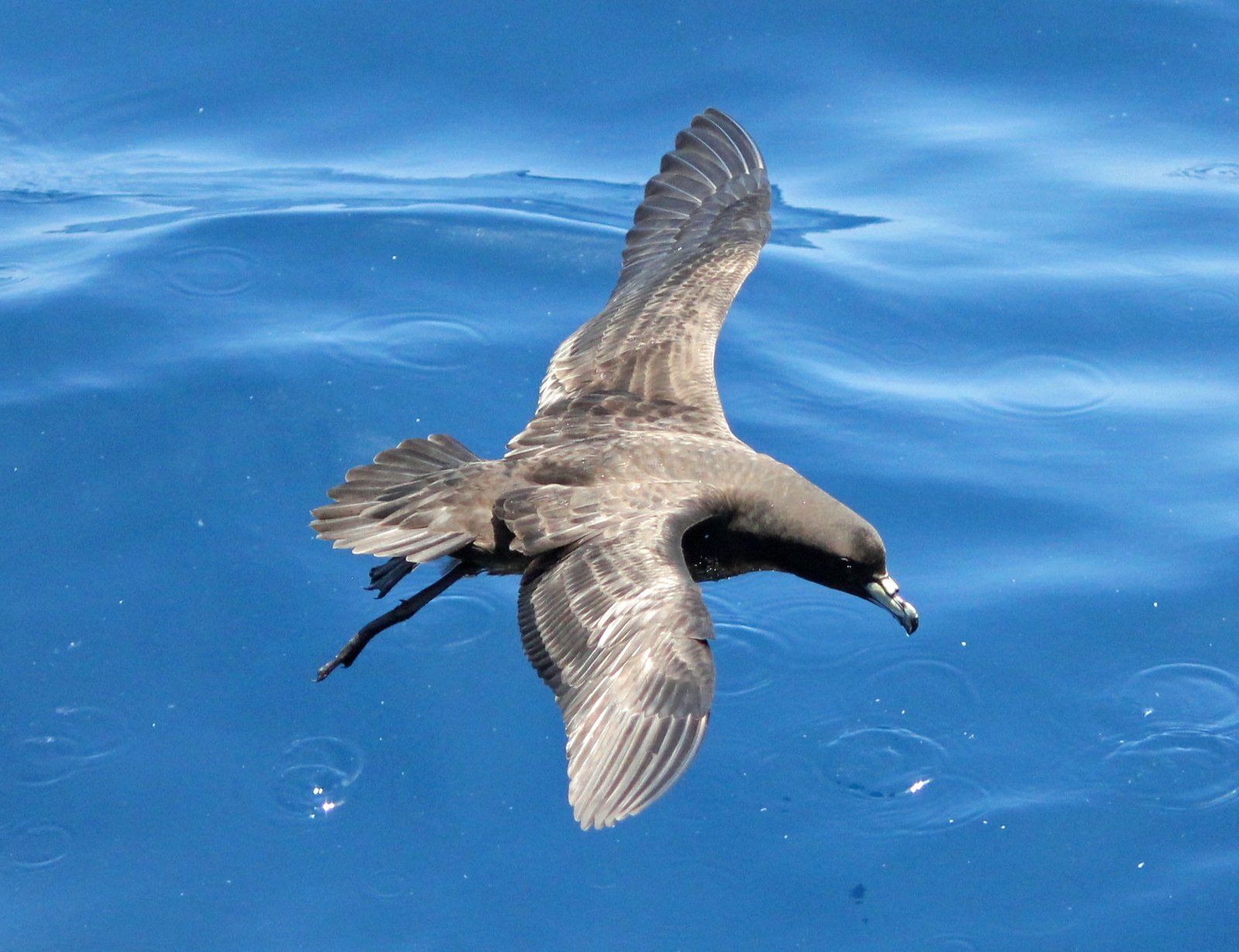
46 cm, a medium-sized, all blackish-brown petrel, slimmer than its relatives, with a pale, yellowish bill with a dark tip and black legs. The underwing is dark, with a pale sheen at the base of the primaries. It flies with fairly fast wingbeats and glides, more lightly than the larger Procellaria species. The sexes are alike; juveniles resemble adults.
Confusion species
Westland Petrel Procellaria westlandica and White-chinned Petrel Procellaria aequinoctialis are clearly larger and heavier, with a stouter bill; White-chinned Petrel lacks the dark bill tip. Dark Wedge-tailed Shearwaters Ardenna pacifica are slimmer, with a longer, wedge-shaped tail and a slender grey bill. Sooty Shearwater Ardenna grisea has a dark bill and a silvery-white underwing.
Habitat
Open ocean, especially warmer, tropical waters far offshore. It feeds on squid, fish and crustaceans, picked from the surface or caught in shallow dives, and sometimes follows dolphins, schools of tuna and fishing boats. It breeds in burrows in forest soil on two islands of New Zealand.
Where the bird is most at home, classified by the vegetation units of the Andes and the west coast.


Range and movements
Outside the breeding season at sea around the Galápagos and off the coast of Ecuador and northern Peru, scarcer off the Pacific coast of Colombia. Absent from Bolivia. It does not breed in the guide area. Outside the guide area it breeds in New Zealand; outside the breeding season in the eastern Pacific from Mexico to Peru.
- Resident
- Winter visitor (c. Oct–Mar)
- dark = core range, pale = thinly spread
How and when to look
On pelagic trips off Ecuador and between the Galápagos and the mainland between May and October; often with other petrels over schools of fish and dolphins.
Conservation status
Vulnerable. The world population is small and breeds on two islands. Bycatch in fisheries, both around New Zealand and in the wintering area, and introduced predators on the breeding islands are the main threats.
Scientific name
Procellaria parkinsoni | Gray, 1862
Gray described the species in 1862 and placed it straight away in the genus where it still stands. The genus Procellaria was introduced in 1758 by Linnaeus. The genus name comes from Latin procella, 'storm, gale'. The species name honours Sydney Parkinson (c. 1745–1771), Scottish natural history artist on James Cook's first voyage. The specimen the first description was based on came from New Zealand.