All species › Tubenoses › Petrels, shearwaters and diving petrels › Wedge-tailed Shearwater
Wedge-tailed Shearwater | Ardenna pacifica
Wigstaartpijlstormvogel | Pardela del Pacífico | Bobo-de-cauda-cunha
The Wedge-tailed Shearwater is a large, slender shearwater of the tropical Indian Ocean and Pacific, with a long, wedge-shaped tail. It breeds on tropical islands from Hawaii to the Revillagigedo Islands off Mexico. In the guide area it is a scarce visitor far offshore, mainly in the warm waters around the Galápagos and off the north.
Voice
Silent at sea. At the breeding sites it gives drawn-out moaning and wailing calls at night.
Recording: Sreekar — CC BY-NC-SA 4.0 · xeno-canto
Identification
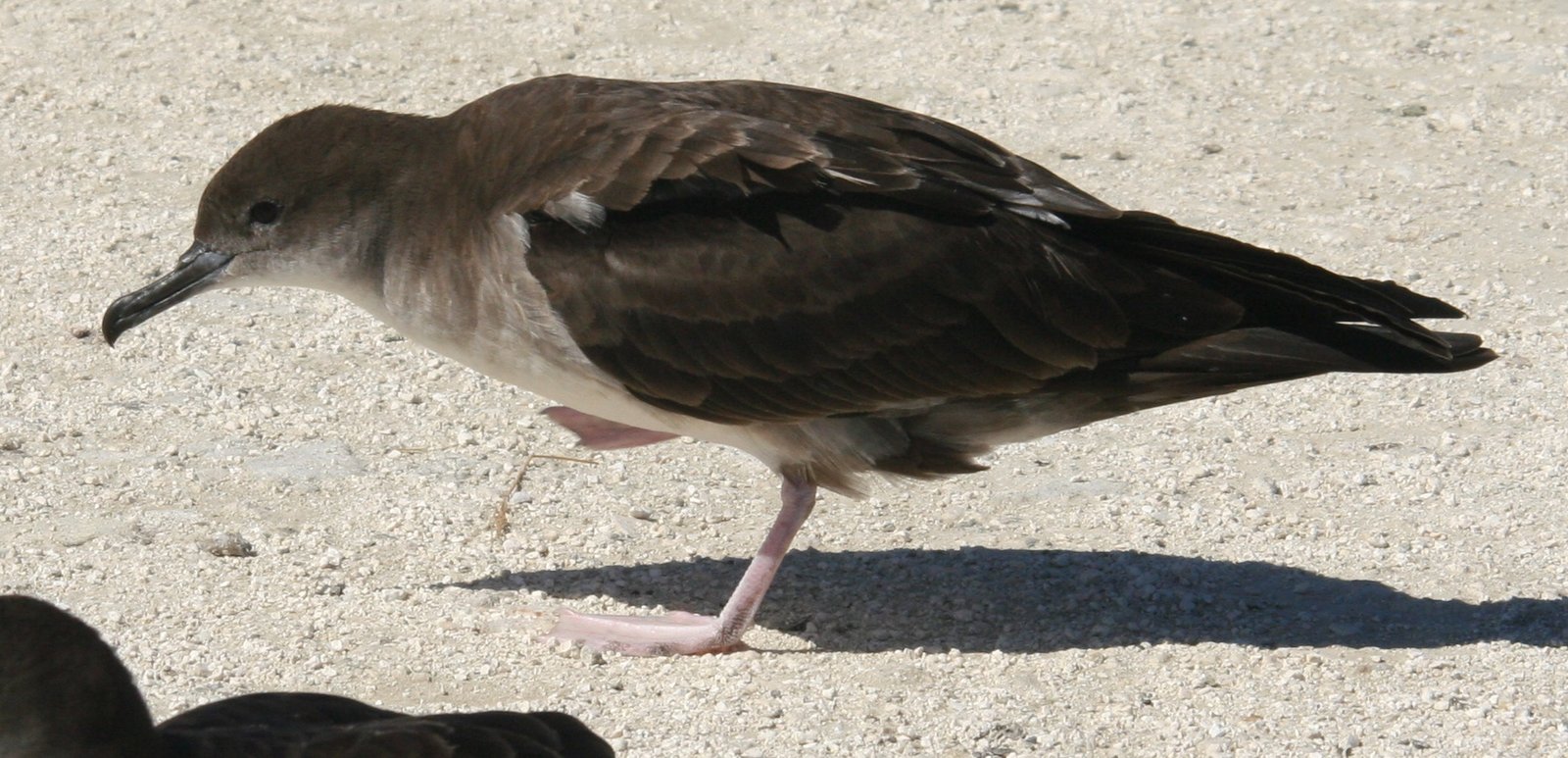
41–46 cm, a slender shearwater with long, broad wings often held bowed forward, a long, wedge-shaped tail and a slender grey bill. There is a dark morph, uniform dark greyish brown, and a pale morph with greyish-brown upperparts and white underparts and underwing with dark borders; both occur in the eastern Pacific. The legs are flesh-coloured. It flies in a relaxed way, with slow wingbeats and long glides low over the water. The sexes are alike.
Confusion species
Sooty Shearwater Ardenna grisea has a shorter, rounded tail, a dark bill, a silvery-white underwing and faster, stiffer wingbeats. Black Petrel Procellaria parkinsoni is more heavily built, with a shorter tail and a pale, dark-tipped bill. Pink-footed Shearwater Ardenna creatopus has a pink, dark-tipped bill, a shorter tail and mottled grey flanks. Buller's Shearwater Ardenna bulleri has a dark M across the grey upperparts and a clean white underwing.
Habitat
Warm, tropical open ocean, usually far offshore, often over schools of tuna and dolphins that drive small fish to the surface. It feeds on fish and squid, picked from the surface in flight or while swimming. It breeds in colonies in burrows in sand or under shrubs on tropical islands.
Where the bird is most at home, classified by the vegetation units of the Andes and the west coast.

Range and movements
At sea in the warm waters around the Galápagos and off the Pacific coast of Colombia and Ecuador, usually far offshore; rare off northern Peru. Absent from Bolivia. It does not breed in the guide area. Outside the guide area it breeds on islands in the tropical Indian Ocean and Pacific, including Hawaii and the Revillagigedo Islands.
- Resident
- dark = core range, pale = thinly spread
How and when to look
On pelagic trips far off Ecuador or between the Galápagos and the mainland; search over groups of dolphins and feeding tuna.
Conservation status
Least Concern. The world population is large. Introduced rats and cats and disturbance on breeding islands are local threats.
Scientific name
Ardenna pacifica | (Gmelin, 1789) (GBIF: Puffinus pacificus)
Gmelin described the species in 1789 as Procellaria pacifica; because it was later moved to another genus, the author and year stand in brackets. The genus Ardenna was introduced in 1853 by Reichenbach. The genus name is a Late Medieval Latin name that Aldrovandi used in 1603 for the 'Diomedean birds'. Ardènna and Artènna are Italian dialect names for a shearwater, according to Capponi based on ardea, 'heron'. The species name refers to the Pacific Ocean, Latin pacificus. The specimen the first description was based on came from Kermadec Islands, New Zealand.