All species › Tubenoses › Petrels, shearwaters and diving petrels › Buller's Shearwater
Buller's Shearwater | Ardenna bulleri
Bullers pijlstormvogel | Pardela de Buller | Pardela-de-buller
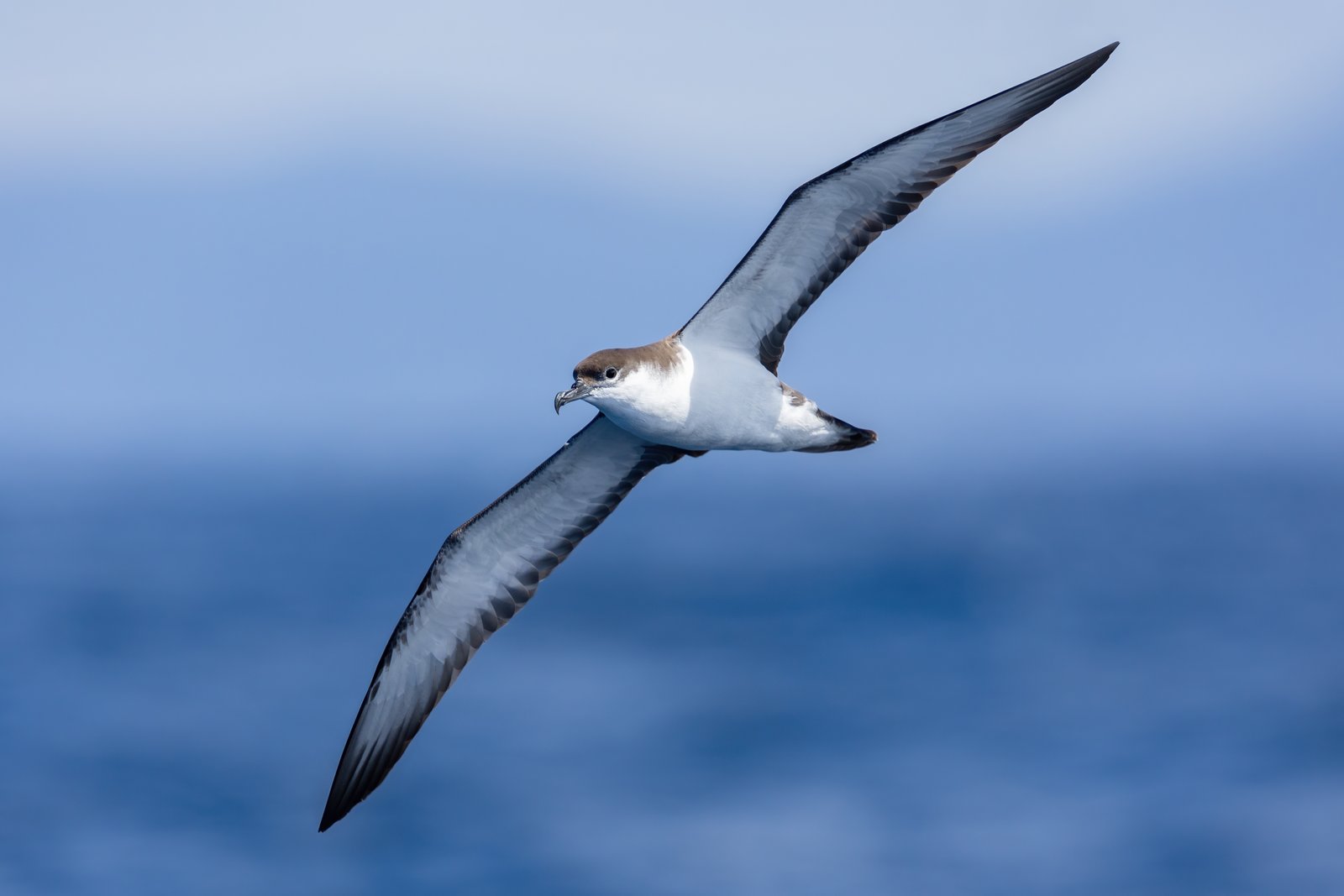
Buller's Shearwater is a medium-sized shearwater with grey upperparts, a dark M across the wings and pure white underparts. The entire world population breeds on one island group, the Poor Knights Islands off northern New Zealand. Outside the breeding season it migrates to the North Pacific; in the guide area it is a rare visitor far offshore.
Voice
Silent at sea. At the breeding colonies it gives wailing and moaning calls at night.
Recording: Alex Lin-Moore — CC BY-NC-SA 4.0 · xeno-canto
Identification
46–47 cm, a slender shearwater with long, narrow wings, a long, wedge-shaped dark tail and a slender grey bill with a dark tip. The crown and hindneck are dark and form a cap reaching below the eye. The mantle, back and inner wing are pale grey; a broad blackish band runs from the primaries across the wing coverts and back, forming a clear M. The underparts and underwing are pure white, the underwing with a narrow dark border. The legs are flesh-coloured. It flies lightly and buoyantly, with long glides and few wingbeats. The sexes are alike; juveniles resemble adults.
Confusion species
Pink-footed Shearwater Ardenna creatopus is heavier, with grey-brown upperparts without a sharp M, a pink, dark-tipped bill, mottled flanks and an underwing with broad dark margins. The light morph of Wedge-tailed Shearwater Ardenna pacifica is plain grey-brown above without an M. Juan Fernandez Petrel Pterodroma externa also has a dark M but is stockier, with a short, thick black bill, a white forehead and a high, arcing flight.
Habitat
Open ocean, usually far offshore over deep water, sometimes at the edge of the Humboldt Current. It feeds on small fish, squid and crustaceans, taken from the surface while swimming or in short dives, and sometimes joins flocks of other seabirds over feeding fish. It breeds in colonies in burrows in the forest floor of the Poor Knights Islands.
Where the bird is most at home, classified by the vegetation units of the Andes and the west coast.


Range and movements
In Peru a rare visitor far offshore, with scattered records off the centre and south. A single record from Ecuador; not known with certainty from Colombia or the Galápagos. Absent from Bolivia. It does not breed in the guide area. Outside the guide area it breeds on the Poor Knights Islands (New Zealand); outside the breeding season in the North Pacific from Japan to off California, and in smaller numbers off Chile.
How and when to look
Only to be expected on pelagic trips far off Peru; a sighting cannot be predicted. Look for the pale grey upperparts with the dark M and the light, buoyant flight.
Conservation status
Vulnerable. The world population is large but breeds on a single island group. After feral pigs were removed in the 1930s the population increased strongly. Introduced predators, fire and changes in food supply at sea are the main risks.
Scientific name
Ardenna bulleri | (Salvin, 1888) (GBIF: Puffinus bulleri)
Salvin described the species in 1888 as Puffinus bulleri; because it was later moved to another genus, the author and year stand in brackets. The genus Ardenna was introduced in 1853 by Reichenbach. The genus name is a Late Medieval Latin name that Aldrovandi used in 1603 for the 'Diomedean birds'. Ardènna and Artènna are Italian dialect names for a shearwater, according to Capponi based on ardea, 'heron'. The species name honours Walter Lawry Buller (1838–1906), New Zealand lawyer and ornithologist. The specimen the first description was based on came from New Zealand.