All species › Passerines › New World sparrows › Black-striped Sparrow
Black-striped Sparrow | Arremonops conirostris
Panamagors | Cerquero negrilistado | Tico-tico-de-listra-preta
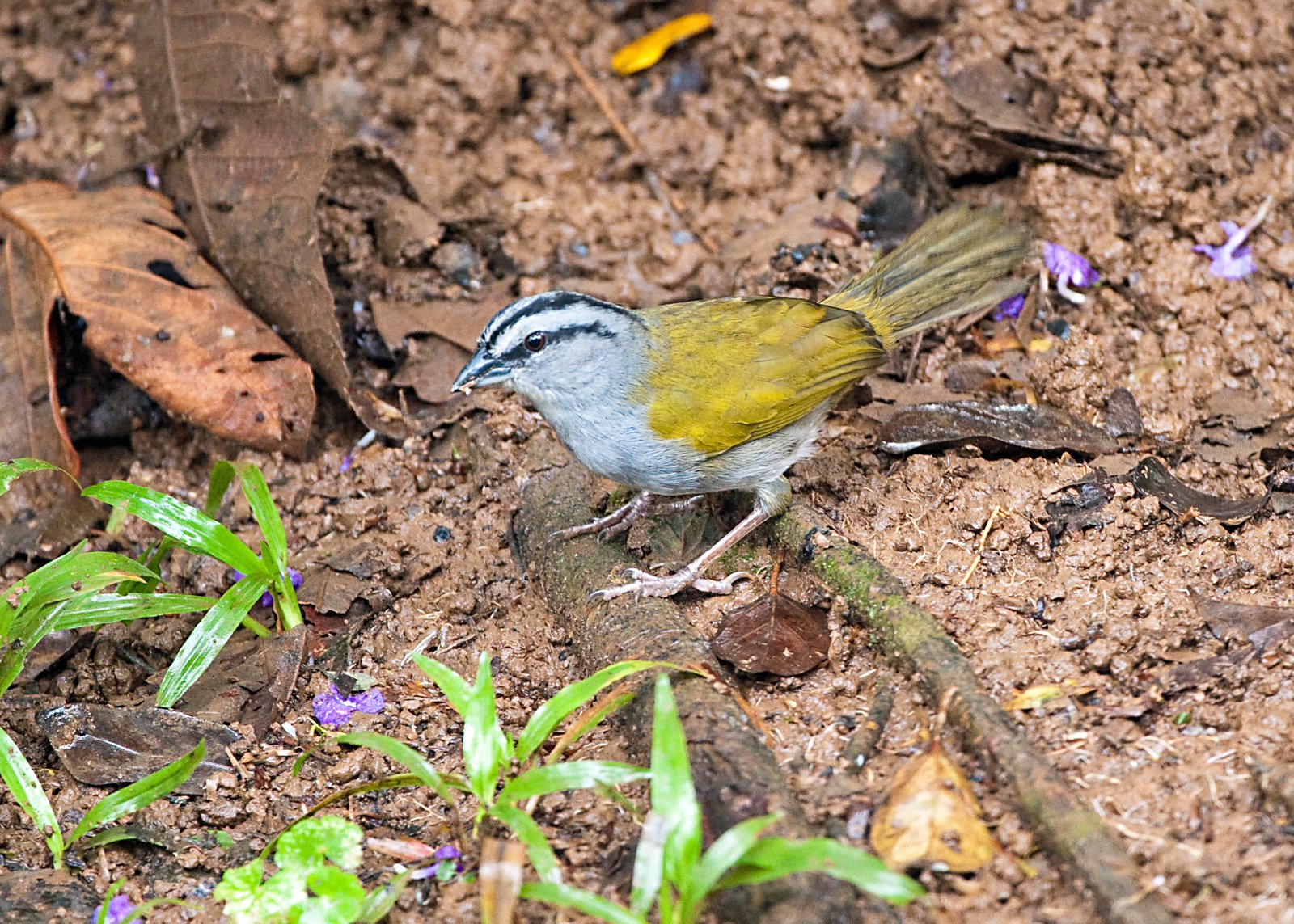
The Black-striped Sparrow is a fairly large, olive-green sparrow with a grey head and black head stripes, living in scrub and forest edge in the lowlands. It keeps to dense vegetation, but gives itself away by its accelerating song. The range extends from Central America to western Ecuador and the far north-west of Peru.
Voice
The song is a series of clear, whistled notes that speed up, like a bouncing ball; also a repeated, hollow hoo-hoo-hoo. The call is a short chip.
Recording: Stephan Risch — CC BY-NC-SA 4.0 · xeno-canto
Identification
16–17 cm, with a heavy, conical, dark bill. The head is grey, with broad black lateral crown stripes and a black eyestripe. The upperparts are olive-green. The throat and belly are whitish, the breast and flanks grey, with an olive or buff tinge towards the rear. There is yellow at the bend of the wing. The sexes are alike. Juveniles are duller, with browner head stripes.
Confusion species
Tocuyo Sparrow Arremonops tocuyensis is smaller and paler, with browner head stripes and a browner back, and lives in dry scrub in La Guajira. Orange-billed Sparrow Arremon aurantiirostris has a black head with a white brow, an orange bill and a black breast band, and lives in the understorey of humid forest. Black-capped Sparrow Arremon abeillei of south-western Ecuador and north-western Peru has a black head, a white brow and a narrow black breast band.
Habitat
Scrub, overgrown clearings, dense forest edge, hedgerows, plantations and the understorey of dry and semi-humid forest, from the lowlands to about 1500 m. It feeds on the ground and in low vegetation on seeds and insects. The nest is a domed structure with a side entrance, low in a shrub.
Where the bird is most at home, classified by the vegetation units of the Andes and the west coast.


Range and movements
In Colombia widespread in the Caribbean lowlands, the Magdalena and Cauca valleys and the northern Llanos. In Ecuador west of the Andes, from Esmeraldas to El Oro and Loja. In Peru only in the far north-west, in Tumbes. Absent from Bolivia and the Galápagos. Outside the guide area from Honduras to Panama, in Venezuela and locally in northern Brazil.
- Resident
- dark = core range, pale = thinly spread
How and when to look
Listen in the early morning along shrubby roadsides and forest edges for the accelerating song; the birds usually stay low in dense scrub and sometimes come up to sing on an open branch.
Conservation status
Least Concern. The species benefits from scrub and secondary growth after deforestation and is common in much of its range.
Scientific name
Arremonops conirostris | (Bonaparte, 1850)
Bonaparte described the species in 1850 as Arremon conirostris; because it was later moved to another genus, the author and year stand in brackets. The genus Arremonops was introduced in 1896 by Ridgway. The genus name combines the genus Arremon with Greek ōps, 'appearance': 'resembling Arremon'. The species name comes from Latin conus, 'cone', and rostrum, 'bill': 'cone-billed'. The specimen the first description was based on came from Colombia.