All species › Passerines › New World sparrows › Chaco Sparrow
Chaco Sparrow | Rhynchospiza strigiceps
Chacogors | Chingolo coronicastaño | Tico-tico-do-chaco
The Chaco Sparrow is a sparrow of the dry thorn forest and scrub of the Gran Chaco. Until 2020 the birds of the Andean valleys of Bolivia and north-western Argentina were included in the same species; they are now split as Rhynchospiza dabbenei. The occurrence of Chaco Sparrow in the narrow sense in the guide area is uncertain and limited to the Bolivian Chaco.
Voice
The song consists of varied trills, sometimes introduced by a few separate notes. The call is a short tsik. In Rhynchospiza dabbenei the song consists mainly of separate chirps.
Recording: Jacob Wijpkema — CC BY-NC-SA 4.0 · xeno-canto
Identification
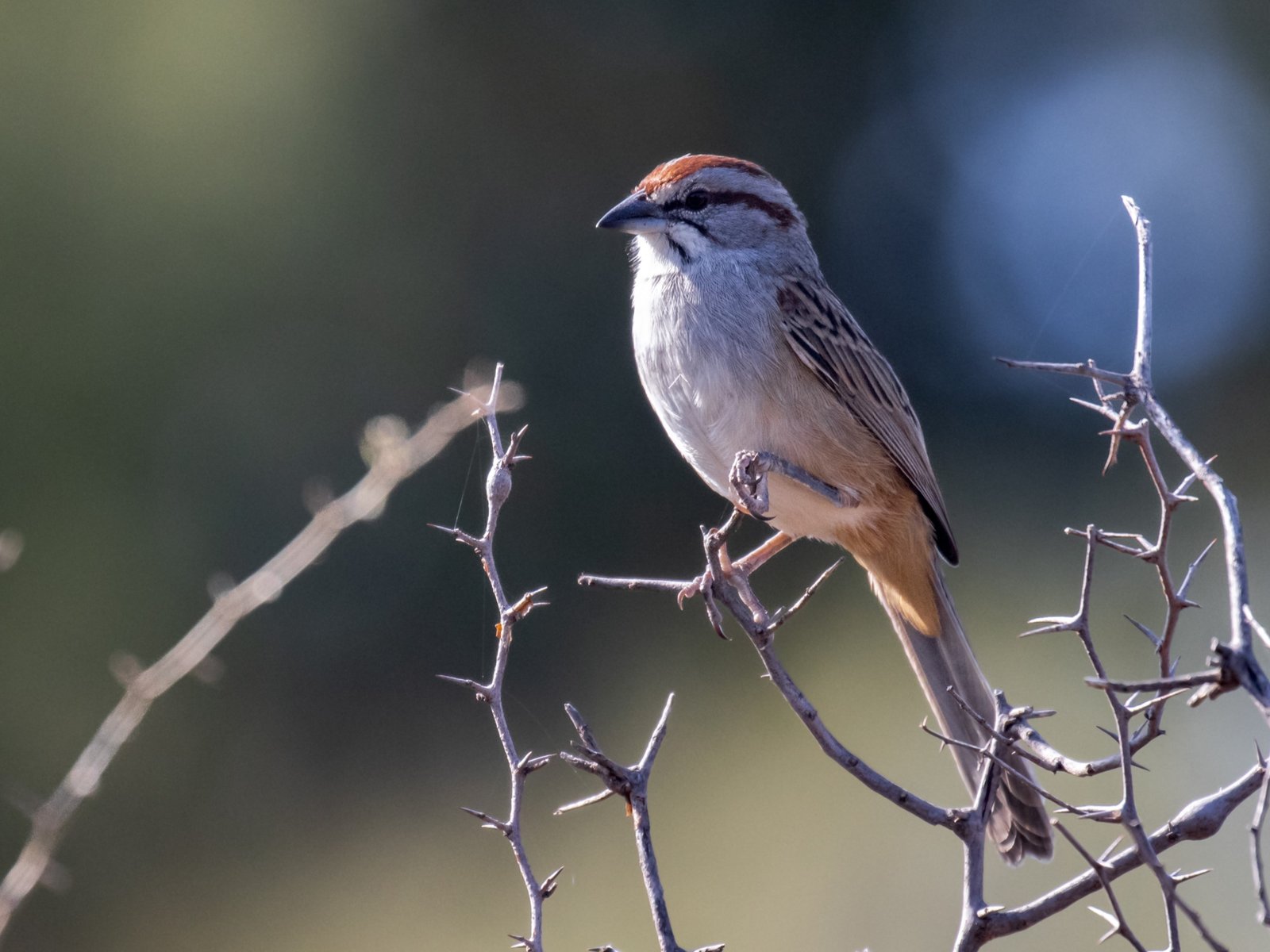
14–15 cm, with a fairly long, pointed bill: the upper mandible is dark, the lower pale. The head is grey, with cinnamon lateral crown stripes, a cinnamon stripe behind the eye, pale lores and a black malar stripe. The upperparts are light brown with dark streaks, with varying amounts of rufous and grey. The underparts are pale grey, turning buff on the flanks. The sexes are alike.
Confusion species
Rhynchospiza dabbenei, formerly included in this species, is slightly larger and lives in dry scrub and farmland in the Andean valleys of Bolivia, higher than the Chaco; in the field the two are separated mainly by habitat and song. Rufous-collared Sparrow Zonotrichia capensis has a small crest, a rufous collar and a black patch on the side of the breast. Tumbes Sparrow Rhynchospiza stolzmanni has a similar head pattern, but lives in north-western Peru and south-western Ecuador.
Habitat
Dry thorn forest, scrub with open patches and a grassy understorey, and grazed land in the Chaco lowlands, up to about 1000 m. It feeds on the ground on seeds and insects. The nest is a cup of grass low in a shrub or on the ground.
Where the bird is most at home, classified by the vegetation units of the Andes and the west coast.


Range and movements
In Bolivia only a few records from the Chaco in the far south-east; whether the species is established there is uncertain, and records from the Andean valleys refer to Rhynchospiza dabbenei. Absent from Colombia, Ecuador, Peru and the Galápagos. Outside the guide area in the Chaco of Paraguay and northern Argentina; some birds move north in the austral winter.
- Resident
- dark = core range, pale = thinly spread
How and when to look
Search open thorn scrub with grass in the Bolivian Chaco, mainly in the austral spring and summer, when the males sing. Document a record with photographs and a sound recording and pay attention to the distinction from Rhynchospiza dabbenei.
Conservation status
Least Concern, assessed under the former, broader species concept. The thorn forest of the Chaco is disappearing rapidly through clearance for farming and ranching.
Scientific name
Rhynchospiza strigiceps | (Gould, 1839)
Gould described the species in 1839 as Zonotrichia strigiceps; because it was later moved to another genus, the author and year stand in brackets. The genus Rhynchospiza was introduced in 1898 by Ridgway. The genus name comes from Greek rhunkhos, 'bill', and spiza, 'finch'. The species name comes from Latin striga, 'streak', and -ceps, 'headed': streak-headed. The specimen the first description was based on came from Santa Fe, Argentina.