All species › Passerines › New World sparrows › Tumbes Sparrow
Tumbes Sparrow | Rhynchospiza stolzmanni
Stolzmanns gors | Sabanero de Tumbes | Tico-tico-de-tumbes
The Tumbes Sparrow is a sparrow of the dry scrub of south-western Ecuador and north-western Peru and one of the characteristic species of the Tumbesian region. It lives mostly on the ground among shrubs and grass. In the rainy season, when the scrub turns green, the males sing and breeding begins.
Voice
The song starts with a few separate ticks and runs into a dry, fast trill; the male sings from a shrub or tussock, mainly in the rainy season. The call is a short, metallic chik.
Recording: Lelis Navarrete — CC BY-NC-SA 4.0 · xeno-canto
Identification
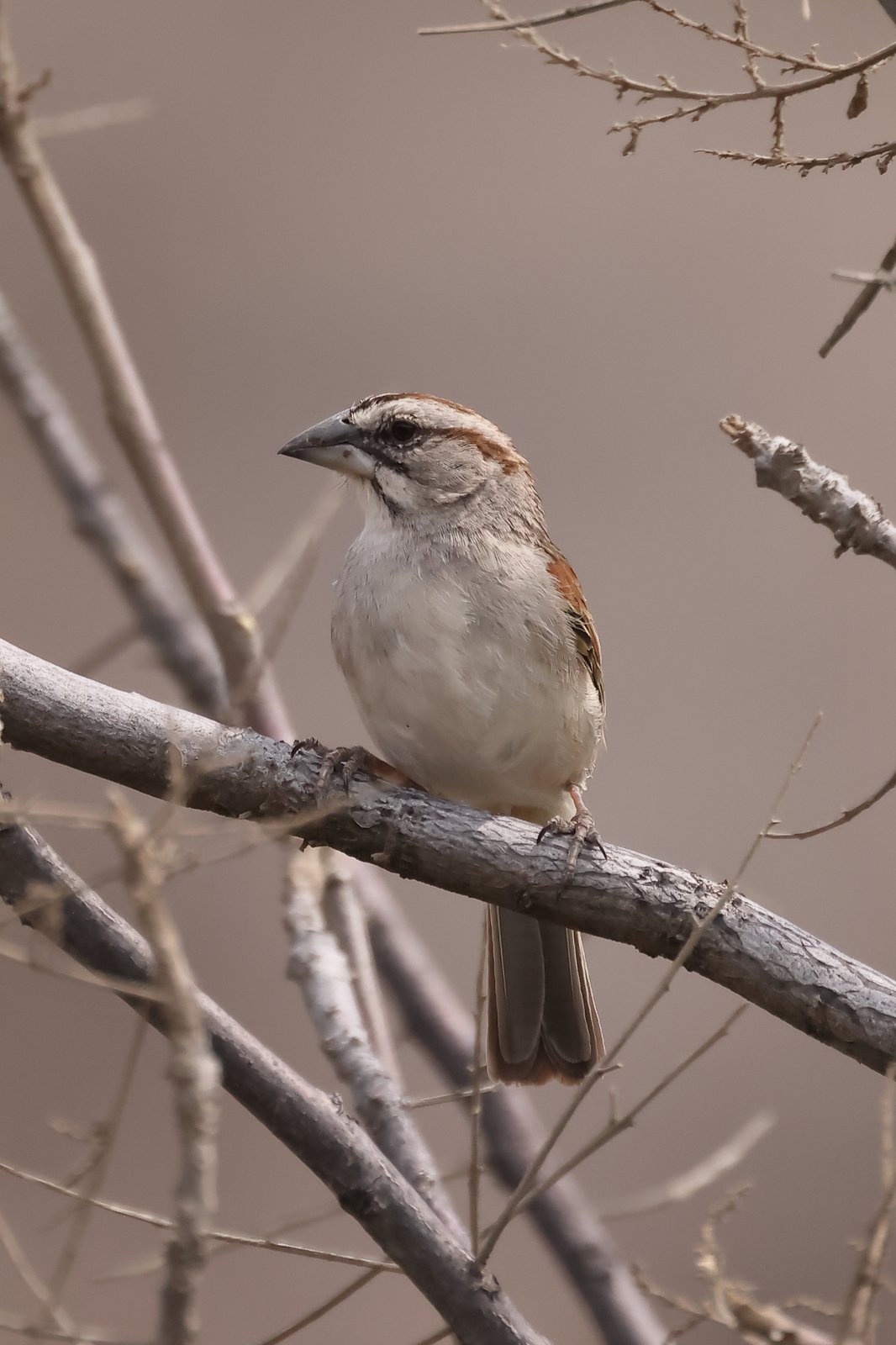
14–15 cm, with a fairly long, pointed bill: the upper mandible is dark, the lower pale. The head is grey, with broad rufous lateral crown stripes, a rufous stripe behind the eye and a narrow black malar stripe; the throat is white. The back is brownish grey streaked black, and the lesser coverts form a rufous shoulder patch. The breast is grey, the belly whitish and the flanks buff. The sexes are alike. Juveniles are browner, with a streaked breast.
Confusion species
Rufous-collared Sparrow Zonotrichia capensis has a small crest, a rufous collar and a black patch on the side of the breast, and no rufous shoulder patch. Black-capped Sparrow Arremon abeillei has a black head with a white brow, an olive-green back and a black breast band, and lives in the shade of dry forest. Chaco Sparrow Rhynchospiza strigiceps, a close relative with a similar head pattern, lives far outside this area, in the Chaco.
Habitat
Dry thorn scrub, open dry forest with an understorey of grass and herbs, and overgrown fields and pastures in the arid lowlands and low hills, from sea level to about 1500 m. It feeds on the ground on seeds and insects. It breeds in the rainy season; the nest is a cup of grass on or just above the ground, hidden under a shrub or in a tussock.
Where the bird is most at home, classified by the vegetation units of the Andes and the west coast.


Range and movements
In Ecuador in the arid south-west, mainly in El Oro and Loja. In Peru in the arid north-west, from Tumbes and Piura south to La Libertad, with records also from the dry Marañón Valley. Absent from Colombia, Bolivia and the Galápagos. Does not occur outside the guide area.
- Resident
- dark = core range, pale = thinly spread
How and when to look
Search the dry scrub of south-western Ecuador and north-western Peru in the rainy season, roughly January–April, when the males sing. In the dry season the birds are quieter and keep more to the ground under shrubs.
Conservation status
Least Concern. The dry scrub of the Tumbesian region is locally cleared and grazed by goats, but the species tolerates an open, partly grazed landscape.
Scientific name
Rhynchospiza stolzmanni | (Taczanowski, 1877)
Taczanowski described the species in 1877 as Haemophila stolzmanni; because it was later moved to another genus, the author and year stand in brackets. The genus Rhynchospiza was introduced in 1898 by Ridgway. The genus name comes from Greek rhunkhos, 'bill', and spiza, 'finch'. The species name honours Jan Sztolcman (Stolzmann, 1854–1928), a Polish zoologist and collector who collected birds in Peru from 1875 to 1882. The specimen the first description was based on came from Tumbes, Peru.