All species › Passerines › New World sparrows › Yellow-browed Sparrow
Yellow-browed Sparrow | Ammodramus aurifrons
Geelwanggors | Sabanero cejiamarillo | Cigarrinha-do-campo
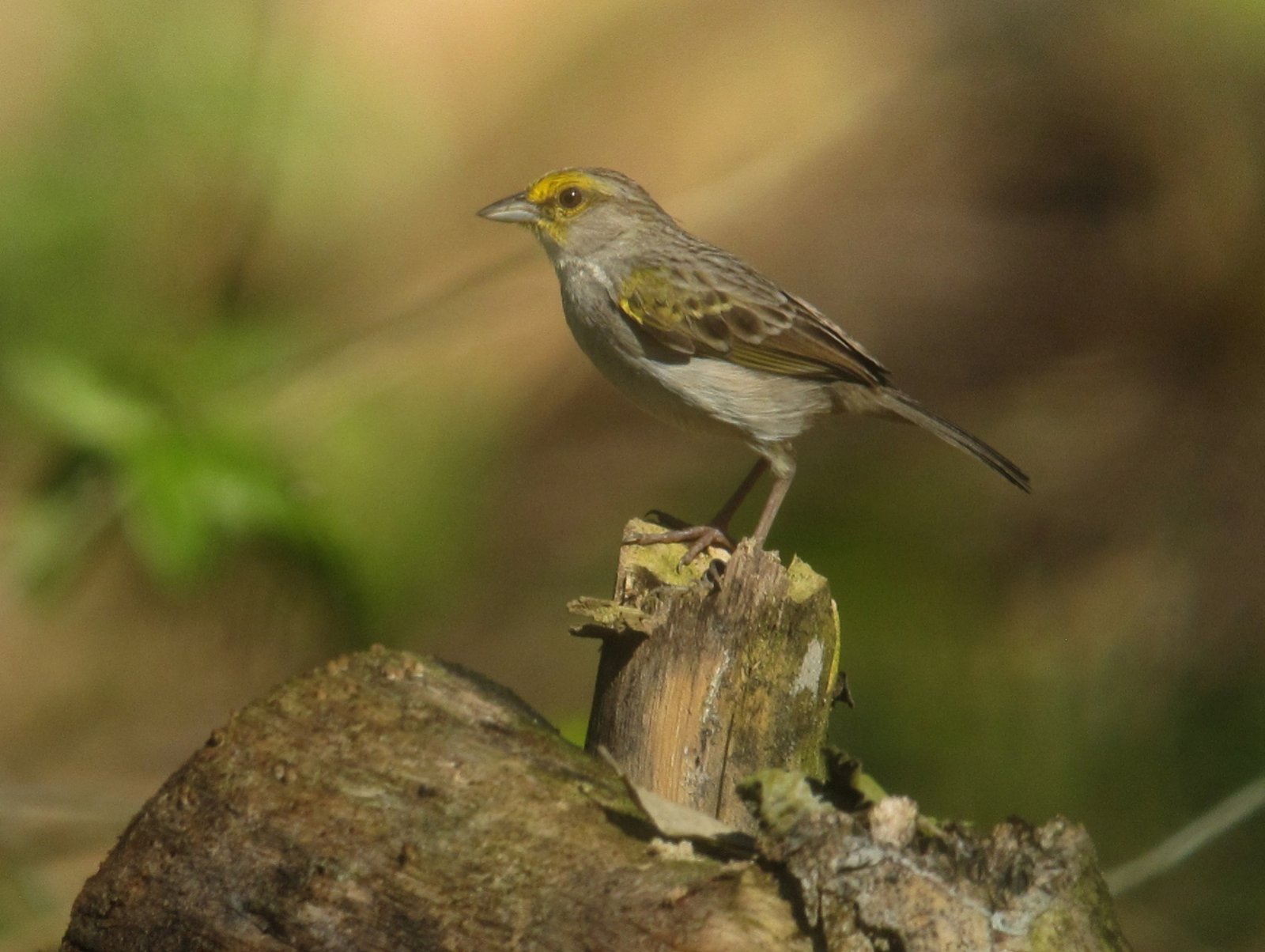
The Yellow-browed Sparrow is a small, grey-brown sparrow with a yellow brow, characteristic of open places in Amazonia. It has increased strongly with deforestation and lives in pastures, along roads, on sandbars and in villages. Its buzzy song is a frequently heard sound in open country in the Amazonian lowlands.
Voice
The song is a thin, insect-like buzz, usually preceded by one or two ticks, roughly tik, tssss-tssss; the male sings from a tussock, stone, fence or roof. The call is a short tsik.
Recording: JAYRSON ARAUJO DE OLIVEIRA — CC BY-NC-SA 4.0 · xeno-canto
Identification
12–13 cm, with a fairly pointed bill and a short tail. The upperparts are grey-brown, with faint dark streaks on the back. The face is grey, with a yellow stripe running from the lores to above the eye; in some birds the chin or cheek is also yellow. The bend of the wing is yellow. The underparts are greyish white, with a greyer breast and flanks. The sexes are alike. Juveniles are browner and less clearly marked, with little yellow on the face and a lightly streaked breast.
Confusion species
Grassland Sparrow Ammodramus humeralis has only a small yellow spot in front of the eye, a more clearly streaked crown and back, and lives on natural savannas. Females and juveniles of Blue-black Grassquit Volatinia jacarina have a conical bill, a streaked breast and no yellow on the face.
Habitat
Pastures, grassy roadsides, open ground around farms and villages, sandbars and grassy riverbanks, and grassland on river islands, in the lowlands up to about 1000 m, locally higher in the valleys of the eastern slope. It feeds on the ground on seeds and insects. The nest is a cup of grass on the ground or low in a tussock.
Where the bird is most at home, classified by the vegetation units of the Andes and the west coast.


Range and movements
In Colombia east of the Andes, in Amazonia and along the southern edge of the Llanos. In Ecuador and Peru throughout the Amazonian lowlands and in the lower valleys of the eastern slope. In Bolivia in the lowlands of the north and centre. Absent west of the Andes and from the Galápagos. Outside the guide area in southern Venezuela and in western and central Brazilian Amazonia.
- Resident
- dark = core range, pale = thinly spread
How and when to look
Search grassy roadsides, football fields and riverbanks near villages in the Amazonian lowlands; singing birds often sit on a tussock or post.
Conservation status
Least Concern. The species benefits from open ground created by deforestation and is common in much of the Amazonian lowlands.
Scientific name
Ammodramus aurifrons | (Spix, 1825)
Spix described the species in 1825 as Tanagra aurifrons; because it was later moved to another genus, the author and year stand in brackets. The genus Ammodramus was introduced in 1827 by Swainson. The genus name comes from Greek ammos, 'sand', and dromos, 'runner': 'sand-runner'. The species name comes from Latin aurum, 'gold', and frons, 'forehead': 'golden-fronted', after the yellow in front of and above the eye. The specimen the first description was based on came from Fonte Boa, Rio Solimões, Brazil.