All species › Passerines › New World warblers › Black-throated Blue Warbler
Black-throated Blue Warbler | Setophaga caerulescens
Blauwe zwartkeelzanger | Reinita azulada | Mariquita-azul-de-garganta-preta
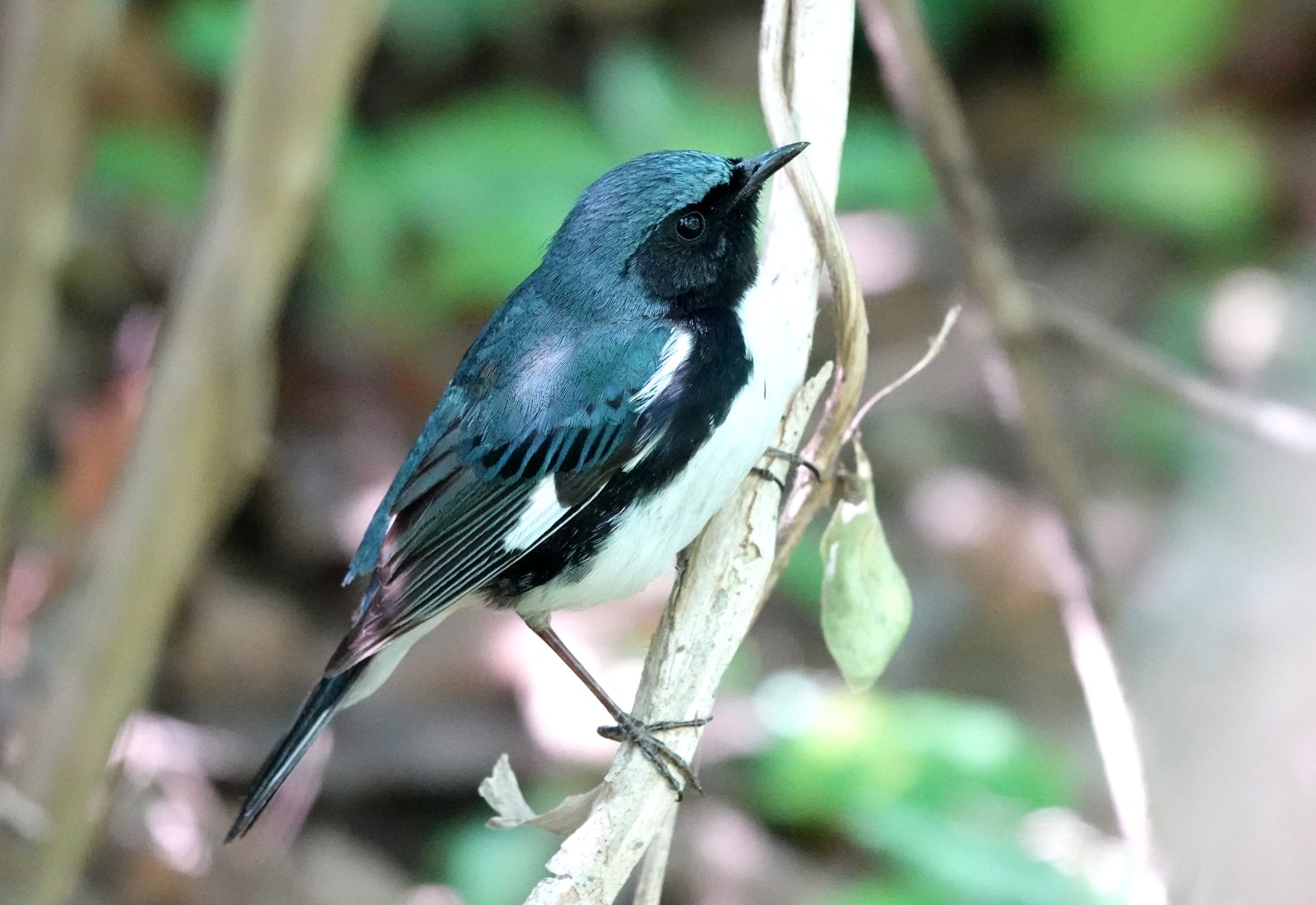
The Black-throated Blue Warbler is a North American warbler that winters mainly in the Greater Antilles and the Bahamas. In the guide area it is a rare winter visitor, almost only in Colombia. Male and female differ so much that they look like two species; both have a small white patch at the base of the primaries.
Voice
The call is a short, dull tsk, like two pebbles knocked together. The song, a slow, buzzy series zur-zur-zreee, is rarely heard in winter.
Recording: Bobby Wilcox — CC BY-NC-SA 4.0 · xeno-canto
Identification
13 cm. The male is deep blue above, with a black face, black throat and black flanks; the belly is white. At the base of the primaries there is a clear white patch. The female is olive-brown to greyish olive above and dingy buffy yellow below, with a narrow pale supercilium, a dark cheek and a small white wing patch, which may be small or absent in young females. Young males are duller blue with greenish edges.
Confusion species
Male Cerulean Warbler Setophaga cerulea is paler sky-blue above, with a white throat, a narrow breast band and two white wing bars. Female Tennessee Warbler Leiothlypis peregrina is greener, with a paler supercilium, no dark cheek and no white wing patch. Female Cerulean Warbler is blue-green, with two white wing bars.
Habitat
In winter in the middle and lower levels of humid forest, forest edges, secondary forest and shade coffee, mainly in the foothills and lower montane forest. It eats insects, also fruit and nectar. It does not breed in the guide area.
Where the bird is most at home, classified by the vegetation units of the Andes and the west coast.


Range and movements
Rare winter visitor, mainly October to April. In Colombia a small number of records, mainly in the Sierra Nevada de Santa Marta and elsewhere in the north, a few also in the Andes. In Ecuador, Peru, Bolivia and the Galápagos absent or at most an exceptional vagrant. Breeds in eastern North America and winters mainly in the Greater Antilles and the Bahamas, in small numbers also in Central America.
How and when to look
In winter, in mixed flocks at forest edges and in coffee plantations in northern Colombia, watch for a dark blue warbler with a white wing patch; in females this patch is often the best feature.
Conservation status
Least Concern. The North American population is stable to increasing.
Scientific name
Setophaga caerulescens | (Gmelin, 1789)
Gmelin described the species in 1789 as Motacilla caerulescens; because it was later moved to another genus, the author and year stand in brackets. The genus Setophaga was introduced in 1827 by Swainson. The genus name comes from Greek sēs (genitive sētos), 'moth', and -phagos, '-eating', so 'moth-eater'. The species name comes from Latin caerulescens, 'bluish', for the male's blue upperparts. The specimen the first description was based on came from Hispaniola.