All species › Passerines › New World warblers › Blackburnian Warbler
Blackburnian Warbler | Setophaga fusca
Sparrenzanger | Reinita gorjinaranja | Mariquita-papo-de-fogo
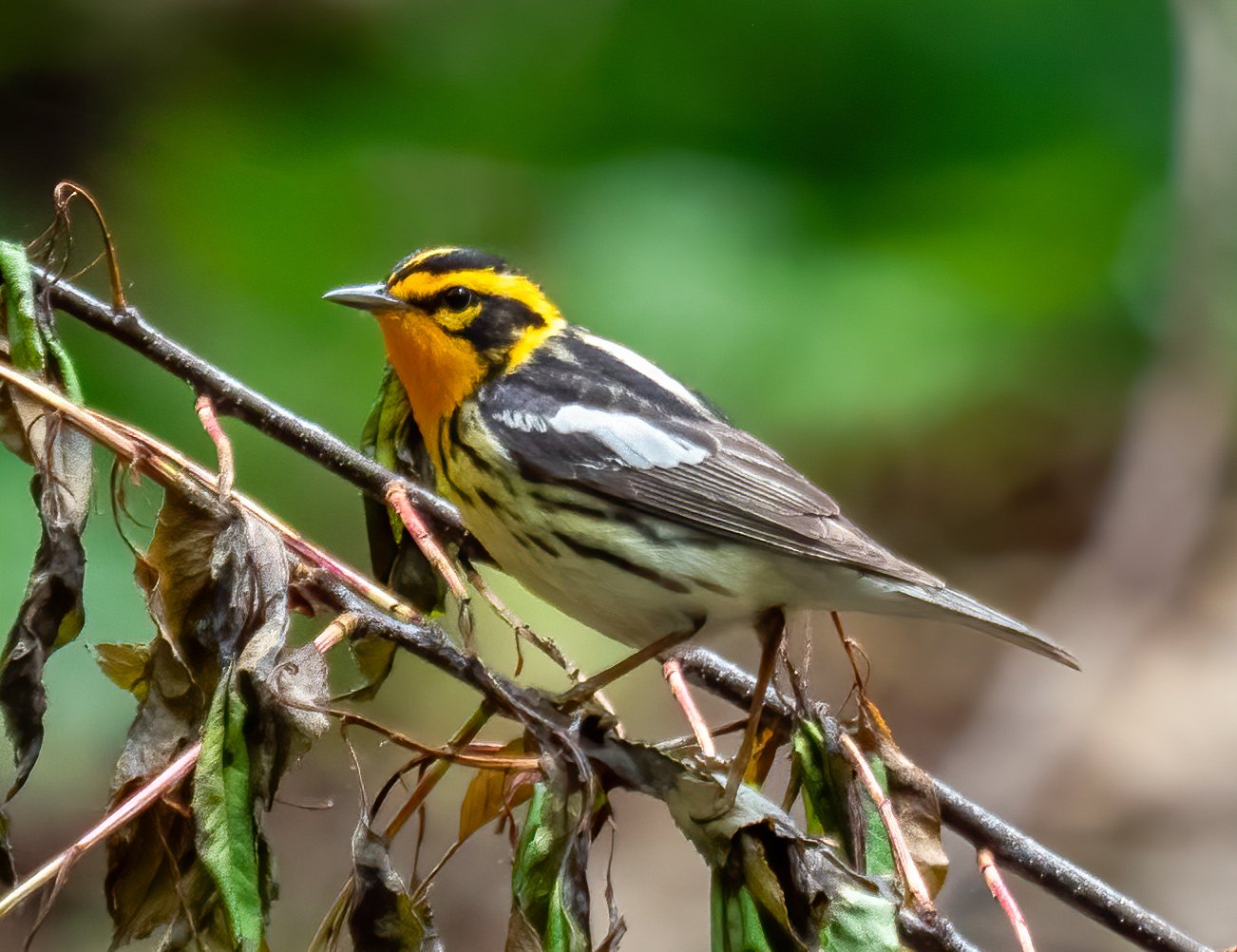
The Blackburnian Warbler is a small warbler with an orange or yellow throat and a dark, triangular cheek patch. It breeds in the conifer forests of Canada and the north-eastern United States and winters largely in the Andes. In the guide area it is one of the most numerous migrants in the mixed flocks of montane forest in winter.
Voice
The call is a fine, high tsip. The song, very high and thin, ends in a rising, hissing trill, tsi-tsi-tsi-tsi-tsiiiii; in the guide area heard mainly in spring.
Recording: Mario Reyes Jr — CC BY-NC-SA 4.0 · xeno-canto
Identification
12–13 cm. Even in non-breeding plumage the male has an orange to yellow-orange throat and upper breast, an orange supercilium and a black triangular cheek patch. The back is black with two pale stripes, and the wing has a large white patch or two broad white bars. The belly is whitish, with black streaks on the flanks. Females and young birds are duller: throat and supercilium yellowish to dull orange-yellow, cheek patch greyish brown, back greyish olive with pale stripes and two white wing bars. In March and April males turn flame orange and black.
Confusion species
Black-throated Green Warbler Setophaga virens has a yellow face with an olive cheek patch, a green, unstreaked back and a black or dark-mottled throat. Female Cerulean Warbler Setophaga cerulea is greenish blue, without a dark cheek patch or pale back stripes. Blackpoll Warbler Setophaga striata and Bay-breasted Warbler Setophaga castanea are greener in non-breeding plumage, without an orange throat or dark cheek triangle. Tropical Parula Setophaga pitiayumi has a blue-grey, unstreaked back.
Habitat
In winter in the canopy of humid montane forest and cloud forest, forest edges, secondary forest and shade coffee, mainly between 1000 and 2500 m, locally to over 3000 m; lower on passage. It searches for insects and caterpillars among the leaves on the outside of the crown, almost always in mixed flocks with tanagers and other warblers. It does not breed in the guide area; the nest is placed high in conifers in the north.
Where the bird is most at home, classified by the vegetation units of the Andes and the west coast.


Range and movements
Colombia: common winter visitor in all three Andean ranges, the Sierra Nevada de Santa Marta and the Serranía de Perijá; also in the lowlands on passage. Ecuador: common on both Andean slopes. Peru: fairly common along the eastern slope of the Andes, scarcer to the south. Bolivia: scarce, mainly in the Yungas of La Paz and Cochabamba. Outside the guide area the species breeds in eastern Canada and the north-eastern United States and winters from Central America to Venezuela.
- Winter visitor (c. Oct–Mar)
- dark = core range, pale = thinly spread
How and when to look
In winter follow a mixed tanager flock along a forest edge or mountain road between 1500 and 2500 m; several Blackburnian Warblers are often present. Watch the outside of the crowns, where the orange throat stands out against the green.
Conservation status
Least Concern. The population is large; montane forest is disappearing in the winter range, but the species also uses secondary forest and shade coffee.
Scientific name
Setophaga fusca | (Müller, 1776)
Müller described the species in 1776 as Motacilla fusca; because it was later moved to another genus, the author and year stand in brackets. The genus Setophaga was introduced in 1827 by Swainson. The genus name comes from Greek sēs (genitive sētos), 'moth', and -phagos, '-eating', so 'moth-eater'. The species name comes from Latin fuscus, 'dark, dusky', probably for the dark plumage of the bird described. The specimen the first description was based on came from French Guiana.