All species › Passerines › Tanagers and allies › Blue-and-gold Tanager
Blue-and-gold Tanager | Bangsia arcaei
Blauw-gouden tangare | Tangara de Arcé | Sanhaço-azul-e-dourado
The Blue-and-gold Tanager is a stocky tanager of humid foothill forest on the Caribbean side of Costa Rica and Panama. In the guide area it is known only as a rare vagrant or border case, from the far north-west of Colombia near the border with Panama. It lives in pairs or small groups in the middle storey of the forest.
Voice
High, thin tseet calls and a short series of high, sharp notes; poorly described.
No recording with a suitable Creative Commons licence is available for this species yet.
Identification
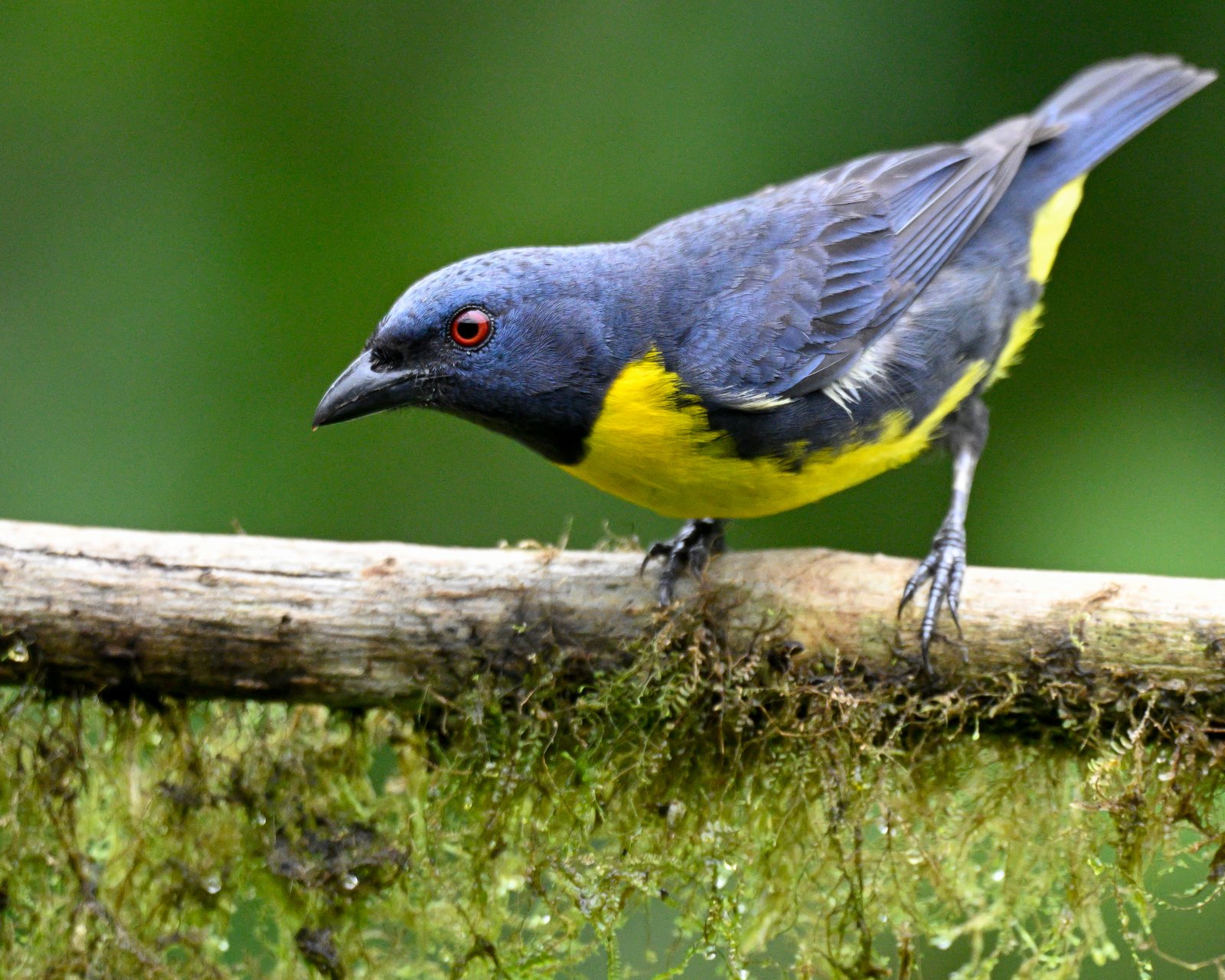
15 cm, with a short, stout bill and a short tail. Head, upperparts and throat are deep dark blue, the shoulders and wing edges slightly paler blue. Breast and belly are bright golden yellow, the flanks olive. The iris is red. The sexes are alike. Juveniles are duller, with a greenish wash to the upperparts.
Confusion species
Golden-chested Tanager Bangsia rothschildi of the Chocó has a blue-black body with only a yellow breast patch and yellow undertail coverts, and a dark iris. Black-and-gold Tanager Bangsia melanochlamys lives in the Andes of Colombia and is black with a golden-yellow centre to the breast and belly. No other tanager in the area combines plain blue upperparts with entirely yellow underparts.
Habitat
Humid foothill forest and lower montane forest, roughly between 400 and 1500 m, mainly in the middle storey and at forest edges. It eats fruit and berries and also searches branches and moss for insects, often in mixed flocks. The nest is a cup of moss in a tree.
Where the bird is most at home, classified by the vegetation units of the Andes and the west coast.


Range and movements
In Colombia known only from a few records in the far north-west, near the border with Panama. Absent from Ecuador, Peru, Bolivia and the Galápagos. Outside the guide area on the Caribbean slope of Costa Rica and in the mountains of western and central Panama.
How and when to look
Its occurrence in the guide area is limited to a remote border region. Any record deserves documentation with a photograph or sound recording.
Conservation status
Near Threatened. The range is small and forest on the lower slopes is cleared locally for farming and cattle ranching.
Scientific name
Bangsia arcaei | (Sclater & Salvin, 1869)
Sclater & Salvin described the species in 1869 as Buthraupis arcaei; because it was later moved to another genus, the author and year stand in brackets. The genus Bangsia was introduced in 1919 by Penard. The genus name honours Outram Bangs (1863–1932), an American zoologist and from 1900 curator of mammals at Harvard's Museum of Comparative Zoology. The species name honours the Guatemalan collector Enrique Arcé, who was active around 1870 in Guatemala, Costa Rica and Panama. The specimen the first description was based on came from Cordillera del Chucú, Veraguas, Panama.