All species › Passerines › Tanagers and allies › Blue Finch
Blue Finch | Rhopospina caerulescens
Kobaltgors | Yal azul | Campainha-azul
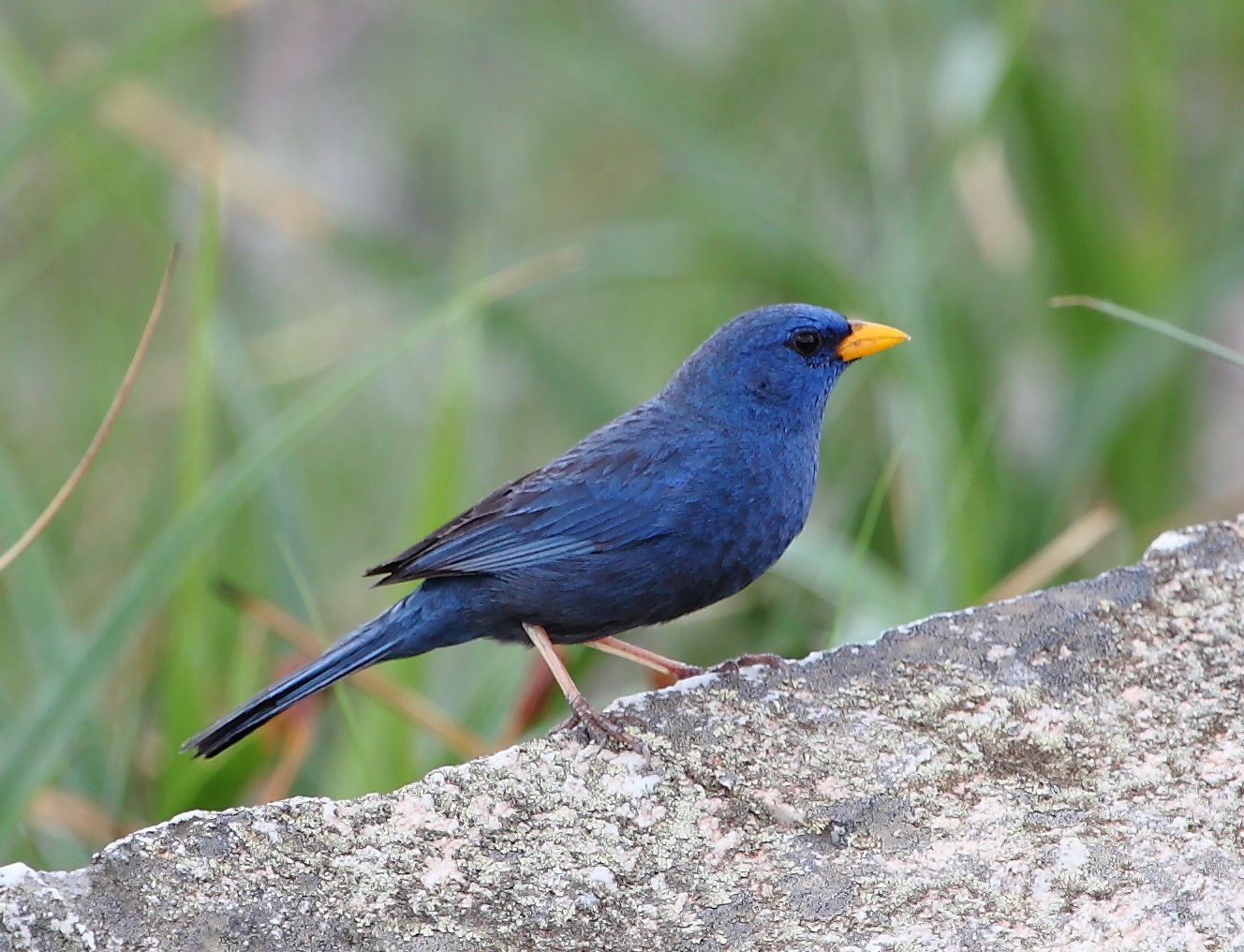
The Blue Finch is a small finch of the cerrado of central Brazil. The male is plain dark cobalt blue with a yellow bill, a combination shown by no other finch in the guide area. In the guide area it is known only as a rare vagrant in eastern Bolivia.
Voice
The song is a short, high and thin series of rapid notes. The call is a fine tsip.
No recording with a suitable Creative Commons licence is available for this species yet.
Identification
13 cm, with a pointed, conical yellow bill. The male is entirely dark cobalt blue, with blackish flight feathers and tail. The female is brown with a dark-streaked breast and a pale throat; her bill is yellowish. Young males are brown with the first blue feathers.
Confusion species
The male Blue-black Grassquit Volatinia jacarina is glossy blue-black with a dark bill and jumps briefly up from its perch when singing. Ultramarine Grosbeak Cyanoloxia brissonii is larger, with a heavy, dark bill and pale blue brow and shoulders. Females differ from female seedeaters Sporophila in the streaked breast and the pointed yellow bill.
Habitat
Cerrado and open grassland with scattered shrubs, often on rocky hills and plateaus, in the lowlands and lower hills. It forages on and just above the ground for seeds and insects.
Where the bird is most at home, classified by the vegetation units of the Andes and the west coast.

Range and movements
In the guide area only a few records in north-eastern Santa Cruz department in Bolivia, in the cerrado of the Serranía de Huanchaca. Not known from Colombia, Ecuador, Peru and the Galápagos. Outside the guide area in the cerrado of central and eastern Brazil.
How and when to look
A record in the guide area is most likely in the cerrado on the Huanchaca plateau in Noel Kempff Mercado National Park; look there in open grassland with small shrubs for small blue finches with a yellow bill.
Conservation status
Near Threatened. The species is declining as the cerrado is converted to cropland and plantations and through frequent fires.
Scientific name
Rhopospina caerulescens | (Wied-Neuwied, 1830) (GBIF: Porphyrospiza caerulescens)
Wied-Neuwied described the species in 1830 as Tanagra caerulescens; because it was later moved to another genus, the author and year stand in brackets. The genus Rhopospina was introduced in 1851 by Cabanis. The genus name combines Greek rhōps, 'bush', and spinos, 'finch'. The species name comes from Latin caerulescens, 'bluish'. The specimen the first description was based on came from interior of Bahia, Brazil.