All species › Passerines › Tanagers and allies › Merida Flowerpiercer
Merida Flowerpiercer | Diglossa gloriosa
Méridaberghoningkruiper | Pinchaflor de Mérida | Fura-flor-de-mérida
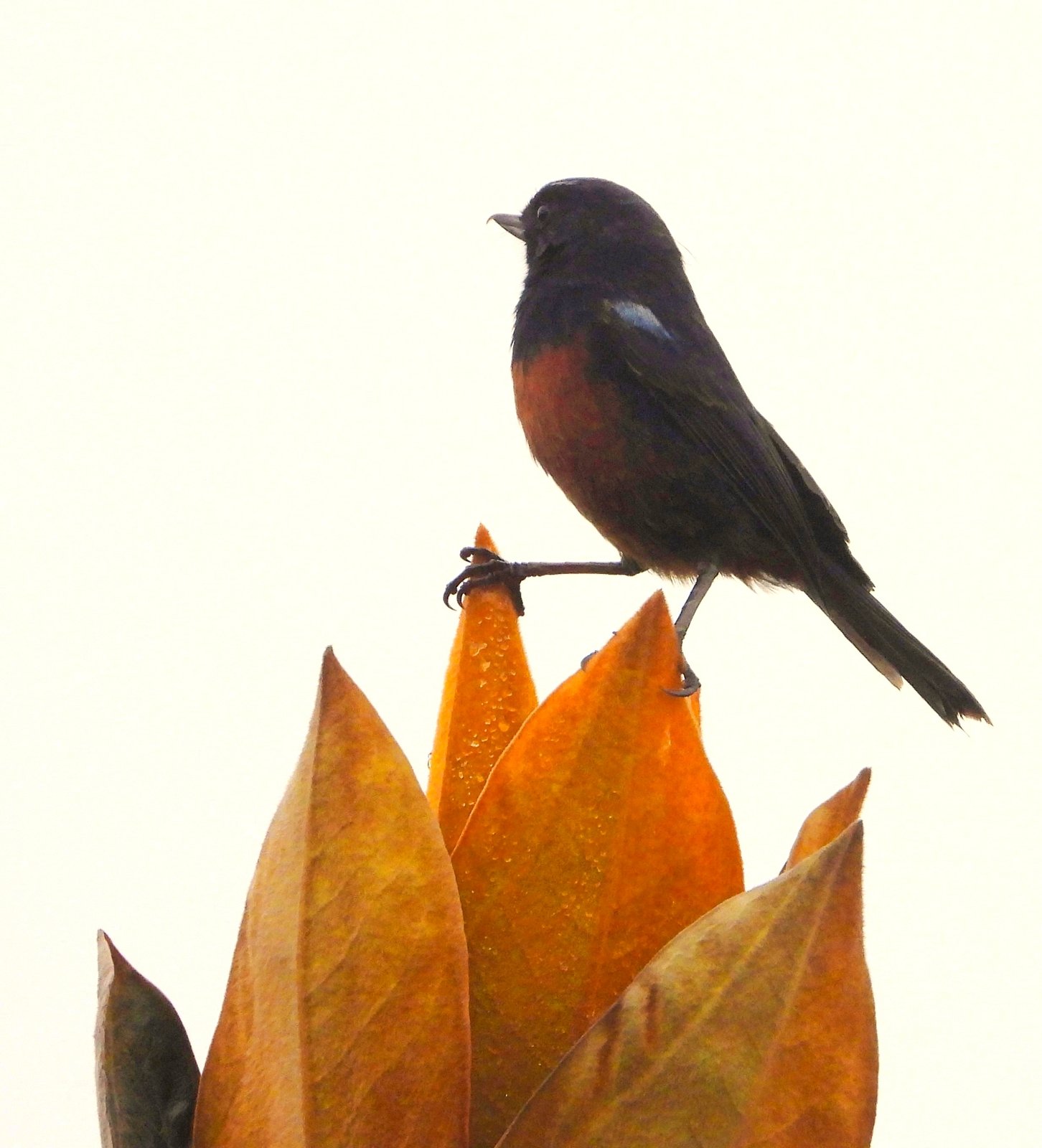
The Merida Flowerpiercer is a dark flowerpiercer with a chestnut belly that lives almost entirely in the Andes of Mérida and Trujillo in western Venezuela. Like all flowerpiercers it pierces the side of flower corollas with its hooked bill and takes nectar without pollinating the flower. In the guide area it is known only as a vagrant.
Voice
The song is a fast, high, twittering series of notes; the call is a thin tsit.
Recording: Joe Klaiber — CC BY-NC-SA 4.0 · xeno-canto
Identification
14 cm, with a short, upturned bill with a hooked tip. The head, throat and upperparts are black, with a blue-grey shoulder patch and a greyish rump. The breast and belly are chestnut, the flanks greyer. The sexes are nearly alike; juveniles are duller brown and streaked below.
Confusion species
Black Flowerpiercer Diglossa humeralis, which lives in the same border region, is entirely black, without a chestnut belly. Glossy Flowerpiercer Diglossa lafresnayii is larger and glossy black, with a blue-grey shoulder, and also lacks brown on the underparts. Rusty Flowerpiercer Diglossa sittoides also has rusty underparts, but blue-grey upperparts and a rusty throat. Black-throated Flowerpiercer Diglossa brunneiventris is very similar, but has a grey malar stripe and lives much further south.
Habitat
Shrubbery at the upper edge of cloud forest, forest edges, hedgerows and shrubby páramo, roughly between 2500 and 4100 m. It takes nectar by piercing the side of flower corollas and also eats insects. The nest is a cup low in a shrub.
Where the bird is most at home, classified by the vegetation units of the Andes and the west coast.


Range and movements
In the guide area only a single record: in July 2024 a bird was photographed at Cruz de Piedra (Herrán, Norte de Santander, Colombia) at about 3000 m, in the Tamá massif on the border with Venezuela. Absent from Ecuador, Peru, Bolivia and the Galápagos. Outside the guide area only in the Andes of Mérida and Trujillo in western Venezuela.
How and when to look
A flowerpiercer with a chestnut belly in the high shrubland of Norte de Santander deserves a photograph and, if possible, a sound recording; check for the absence of a grey malar stripe.
Conservation status
Least Concern. The range is small, but the species is fairly common there and part of it lies in protected areas; fires and clearance of páramo and scrub are local threats.
Scientific name
Diglossa gloriosa | Sclater & Salvin, 1871
Sclater & Salvin described the species in 1871 and placed it straight away in the genus where it still stands. The genus Diglossa was introduced in 1832 by Wagler. The genus name comes from Greek diglōssos, 'double-tongued' or 'speaking two languages'. The specific name comes from Latin gloriosus, 'glorious, famous', from gloria, 'fame, glory'. The specimen the first description was based on came from Páramo de La Culata, Mérida, Venezuela.