All species › Passerines › Tanagers and allies › Blue-and-yellow Tanager
Blue-and-yellow Tanager | Rauenia bonariensis
Blauw-gele tangare | Tangara naranjera | Sanhaço-papa-laranja
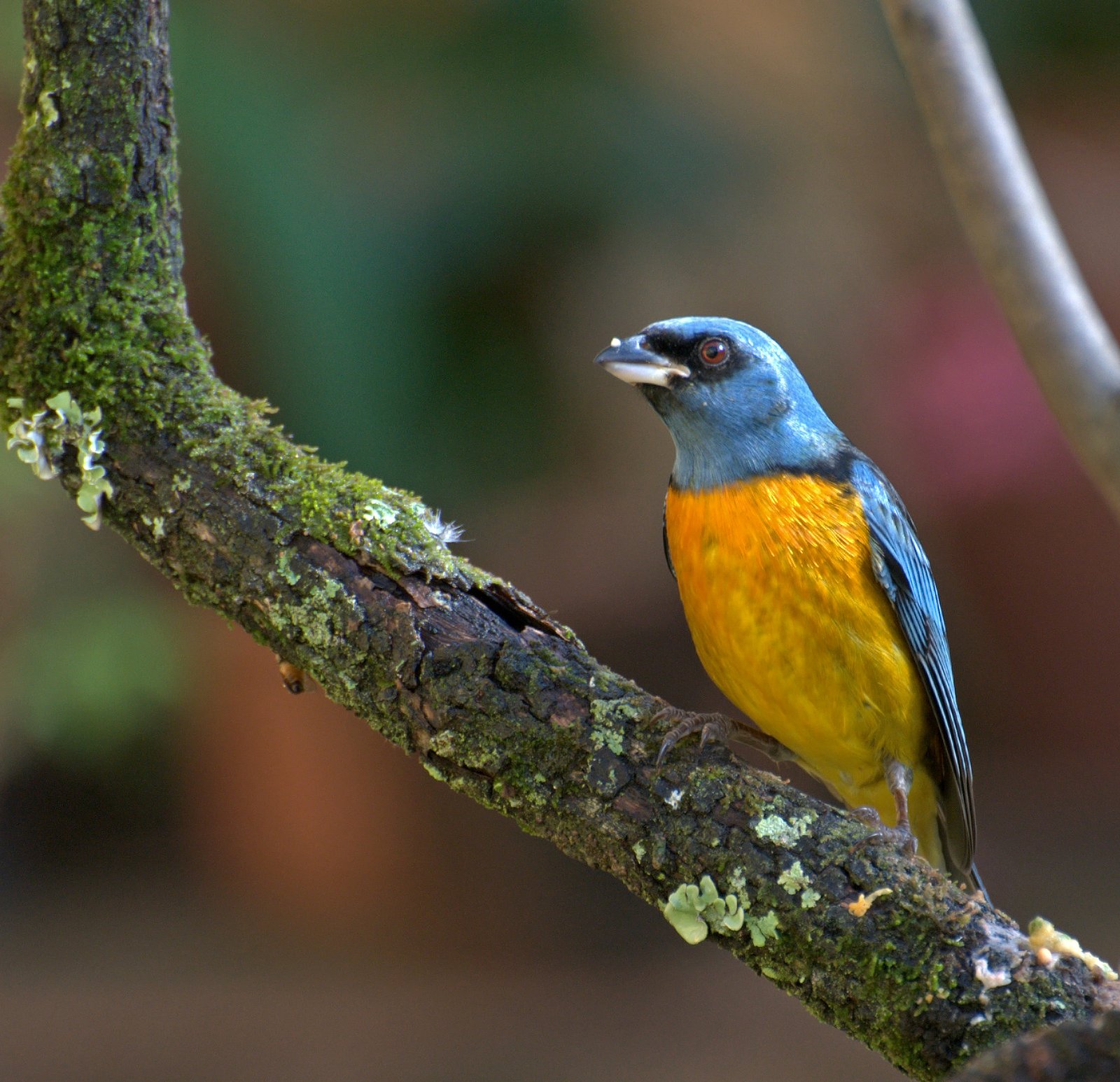
The Blue-and-yellow Tanager is a sturdy tanager of dry valleys and scrub in the Andes, with a cobalt-blue head, a black mask and a yellow to orange breast. It lives in semi-open country with hedgerows, gardens and orchards and eats much fruit.
Voice
Gives a sharp chip and high, fine notes; the song is a series of clear, somewhat scratchy notes, often from a high perch.
Recording: Juan Freile — CC BY-NC-SA 4.0 · xeno-canto
Identification
17 cm, with a short, thick bill. The male has a cobalt-blue head with black lores and cheek patch, a black to olive-black mantle, an orange-yellow rump and yellow underparts with an orange wash on the breast. Wings and tail are black with blue edges. In birds from Ecuador and Peru the mantle is olive and the breast less orange. The female is duller: grey-brown to olive-brown above, with a faintly bluish head, and dull yellow to ochre below. Juveniles resemble the female.
Confusion species
Fawn-breasted Tanager Pipraeidea melanonota is smaller and has a pale blue crown and ochre-buff underparts without yellow. Blue-winged Mountain Tanager Anisognathus somptuosus lives in humid montane forest and also has yellow underparts, but a black head with a yellow crown patch and blue shoulders. The female may resemble a female Hooded Siskin Spinus magellanicus, but is larger, has a thicker bill and no yellow wing bar.
Habitat
Dry and semi-arid inter-Andean valleys and the western slope, with scrub, hedgerows, eucalyptus, fields, orchards, parks and gardens, from about 1500 to 3500 m, in Peru locally lower in coastal valleys. It eats mainly fruit, including cultivated fruit, as well as insects. The nest is a cup in a tree or shrub.
Where the bird is most at home, classified by the vegetation units of the Andes and the west coast.


Range and movements
Not known from Colombia. In Ecuador in the dry inter-Andean valleys from north to south. In Peru on the western slope and in the inter-Andean valleys along almost the entire length of the country. In Bolivia in the Andean valleys and on the eastern slope, south to the far south. Does not occur on the Galápagos. Outside the guide area in northern Chile, Argentina, Uruguay, Paraguay and southern Brazil.
- Resident
- dark = core range, pale = thinly spread
How and when to look
Search gardens, hedgerows and orchards in dry Andean valleys, for example around Quito, Cuenca, Cusco and Cochabamba; the birds often perch high on a branch or wire and come to ripe fruit.
Conservation status
Least Concern. Fairly common in semi-open, man-made landscapes; benefits from gardens and orchards.
Scientific name
Rauenia bonariensis | (Gmelin, 1789)
Gmelin described the species in 1789 as Loxia bonariensis; because it was later moved to another genus, the author and year stand in brackets. The genus Rauenia was introduced in 1980 by Wolters. The genus name was given by Hans Edmund Wolters in 1980 and may be named after a person; who that was could not be traced. The species name refers to Buenos Aires in Argentina. The specimen the first description was based on came from Buenos Aires, Argentina.