All species › Passerines › Tanagers and allies › White-rumped Tanager
White-rumped Tanager | Cypsnagra hirundinacea
Witstuittangare | Tangara culiblanca | Bandoleta
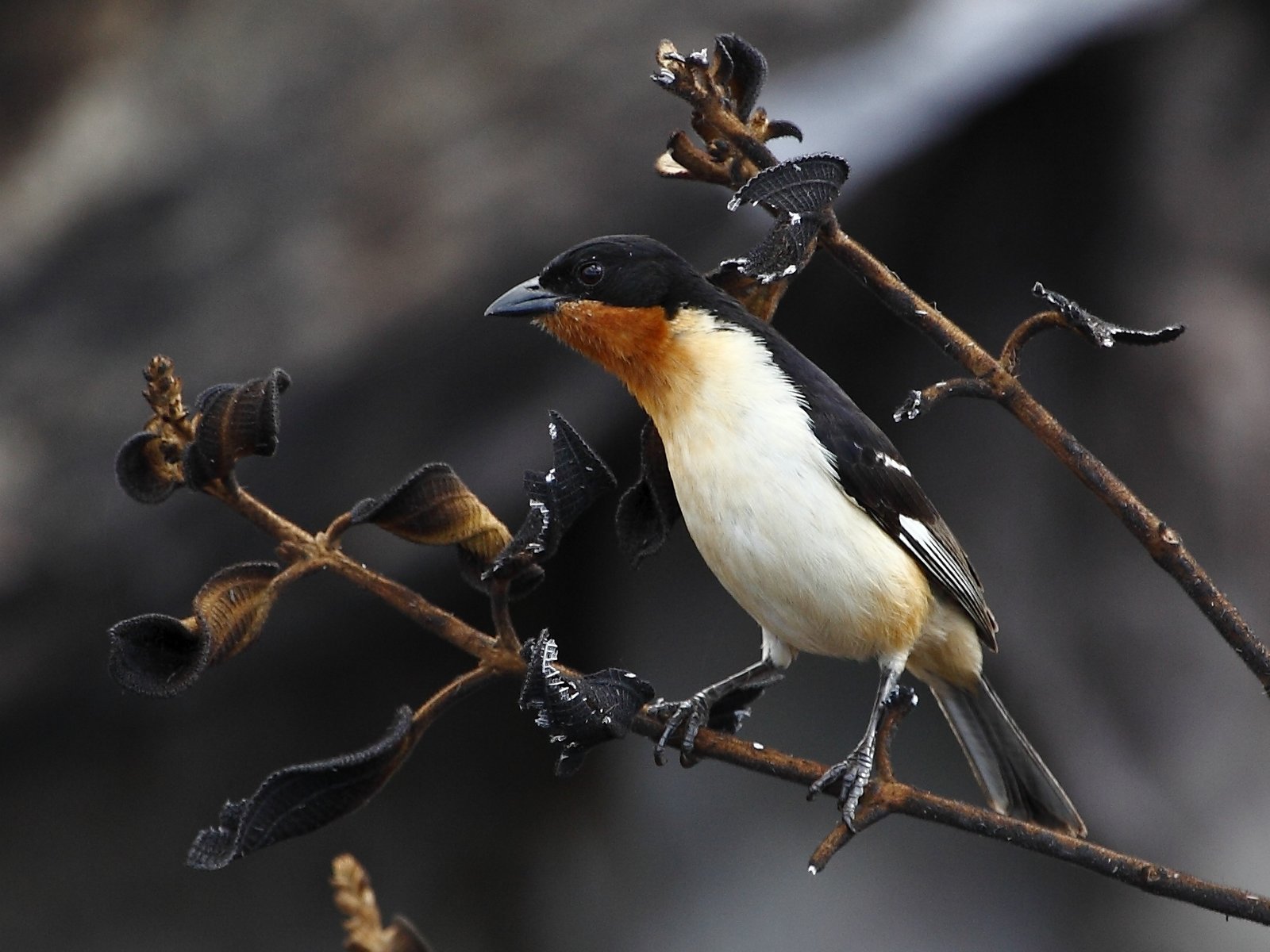
The White-rumped Tanager is a black-and-white tanager of the cerrado and open savannas of central South America. Pairs and family groups perch upright on top of shrubs and small trees and give loud duets from there. In the guide area it lives only in the eastern lowlands of Bolivia.
Voice
Pairs and groups sing together in a loud, rhythmic duet of whistled and harsh notes, mainly in the early morning. Also short, hard contact calls.
Recording: Richard E. Webster — CC BY-NC-SA 4.0 · xeno-canto
Identification
16 cm, with a short, fairly thick, dark bill. The head, back, wings and tail are black; the rump is white and conspicuous in flight, as is a white patch at the base of the primaries. The throat and upper breast are orange-brown to pale ochre, the rest of the underparts whitish. The sexes are similar. Young birds are duller, with brownish-black upperparts.
Confusion species
Shrike-like Tanager Neothraupis fasciata is grey, with a black mask and a white wing bar, and lacks a white rump. Black-faced Tanager Schistochlamys melanopis is plain grey with a black face and throat. White-rumped Monjita Xolmis velatus also has a white rump, but has a white head and underparts and a thin flycatcher bill.
Habitat
Cerrado, open savanna with scattered shrubs and small trees, and the edges of dry forest, in the lowlands up to about 1000 m. It forages in pairs or small groups for insects and fruit in shrubs and trees and often joins mixed flocks. The nest is an open cup in a shrub or small tree.
Where the bird is most at home, classified by the vegetation units of the Andes and the west coast.


Range and movements
In Bolivia in the eastern lowlands, in the savannas and cerrado of Beni and Santa Cruz. Absent from Colombia, Ecuador, Peru and the Galápagos. Outside the guide area in the cerrado of central and eastern Brazil and in north-eastern Paraguay.
- Resident
- dark = core range, pale = thinly spread
How and when to look
Search the cerrado of eastern Santa Cruz, for example around Noel Kempff Mercado park and in the Chiquitania; in the early morning watch for duetting birds on top of shrubs and for the white rump in flight.
Conservation status
Least Concern. The species is losing habitat as cerrado is converted to cropland and pasture, but it still occurs widely over a large area.
Scientific name
Cypsnagra hirundinacea | (Lesson, 1831)
Lesson described the species in 1831 as Tanagra hirundinacea; because it was later moved to another genus, the author and year stand in brackets. The genus Cypsnagra was introduced in 1831 by Lesson. The genus name combines Greek kupselos, 'swallow', with the genus name Tanagra (tanager). The specific name comes from Modern Latin hirundinaceus, 'swallow-like'. The specimen the first description was based on came from Franca, São Paulo, Brazil.