All species › Passerines › Tanagers and allies › Slaty Tanager
Slaty Tanager | Creurgops dentatus
Leigrijze tangare | Tangara pizarrosa | Sanhaço-ardósia
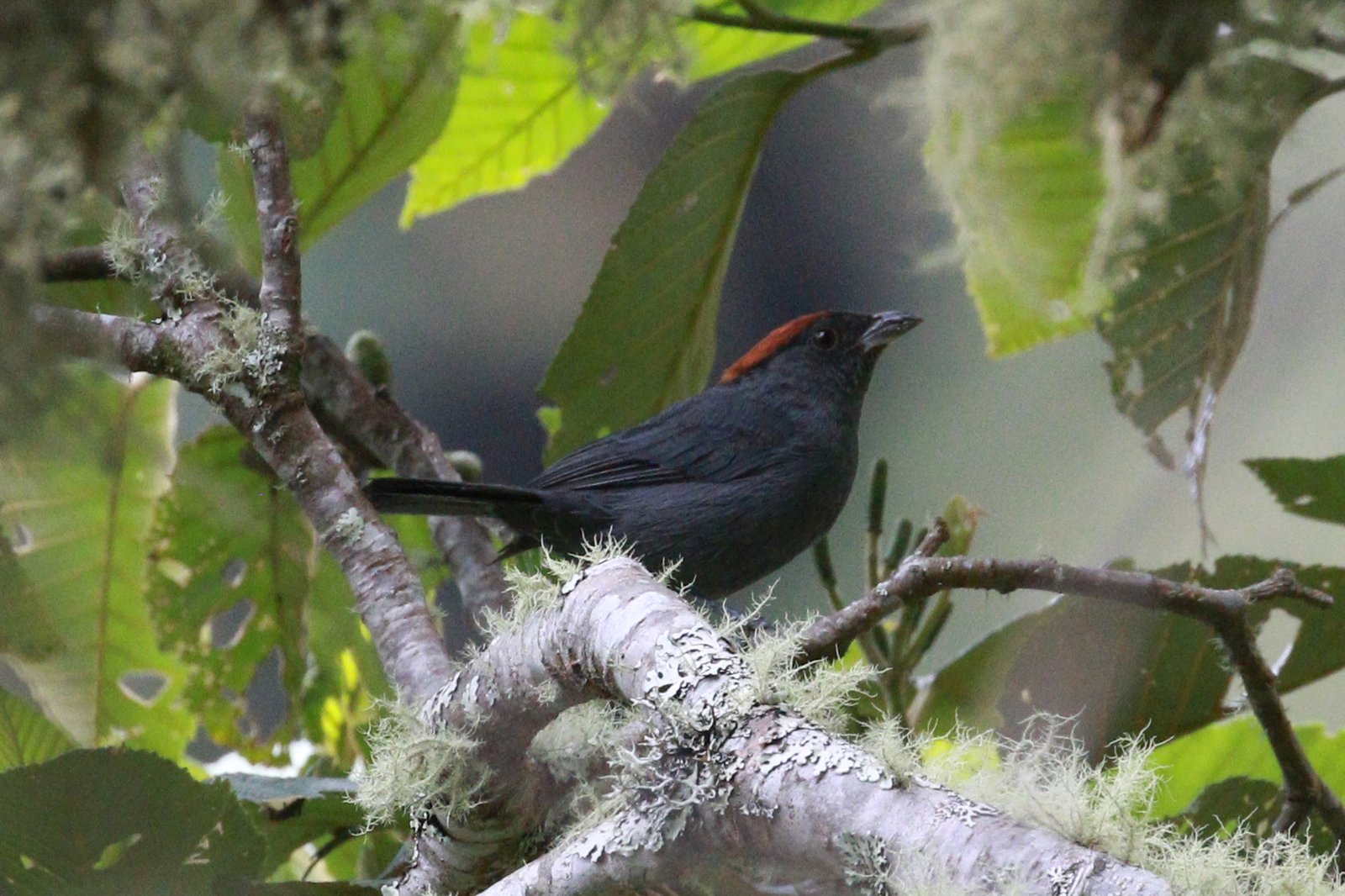
The Slaty Tanager is the southern counterpart of the Rufous-crested Tanager, in the Yungas of south-eastern Peru and Bolivia. The male is uniform slate-grey with a chestnut crown patch; the female has a rufous throat and breast. It searches the canopy for insects, mostly in mixed flocks.
Voice
High, thin calls; the song is little described and consists of high, thin notes.
No recording with a suitable Creative Commons licence is available for this species yet.
Identification
14–15 cm, with a short, dark bill with a small tooth in the upper mandible. The male is entirely slate-grey, paler on the belly, with a chestnut crown patch bordered black at the sides. The female is grey above, without a crown patch, with a rufous to cinnamon throat and breast and a paler belly. Juveniles resemble the female.
Confusion species
Bluish Flowerpiercer Diglossa caerulescens is bluer grey, with a fine, slightly upturned bill and no crown patch. Cinereous Conebill Conirostrum cinereum is smaller, with a white supercilium and wing patch, and lives in drier, open country. Rufous-crested Tanager Creurgops verticalis lives further north and is entirely cinnamon below in both sexes.
Habitat
The canopy and middle levels of humid montane forest and cloud forest in the Yungas, also forest edges, roughly between 1500 and 2700 m. It searches branches and foliage for insects and also eats fruit, mostly in mixed flocks. Little is known about the nest.
Where the bird is most at home, classified by the vegetation units of the Andes and the west coast.


Range and movements
In Peru on the eastern slope of the Andes in the south-east (Cusco, Puno). In Bolivia on the eastern slope of the Andes in La Paz and Cochabamba. Absent from Colombia, Ecuador and the Galápagos. Does not occur outside the guide area.
- Resident
- dark = core range, pale = thinly spread
How and when to look
Along the mountain roads through the Yungas, such as the Manu road in Peru and the old road to Coroico in Bolivia, look in mixed flocks for a uniform grey tanager searching branches high in the trees.
Conservation status
Least Concern. The species has a limited range, but most of the Yungas montane forest there is still present.
Scientific name
Creurgops dentatus | (Sclater & Salvin, 1876)
Sclater & Salvin described the species in 1876 as Malacothraupis dentata; because it was later moved to another genus, the author and year stand in brackets. The genus Creurgops was introduced in 1858 by Sclater. The genus name combines Greek kreourgos, 'butcher', and ōps, 'appearance'. The species name is Latin dentatus, 'toothed', probably after the tooth-like notch in the bill. The specimen the first description was based on came from Yungas, La Paz, Bolivia.