All species › Passerines › Tanagers and allies › Rufous-crested Tanager
Rufous-crested Tanager | Creurgops verticalis
Okerkuiftangare | Tangara crestirrufa | Sanhaço-de-crista-ruiva
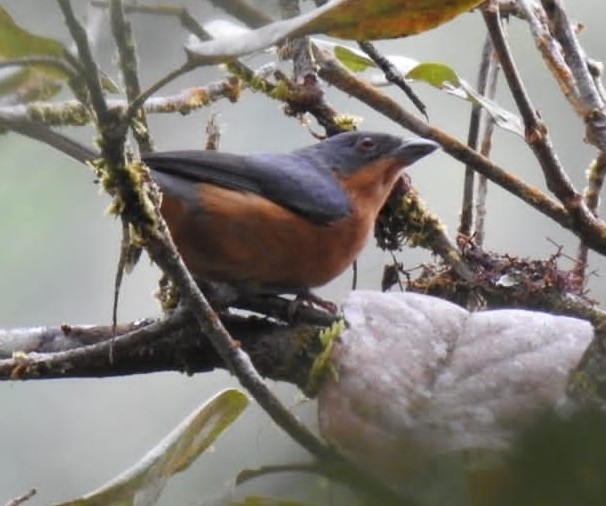
The Rufous-crested Tanager is a canopy tanager of humid montane forest in the northern and central Andes. It is blue-grey above and cinnamon below, and the male has a rufous crown patch bordered with black. It searches branches and foliage for insects, mostly in mixed flocks.
Voice
High, thin tsip calls; the song is a short series of high, thin notes.
Recording: Mitch Lysinger — CC BY-NC-SA 4.0 · xeno-canto
Identification
15 cm, with a fairly short, dark bill. The male is blue-grey above, with a rufous crown patch bordered black at the sides; the throat and underparts are uniform ochre to cinnamon. The female lacks the rufous crown patch and the black border, and is slightly paler below. Juveniles are duller.
Confusion species
Rufous-chested Tanager Thlypopsis ornata has an entirely rufous head and a white belly. Fawn-breasted Tanager Pipraeidea melanonota has a black mask and a blue crown, and is paler buff below. Slaty Tanager Creurgops dentatus lives further south, in south-eastern Peru and Bolivia; the male is grey below as well.
Habitat
The canopy and upper levels of humid montane forest and cloud forest, also tall forest edges, roughly between 1200 and 2500 m. It searches branches, moss and leaves for insects and also eats small fruits; almost always in mixed flocks with other tanagers. Little is known about the nest.
Where the bird is most at home, classified by the vegetation units of the Andes and the west coast.


Range and movements
In Colombia in all three Andean ranges. In Ecuador mainly on the eastern slope of the Andes, locally also in the north-west. In Peru on the eastern slope of the Andes, south to Cusco. Absent from Bolivia and the Galápagos. Outside the guide area in western Venezuela.
- Resident
- dark = core range, pale = thinly spread
How and when to look
Check mixed flocks along roads through montane forest for a grey tanager with cinnamon underparts searching branches in the canopy; it usually occurs singly or in pairs among the other tanagers.
Conservation status
Least Concern. The species is rather scarce but widespread; clearance of montane forest plays a role locally.
Scientific name
Creurgops verticalis | Sclater, 1858
Sclater described the species in 1858 and placed it straight away in the genus where it still stands. He introduced the genus Creurgops in that same work. The genus name combines Greek kreourgos, 'butcher', and ōps, 'appearance'. The species name comes from Latin vertex, 'crown', after the rufous crown. The specimen the first description was based on came from Río Napo, Ecuador.