All species › Passerines › Tanagers and allies › White-capped Tanager
White-capped Tanager | Sericossypha albocristata
Witkaptangare | Tangara caretiblanca | Tiê-de-coroa-branca
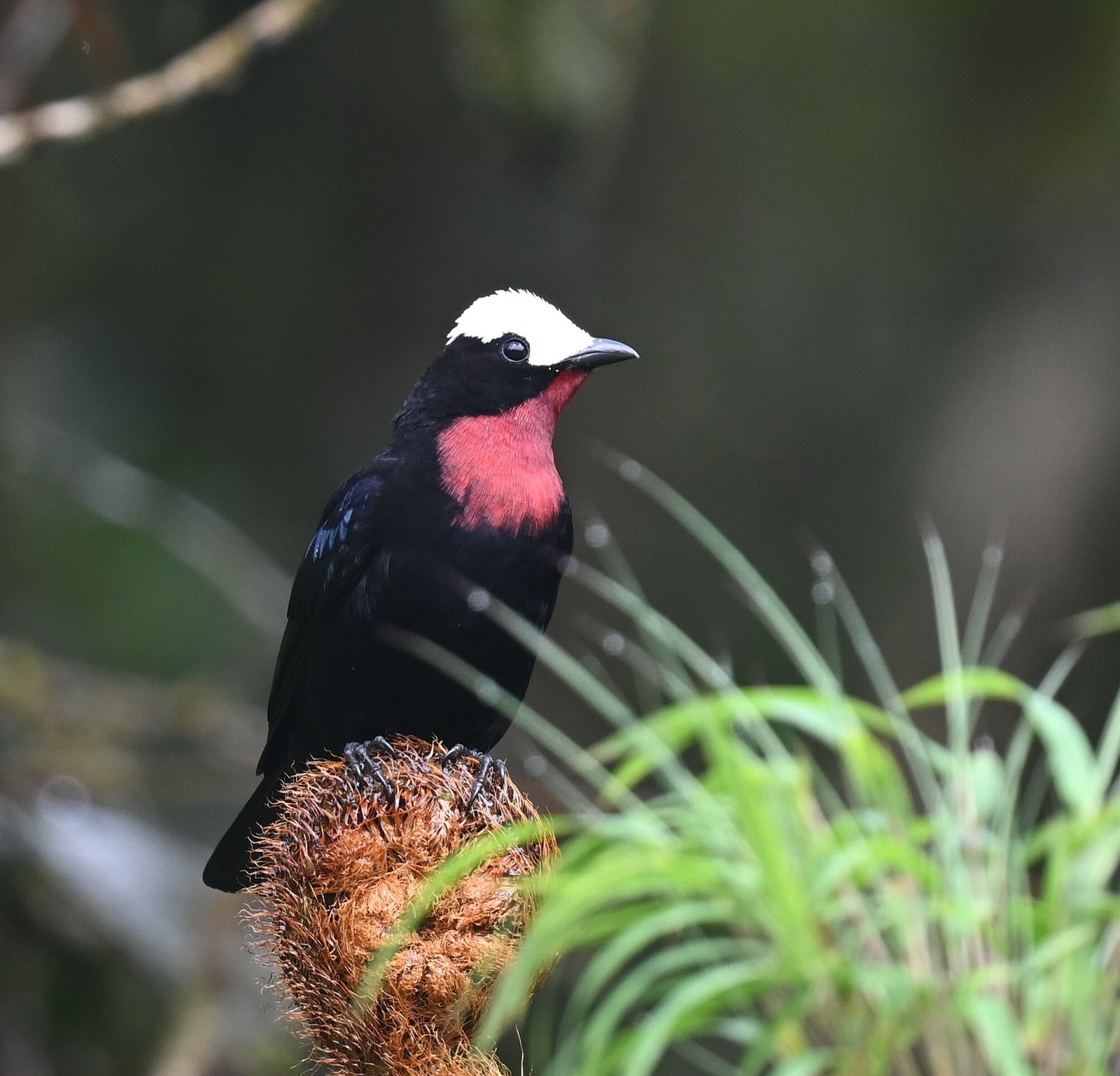
The White-capped Tanager is one of the largest tanagers: a glossy black bird with a snow-white crown and, in the male, a crimson throat. Groups of four to ten birds move noisily through the canopy of cloud forest in the northern and central Andes. Their shrill calls carry far across the mountain slopes.
Voice
Very noisy. Groups give shrill, piercing, slightly harsh calls, like chew or cheek, often several birds at once; the sound carries hundreds of metres.
Recording: Carlos Delgado JUMABITA — CC BY-NC-SA 4.0 · xeno-canto
Identification
24 cm, large and long-tailed, with a stout black bill. The plumage is mostly black with a bluish gloss; the forehead and crown are bright white. The male has a crimson throat and upper breast; in the female the red is smaller and darker, more purplish red. Juveniles are a duller black, with a smaller white cap and little or no red.
Confusion species
Unmistakable: no other black bird of this size has a white cap. Groups moving through the canopy recall jays in size and behaviour, but Turquoise Jay Cyanolyca turcosa is blue with a black mask and Green Jay Cyanocorax yncas is green and yellow. Hooded Mountain Tanager Buthraupis montana is blue and yellow with a black hood.
Habitat
Canopy and edges of cloud forest and upper montane forest, mostly between 2000 and 3000 m, locally lower. It lives in tight groups that cover large distances and sometimes join mixed flocks. It eats fruit and insects taken from branches and leaves. Little is known about its breeding biology.
Where the bird is most at home, classified by the vegetation units of the Andes and the west coast.


Range and movements
In Colombia locally in the Central and Eastern Andes and more rarely in the Western Andes. In Ecuador mainly on the eastern slope of the Andes. In Peru on the eastern slope south to Junín. Absent from Bolivia and the Galápagos. Outside the guide area only in the Andes of western Venezuela.
- Resident
- dark = core range, pale = thinly spread
How and when to look
In cloud forest at 2000–3000 m, listen for the shrill calls of a group; you often hear the birds long before a group crosses the canopy along a forest edge or road. Known sites lie along mountain roads on the eastern slope in Ecuador and northern Peru.
Conservation status
Vulnerable. The species needs large, continuous forests and is declining through clearance of montane forest for farming and cattle; the population is fragmented and decreasing.
Scientific name
Sericossypha albocristata | (de Lafresnaye, 1843)
De Lafresnaye described the species in 1843 as Tanagra (Lamprotes) albo-cristatus; because it was later moved to another genus, the author and year stand in brackets. The genus Sericossypha was introduced in 1844 by Lesson. The genus name combines Greek sērikos, 'silken', and kossuphos, 'blackbird'. The species name comes from Latin albus, 'wit', en cristatus, 'met een kuif', for the white cap. The specimen the first description was based on came from Colombia.