All species › Passerines › Tanagers and allies › Grass-green Tanager
Grass-green Tanager | Chlorornis riefferii
Papegaaitangare | Clorornis patirrojo | Sanhaço-verde-capim
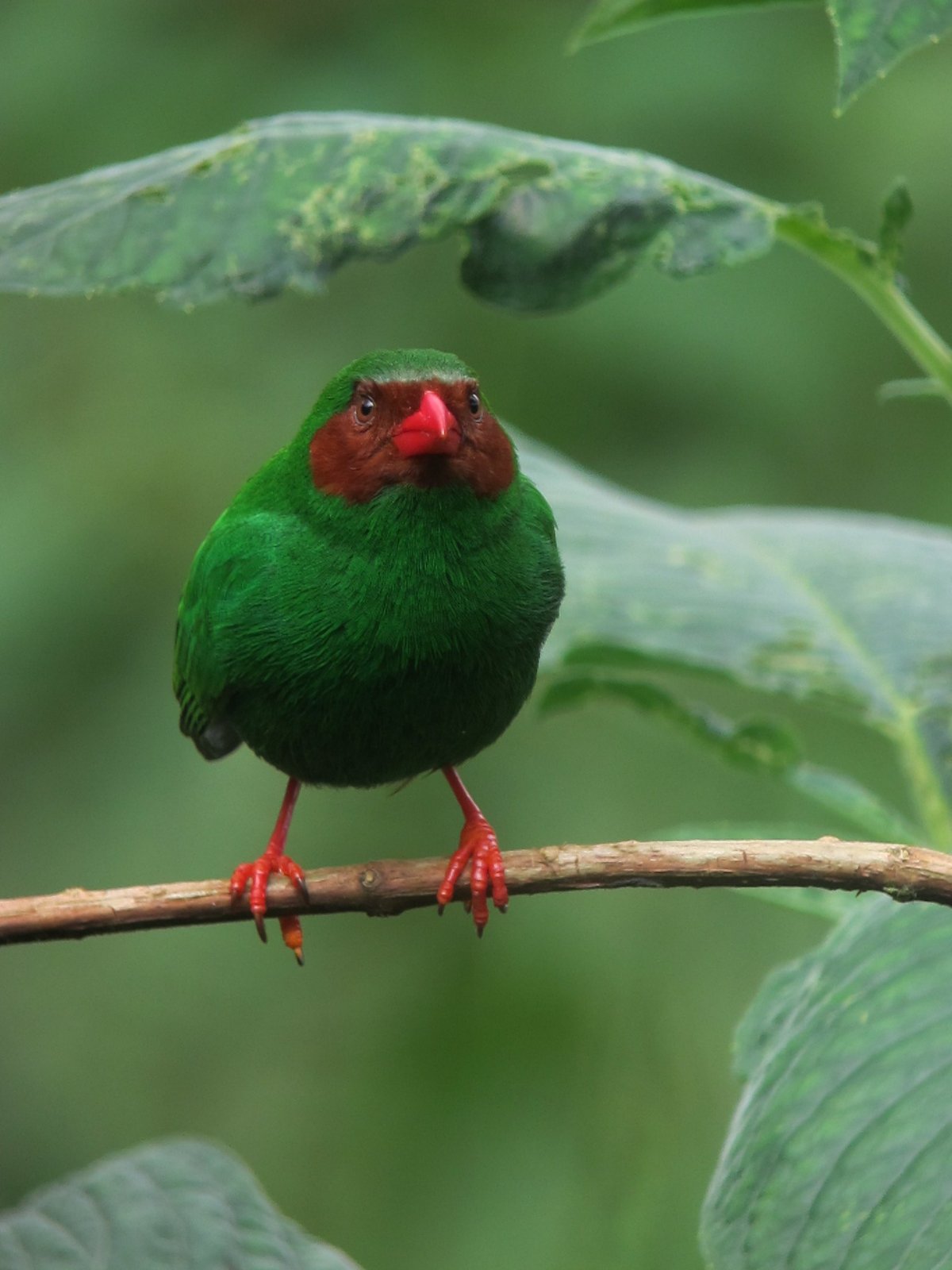
The Grass-green Tanager is a grass-green tanager of Andean cloud forest with a chestnut face and a red bill and legs, which give it a parrot-like look. It moves slowly through the canopy, usually in pairs or as a regular member of mixed flocks.
Voice
Gives nasal, somewhat husky notes such as enk, often repeated, and a dry chatter.
Recording: Jaime Suárez — CC BY-NC-SA 4.0 · xeno-canto
Identification
20 cm, with a stout red bill and red legs. The plumage is plain bright grass green. The face around the bill and eye is chestnut; the undertail coverts are also chestnut. The sexes are alike. Juveniles are duller, with a darker bill.
Confusion species
Green-and-black Fruiteater Pipreola riefferii is also green with a red bill and red legs, but is chunkier and lacks the chestnut face; the male has a black head, the female yellow-streaked underparts. Green parakeets in the same forest have a long, pointed tail and a hooked bill.
Habitat
Humid cloud forest and upper montane forest, also forest edges, from about 2000 to 3300 m, locally higher. It eats fruit, berries and insects, from mid-height into the canopy. Little is known about the nest.
Where the bird is most at home, classified by the vegetation units of the Andes and the west coast.


Range and movements
In Colombia in all three Andean ranges. In Ecuador on both slopes of the Andes. In Peru on the eastern slope of the Andes along the whole length of the country. In Bolivia on the eastern slope in La Paz and Cochabamba. Not on the Galápagos. Not known outside the guide area.
- Resident
- dark = core range, pale = thinly spread
How and when to look
In mixed flocks in cloud forest, look for a green bird with a red bill moving slowly through the foliage, for example around Yanacocha in Ecuador or along the Manu road in Cusco.
Conservation status
Least Concern. Fairly common in suitable forest; sensitive to deforestation.
Scientific name
Chlorornis riefferii | (Boissonneau, 1840)
Boissonneau described the species in 1840 as Tanagra Riefferii; because it was later moved to another genus, the author and year stand in brackets. The genus Chlorornis was introduced in 1850 by Reichenbach. The genus name comes from Greek khlōros, 'green', and ornis, 'bird'. The species name honours Gabriel Rieffer, a bird collector in Colombia. The specimen the first description was based on came from Bogotá, Colombia.