All species › Passerines › Tanagers and allies › Blue-black Grassquit
Blue-black Grassquit | Volatinia jacarina
Jacarinagors | Semillero brincador | Tiziu
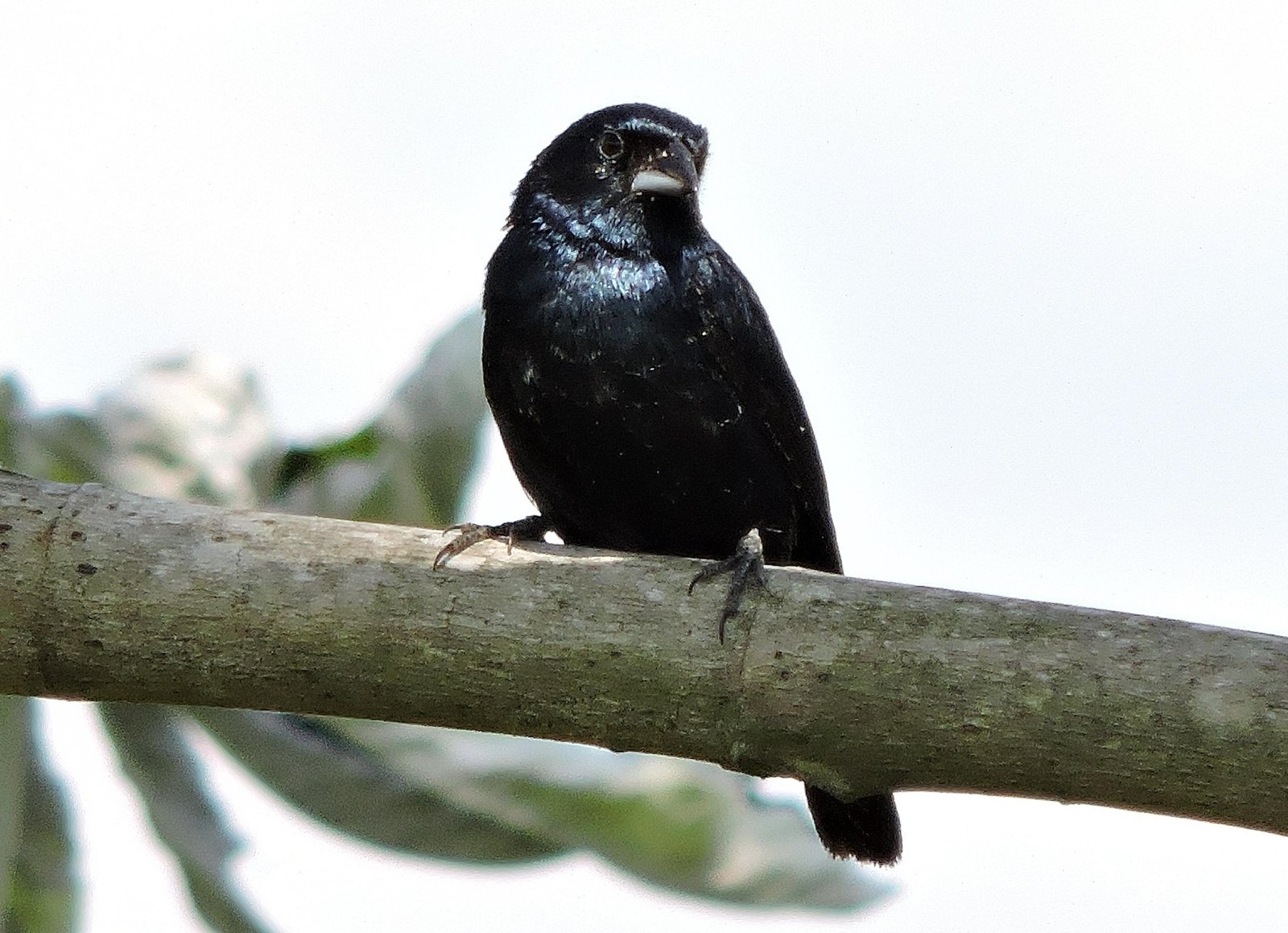
The Blue-black Grassquit is a small seed-eater of open, grassy country that occurs over much of the guide area. The male is glossy blue-black and, when singing, repeatedly jumps half a metre straight up from its song perch, revealing small white patches under the wing. In fields, roadsides and waste ground it is among the most numerous small birds.
Voice
The song is a short, buzzy dzee-yu, given at the top of the jump and repeated many times a minute. The call is a soft tsip.
Recording: José María Loaiza B. — CC BY-NC-SA 4.0 · xeno-canto
Identification
10 cm, with a pointed, conical, dark bill. The breeding male is entirely glossy blue-black, with a small white spot at the bend of the wing and under the wing that shows mainly in flight. Outside the breeding season and in young males the plumage is mottled brown and black. The female is plain brown above and paler buffy brown below, with dark streaks on the breast and flanks. Juveniles resemble the female.
Confusion species
Sooty Grassquit Asemospiza fuliginosa is dull blackish grey without gloss, with a paler bill base, and lives mainly at forest edges. Thick-billed Seed Finch Sporophila funerea is also black with small white underwing patches, but larger and with a very thick bill. Female seedeaters Sporophila have a shorter, thicker, curved bill and an unstreaked breast. Female Blue-black Grosbeak Cyanoloxia cyanoides is much larger and warmer brown.
Habitat
Grassy, open country with scattered shrubs: roadsides, waste ground, fields, pastures, gardens and clearings in forest, from the lowlands to roughly 2000 m in the warmer Andean valleys. It feeds mainly on grass seeds, also insects. The nest is a small cup of grass, low in a grass tussock or shrub.
Where the bird is most at home, classified by the vegetation units of the Andes and the west coast.


Range and movements
In Colombia widespread in the lowlands and the warmer Andean valleys. In Ecuador widespread in the west and in open country in the east. In Peru along the coast, in the dry valleys and in open country in the Amazonian lowlands. In Bolivia in the lowlands and the lower valleys. Absent from the Galápagos. Outside the guide area from Mexico to northern Argentina.
- Resident
- dark = core range, pale = thinly spread
How and when to look
In the rainy season, watch roadsides and fallow fields for males jumping up repeatedly from a grass stem or wire with their buzzy call; outside the breeding season the birds sit in small groups in the grass, often together with seedeaters.
Conservation status
Least Concern. The species benefits from deforestation and from the spread of pasture and farmland.
Scientific name
Volatinia jacarina | (Linnaeus, 1766)
Linnaeus described the species in 1766 as Tanagra jacarina; because it was later moved to another genus, the author and year stand in brackets. The genus Volatinia was introduced in 1850 by Reichenbach. The genus name is a diminutive of Latin volatus, 'flying'. The species name comes from Tupi, where jacarina was a name for a kind of finch. The specimen the first description was based on came from northeastern Brazil.