All species › Passerines › Tanagers and allies › Pardusco
Pardusco | Nephelornis oneilli
Pardusco | Tangara pardusca | Pardusco
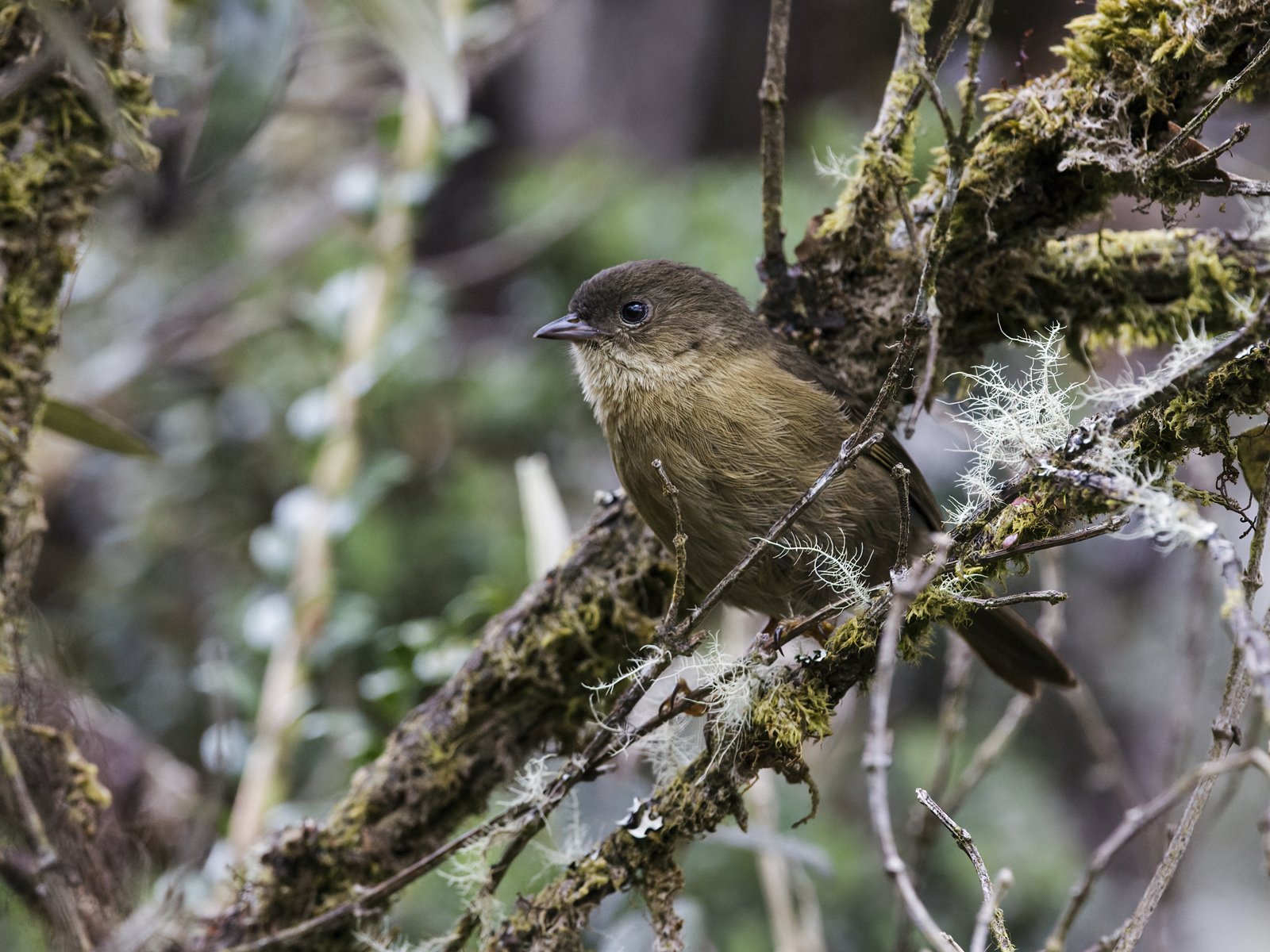
The Pardusco is a small, plain brown tanager of the treeline in central Peru, described only in 1976. It lives in active small groups in elfin forest and shrubbery on the east slope of the Andes. The genus Nephelornis contains only this species.
Voice
Groups keep in contact with high, thin tseet calls and soft chattering; a song is poorly described.
Recording: Fabrice Schmitt — CC BY-NC-SA 4.0 · xeno-canto
Identification
13 cm, with a thin, pointed bill. The upperparts are plain dark olive-brown, the wings darker with paler brown edges forming faint wing bars. The underparts are warmer and paler, ochre-brown to yellowish brown, palest on the belly. There are no distinct markings on the head or tail. The sexes are similar.
Confusion species
Cinereous Conebill Conirostrum cinereum is greyer, with a white eyebrow and a white wing patch. Black-throated Flowerpiercer Diglossa brunneiventris has a black throat and head, a rufous belly and a hook-tipped bill. Female Plain-colored Seedeaters Catamenia inornata are streaked and have a short, conical bill.
Habitat
Elfin forest, shrubbery and the upper forest edge along the treeline, roughly between 3000 and 3700 m. Groups of a few to about ten birds move quickly through the shrubs, searching for insects among leaves and flowers, often with flowerpiercers and conebills. The nest is poorly described.
Where the bird is most at home, classified by the vegetation units of the Andes and the west coast.


Range and movements
Only in Peru, on the east slope of the Andes in the regions of Huánuco, Pasco and Junín. Absent from Colombia, Ecuador, Bolivia and the Galápagos. Does not occur outside the guide area.
- Resident
- dark = core range, pale = thinly spread
How and when to look
Search the elfin forest and shrubbery along the treeline, for example at Bosque Unchog in Huánuco; watch for a group of small, plain brown birds moving quickly through the shrubs.
Conservation status
Least Concern. The range is small, but the habitat is largely remote; fires and grazing along the treeline degrade it locally.
Scientific name
Nephelornis oneilli | Lowery & Tallman, 1976
Lowery & Tallman described the species in 1976 and placed it straight away in the genus where it still stands. He introduced the genus Nephelornis in that same work. The genus name comes from Greek nephelē, 'cloud', and ornis, 'bird', after the cloud forest where the species lives. The species name honours the American ornithologist and bird artist John Patton O'Neill, who worked for many years in Peru. The specimen the first description was based on came from Huánuco, Peru.