All species › Passerines › Tanagers and allies › Sooty Grassquit
Sooty Grassquit | Asemospiza fuliginosa
Zwartborstgrondvink | Semillero fuliginoso | Cigarra-preta
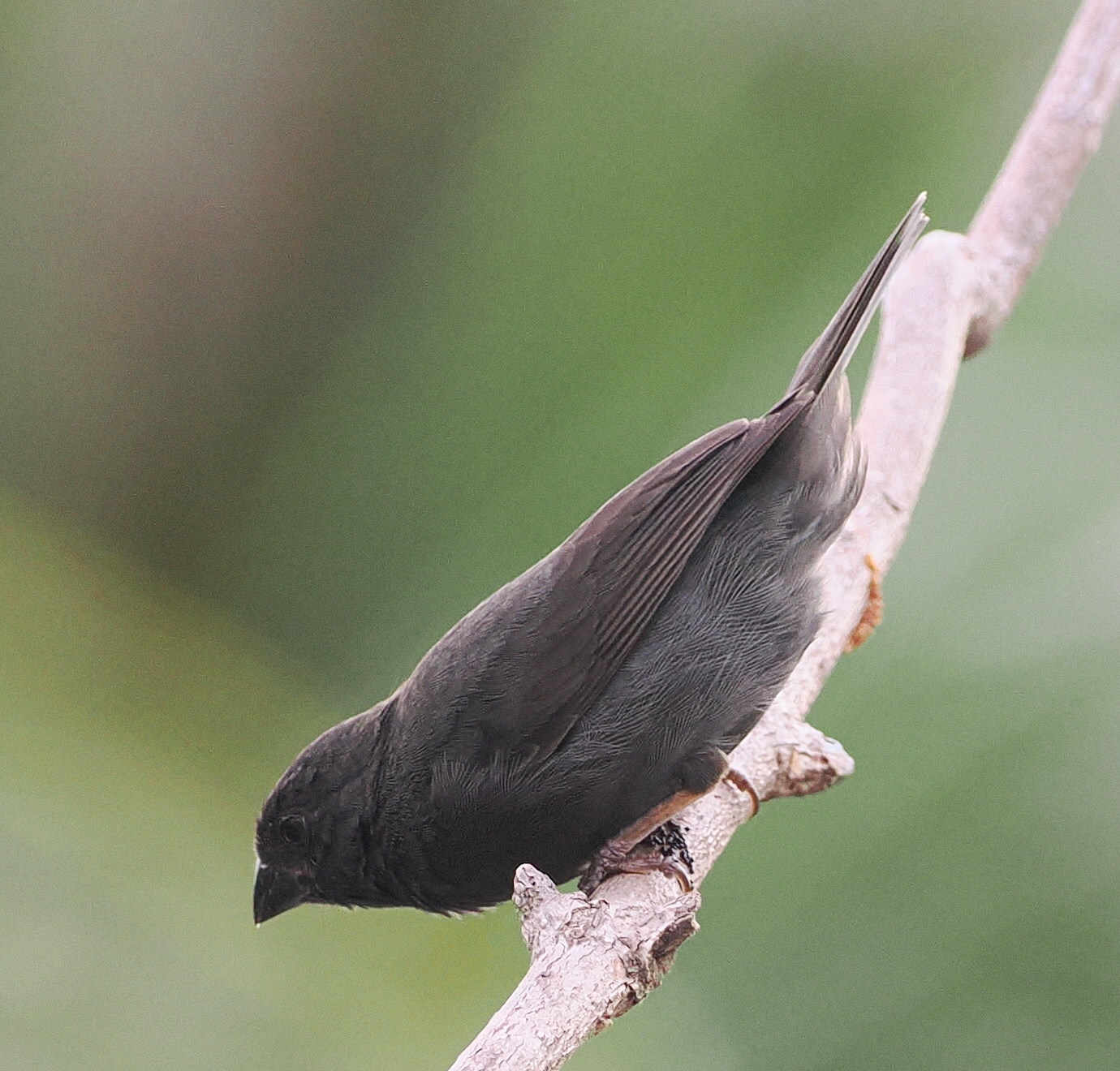
The Sooty Grassquit is a small, uniformly dark finch with a fairly long, conical bill. The male is sooty black, the female olive-brown. The species has its main range outside the guide area, in Venezuela and eastern Brazil; in Colombia it is very local and scarce, and from Bolivia it is known from a single record only.
Voice
The song is a fast, high, thin and wiry series of notes with a buzzy quality, roughly zizi-tsuur-shree. The call is a short chee.
Recording: JAYRSON ARAUJO DE OLIVEIRA — CC BY-NC-SA 4.0 · xeno-canto
Identification
11 cm, with a fairly long, pointed, conical dark bill. The male is uniformly sooty black with an olive tinge on the back and slightly paler underparts, without markings. The female is warm olive-brown, darker above than below, with a slightly paler bill. The iris and legs are dark. Juveniles resemble the female.
Confusion species
The male Black-faced Grassquit Melanospiza bicolor has a black head and breast contrasting with an olive back, and lives in dry lowlands. Dull-colored Grassquit Asemospiza obscura is paler greyish brown, with a pale lower mandible. The male Slaty Finch Haplospiza rustica is slate-grey, with a finer, more pointed bill, and lives in bamboo in cloud forest. Female seedeaters Sporophila have a shorter, more rounded bill.
Habitat
Edges of humid forest, grassy clearings inside and outside forest and regenerating burned areas; in Colombia between about 1000 and 1500 m. It feeds mainly on seeds of grasses and bamboo and elsewhere sometimes appears temporarily where bamboo or grass is seeding. The nest is a globular structure with a side entrance, low in the vegetation.
Where the bird is most at home, classified by the vegetation units of the Andes and the west coast.


Range and movements
In Colombia very local and scarce, with records from the Sierra Nevada de Santa Marta, the Serranía del Perijá, the northern end of the Central Andes and the western slope of the Eastern Andes; the number of confirmed records is small. In Bolivia a single confirmed record. Absent from Ecuador, Peru and the Galápagos. Outside the guide area in Venezuela, on Trinidad, in eastern and central Brazil, in Paraguay and in north-eastern Argentina.
- Resident
- dark = core range, pale = thinly spread
How and when to look
A rare bird in the guide area: in Colombia, watch the edges of humid montane forest and grassy clearings for dark finches feeding low in the grass, especially where bamboo is seeding.
Conservation status
Least Concern. In the guide area the species is rare and poorly known.
Scientific name
Asemospiza fuliginosa | (Wied-Neuwied, 1830)
Wied-Neuwied described the species in 1830 as Fringilla fuliginosa; because it was later moved to another genus, the author and year stand in brackets. The genus Asemospiza was introduced in 2016 by Burns, Unitt & Mason. The genus name combines Ancient Greek asēmos, 'without marks', and spiza, 'finch'. The species name is Latin fuliginosus, 'sooty'. The specimen the first description was based on came from Camamu, Bahia, Brazil.