All species › Passerines › Tanagers and allies › Dull-colored Grassquit
Dull-colored Grassquit | Asemospiza obscura
Bruine grondvink | Espiguero pardo | Cigarra-parda
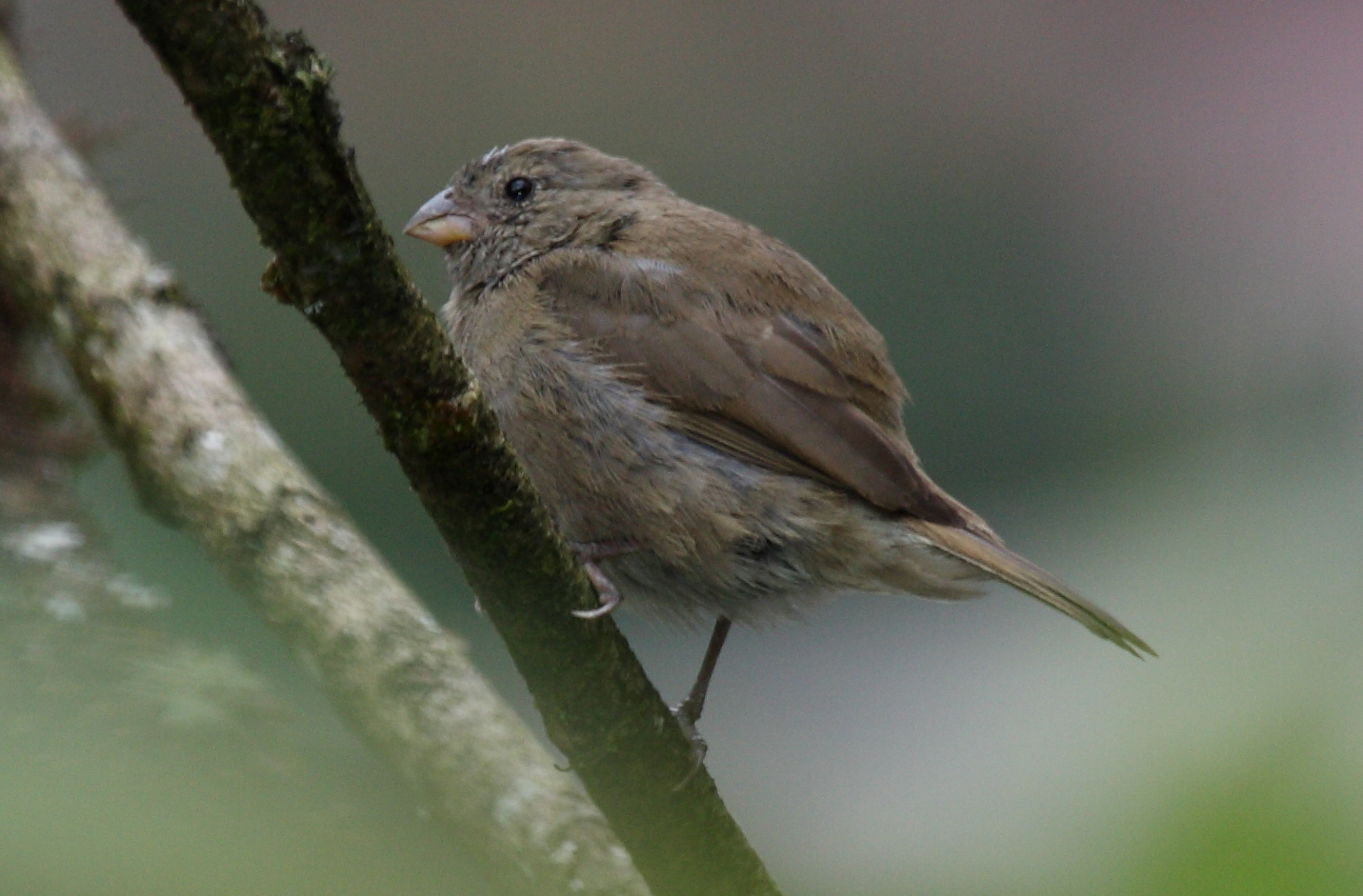
The Dull-colored Grassquit is a small, plain greyish-brown finch without obvious markings, best identified by its bicoloured bill with a pale lower mandible. It lives in scrub and open country on the lower and middle mountain slopes. The sexes are almost alike, which distinguishes it from most of its relatives.
Voice
The song is a short, buzzy and squeaky series, such as dzee-dzee-zeezee, often repeated from a shrub or wire. The call is a high tsip.
Recording: José María Loaiza B. — CC BY-NC-SA 4.0 · xeno-canto
Identification
11 cm, with a conical, fairly pointed bill: the upper mandible is dark, the lower mandible pale yellowish to horn. Upperparts plain olive-brown to greyish brown, underparts paler greyish brown, paler and slightly buffier on the belly. No streaks or spots in the plumage. The sexes are alike; juveniles are slightly warmer brown.
Confusion species
The female Yellow-faced Grassquit Tiaris olivaceus is greener and has a faint yellow supercilium and throat. Plain-colored Seedeater Catamenia inornata is larger and greyer, with a pinkish to horn bill and chestnut undertail coverts, and lives higher. Female seedeaters such as Drab Seedeater Sporophila simplex have a shorter, more rounded and thicker bill. Sooty Grassquit Asemospiza fuliginosa is darker and has an all-dark bill.
Habitat
Dry to semi-humid scrub, forest edges, grassy slopes, field edges, gardens and secondary growth, especially in dry valleys between about 500 and 2500 m, locally higher or lower. It feeds on seeds of grasses and herbs, taken on the ground or low in the vegetation, often in pairs or small groups and sometimes with seedeaters. The nest is a globular structure with a side entrance, in a shrub.
Where the bird is most at home, classified by the vegetation units of the Andes and the west coast.


Range and movements
In Colombia locally in the Andes and the inter-Andean valleys. In Ecuador mainly in the south and south-west and in dry Andean valleys. In Peru along the western slope, in the dry inter-Andean valleys, including the Marañón valley, and in dry valleys on the eastern slope. In Bolivia in the valleys and foothills of the Andes. Absent from the Galápagos. Outside the guide area in western Venezuela and north-western Argentina.
- Resident
- dark = core range, pale = thinly spread
How and when to look
In the dry valleys of Peru and Ecuador, search scrub and field edges for plain brown finches with a pale lower mandible; the buzzy song helps to find them.
Conservation status
Least Concern. The species tolerates human-modified landscapes well.
Scientific name
Asemospiza obscura | (d'Orbigny, ACVMD & de Lafresnaye, 1837)
D'Orbigny, ACVMD & de Lafresnaye described the species in 1837 as Emberiza obscura; because it was later moved to another genus, the author and year stand in brackets. The genus Asemospiza was introduced in 2016 by Burns, Unitt & Mason. The genus name combines Ancient Greek asēmos, 'without marks', and spiza, 'finch'. The species name is Latin obscurus, 'dark' or 'dull'. The specimen the first description was based on came from Chiquitos, Santa Cruz, Bolivia.